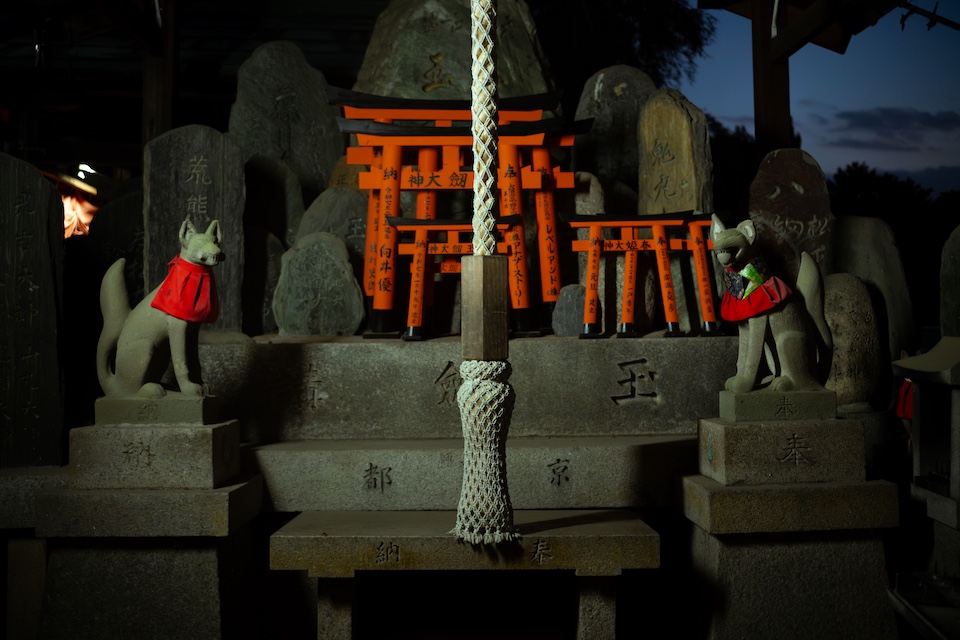
Every January 1st, before the sun rises over Osaka, the Emperor of Japan steps outside, faces the four cardinal directions, and bows. He offers prayers to the deities of heaven and earth, the stars of the Big Dipper, and the spirits presiding over the new year. This ritual, called Shihōhai (四方拝), has been performed continuously by the imperial family for well over a thousand years.
Most people who witness it — even many Japanese — see it as a quaint ceremonial relic. But to understand what it actually represents, you need to travel back about fourteen centuries, to a moment when Japan was busy absorbing one of the most ambitious intellectual systems ever imported from the Asian continent.
That system is called Onmyodo (陰陽道) — the Way of Yin and Yang.
And whether you’ve ever heard of it or not, if you’ve spent any time in Japan — or simply consumed Japanese culture from a distance — Onmyodo has already shaped how you experience it.
I Had to Leave Japan to Understand It
I’m a designer. I’ve spent decades thinking about form, proportion, color, and the invisible values embedded in objects. I’ve practiced Kendo and Judo since I was a child. I’ve studied Zen Buddhism and Shintoism in Kyoto. And yet, for most of my adult life, I walked past the evidence of Onmyodo every single day without truly seeing it.
It wasn’t until I began explaining Japanese culture to Western friends — Americans, mostly, pragmatic and curious — that I started noticing how many of my own instincts, habits, and gut feelings traced back to a philosophical system I couldn’t fully name. Why do I feel uneasy about certain directions when I set up a workspace? Why does setsubun (the bean-throwing festival in February) feel spiritually significant to me, even though I couldn’t have told you why until recently? Why do I instinctively visit a local shrine when I travel somewhere new — not to pray for something, but just to… announce myself?
Onmyodo is a large part of the answer.
What It Actually Is (Not What You Might Expect)
Let me be honest about something upfront: Onmyodo is not easy to categorize. Western languages tend to push it into boxes — “occultism,” “astrology,” “folk magic” — and every one of those labels is simultaneously half-right and completely misleading.
Onmyodo arrived in Japan from the Korean peninsula sometime in the 5th or 6th century, as part of a broader wave of continental knowledge that included Buddhism, Confucianism, medical science, and calendar-making. At its intellectual core was the Chinese theory of Yin and Yang (陰陽) — the idea that all phenomena in the universe arise from the interplay of two complementary forces: active and passive, light and dark, expansion and contraction.
Layered on top of this was the Five Elements theory (五行説): the belief that all matter and all processes flow through five phases — Wood, Fire, Earth, Metal, and Water — in cycles of generation and destruction. Each element corresponds to a direction, a season, an organ in the body, a color, and a quality of character.
On paper, this might sound abstract. But in practice, it was extraordinarily systematic. The Five Elements gave ancient Japanese intellectuals a unified framework for understanding astronomy, medicine, agriculture, architecture, and governance — all at once. It was, in a very real sense, the science of its time.
When Japan’s early rulers institutionalized this knowledge in the late 7th century, they created a government bureau called the Onmyoryo (陰陽寮). This was not a temple. It was a ministry — staffed by technical specialists who tracked celestial events, managed the official calendar, monitored the water clocks that kept state time, and assessed the cosmic auspiciousness of political decisions.
Think of it as something between NASA, the National Weather Service, and the Office of Strategic Planning — all run through the lens of Yin-Yang cosmology.
When Science Became Ritual
The shift happened during the Heian period (794–1185 CE), and it’s one of the most fascinating transformations in Japanese cultural history.
Heian-era aristocrats were, in many ways, deeply anxious people. The capital had been relocated to what is now Kyoto to escape the spiritual pollution of the previous site. Epidemics, political violence, and sudden deaths were common. And the dominant belief of the time held that these misfortunes were caused by onryo — vengeful spirits of the wronged dead, wandering the city and attaching themselves to the living.
In that climate, the cool astronomical precision of the Onmyoryo was not enough. People didn’t just want to understand the universe. They wanted protection from it.
So Onmyodo evolved. It absorbed elements of Taoist ritual, esoteric Buddhism, and ancient Japanese folk belief. The specialists who had once been bureaucratic astronomers became something far more charged: ritual intermediaries between the human world and the invisible forces pressing against it.
The most famous of them was Abe no Seimei (安倍晴明), who lived from around 921 to 1005 CE. Seimei served at the imperial court for decades, advising emperors and powerful nobles, interpreting celestial omens, and performing purification rituals to deflect curses. Legends accumulated around him like sediment — that he could summon spirit-servants called shikigami, that he had once neutralized a curse aimed at the powerful regent Fujiwara no Michinaga by redirecting it back to its source.
The historical Seimei was almost certainly a brilliant astrologer and an exceptionally skilled political operator. The mythological Seimei became something else: the archetype of the onmyoji, the Yin-Yang master — a figure so deeply embedded in Japanese imagination that he still appears in manga, novels, films, and video games more than a thousand years after his death.
But what interests me more than the legend is the structure underneath it: a system sophisticated enough to serve as the operating system for an entire civilization’s relationship with time, space, and the unseen.
How It Shaped the Lives of Emperors — and Everyone Else
The influence of Onmyodo on daily life during the Heian period was total — and I mean that almost literally.
The Emperor’s movements were governed by the principle of katatagae (方違え): if the direction of his intended destination was cosmically inauspicious on a given day, he would first travel in a different direction, spend the night elsewhere, then approach his destination from a new angle the following morning. An unfavorable direction was not merely unlucky — it was a genuine strategic threat, like walking into enemy territory.
Then there was monoimi (物忌み): a period of ritual seclusion observed when a person had been contaminated by spiritual pollution — a nightmare, a death in the family, or contact with something impure. During a monoimi, the Emperor withdrew entirely from public life. Courtiers sealed themselves indoors and hung paper signs on their gates. The machinery of state paused.
And before the Emperor took any significant journey, an onmyoji would walk ahead of him performing henbai (反閉): a specific stamping ritual derived from an ancient Chinese walking pattern attributed to the legendary sage-king Yu. The rhythm of the stamping was believed to suppress malevolent energies lurking in the earth.
I want to be clear: I’m not telling you this to suggest that Heian Japan was irrational. Every culture has its operating metaphysics — its invisible framework for what is safe, what is dangerous, what is clean, and what is polluted. Onmyodo was Japan’s. It was internally coherent, institutionally supported, and taken completely seriously by people who were, by any measure, highly intelligent.
What makes it fascinating is how much of it survived — in transformed, often unrecognized form — into the present.
What Was Banned in 1870 Is Still Alive Today
In 1870, two years into the Meiji government’s drive to modernize Japan along Western lines, Onmyodo was formally abolished. The Tenshū Kinshirei — the “Prohibition of the Heavenly Shrine” — made the practice of Onmyodo illegal. The following year, Japan switched to the Gregorian calendar.
The government’s reasoning was straightforward: Onmyodo was superstition, and superstition was incompatible with a modern nation-state. After roughly 1,200 years as a recognized institution, the tradition was erased from official existence almost overnight.
But here’s the thing about ideas that have spent twelve centuries weaving themselves into a culture’s daily rhythms: they don’t disappear when you ban them. They go underground. They embed themselves in habit. They survive as custom, as instinct, as things people do without quite knowing why.
Open a Japanese calendar today — a real one, printed for everyday use — and you’ll find small notations in the corner of each date. They cycle through six designations: Taian (大安, “great peace”), Butsumetsu (仏滅, “Buddha’s death”), Tomobiki (友引, “pulling a friend”), and three others. These are the rokuyō (六曜) — a system for determining whether a given day is auspicious, inauspicious, or neutral for specific activities.
Taian is the most favorable day: Japanese couples book wedding venues based on it months or years in advance. Butsumetsu is the most dangerous: many Japanese people will not schedule funerals on Tomobiki (“pulling a friend”), because of the fear that the deceased might pull a companion into death.
The rokuyō are not official. They have no legal standing. Japanese society is not particularly religious in any conventional sense. And yet: the calendars include them. The wedding venues charge premium prices on Taian days. Funeral directors field calls about Tomobiki every week.
This is Onmyodo in its current form — not a belief system you consciously hold, but a grammar of time and space that shapes behavior from below.
The Shinto Connection (And Why It Matters to Me Personally)
I practice Shinto — or more accurately, I live in a way that Shinto has always described. I believe in yaoyorozu no kami: the eight million deities that inhabit natural phenomena, places, and the world around us. I don’t go to shrines to ask for things. I go to report back — to say “I was here this month, things went reasonably well, thank you.” When I travel, I visit the local shrine to announce my arrival, the way you might introduce yourself to a neighbor.
Onmyodo and Shinto grew up together, and they shaped each other in ways that are nearly impossible to fully separate now.
The Shinto concept of kegare (穢れ) — spiritual pollution, impurity — gained its structured ritual grammar largely through Onmyodo. The specific purification ceremonies, the periods of avoidance, the logic of which substances and events create contamination: these were systematized through Yin-Yang cosmology. The great annual Oharae (大祓い) purification ritual, still performed at shrines across Japan every June and December, bears the fingerprints of Onmyodo in its structure.
Even the setsubun bean-throwing ceremony in February — where Japanese families drive away evil spirits by shouting “Oni wa soto! Fuku wa uchi!” (“Demons out! Fortune in!”) — originated as a formal imperial court ritual called Tsuina, performed by onmyoji to expel malevolent energies at the turn of the year.
I throw beans every February. My children find it entertaining. I find it right, in a way I can’t fully articulate — a way that has something to do with the rhythm of the year, the sensation of performing an action that millions of people before me also performed, the satisfying seriousness of a thing done for no practical reason except that it matters.
That, I think, is what Onmyodo ultimately bequeathed to Japanese culture: a felt sense that the universe has a structure, that human beings are embedded within that structure, and that the small acts of daily life — the direction you face, the day you choose, the threshold you cross carefully — are not trivial. They are how you participate.
Why I’m Telling You This
If you’re reading this as someone who came to Japan — or to Japanese culture — drawn by Zen, or wabi-sabi, or the clean minimalism of Japanese design: Onmyodo is part of the water those ideas swim in.
When a Japanese architect thinks carefully about which direction a building faces, that’s not purely aesthetic instinct. When a Japanese person feels genuine unease about an inauspicious calendar date, that’s not simple superstition. When a craftsperson treats even a mundane tool with a kind of reverent attention — cleaning it, storing it with care, refusing to use it carelessly — there is a cosmology underneath that behavior. A sense that things have their proper position within a larger order.
I’m not asking you to believe what I believe. I’m not sure I “believe” in Onmyodo in any intellectually tidy sense. But I’ve come to understand that the Japanese relationship with the invisible — with direction, time, purity, spirit, and the animating force in things — was not assembled randomly or inherited passively.
It was designed. Over centuries. By remarkably serious people.
And understanding that design is the beginning of understanding Japan.
Never Miss an Update
New articles and exclusive cultural insights are announced first on LinkedIn. If you want to keep expanding your understanding of Japanese philosophy and modern resilience, let’s stay in touch.
[Follow My LinkedIn Profile Here]
If this article brought a moment of peace or insight to your day, consider supporting my work.
Thank you.