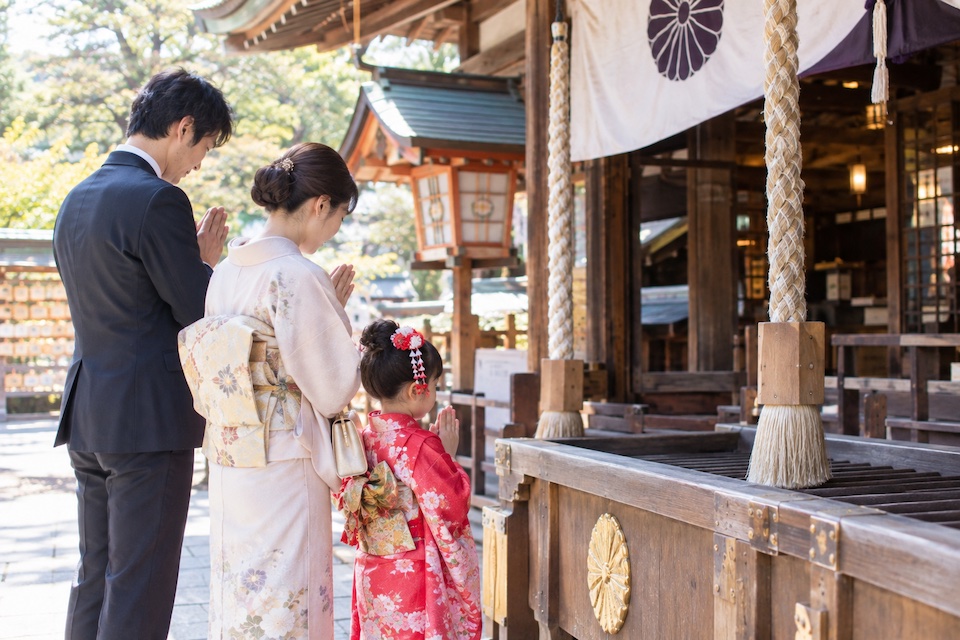
In Japan, a newborn is carried to a Shinto shrine about a month after birth. Decades later, that same person’s ashes will be placed in a Buddhist temple.
Between those two events, Shinto and Buddhism take turns marking the milestones. Children are celebrated at shrines at ages three, five, and seven. Students buy exam charms from shrine offices. Couples may marry in front of a kami. New Year begins with a shrine visit. And when death comes, a Buddhist priest chants sutras, and the family begins a cycle of memorial services that stretches years into the future.
None of this strikes a Japanese person as strange. It is simply how life works. But for someone from a culture where you choose one religion and carry it from birth to death, the pattern is genuinely puzzling. This article walks through the major life events in Japan and explains the Shinto and Buddhist logic behind each one.
Miyamairi: The first shrine visit
About thirty days after a baby is born (thirty-one for boys, thirty-three for girls, though the exact day varies by region), the family takes the child to a Shinto shrine for a ceremony called miyamairi (宮参り). This is the baby’s formal introduction to the kami.
The ceremony has a specific purpose: to present the child to the local guardian kami (ujigami) and to ask for protection and healthy growth. It is also a public announcement. The family is telling the community and the kami that a new life has arrived.
The baby is typically dressed in a formal white kimono or wrapped in a decorative covering. The grandmother on the father’s side traditionally holds the baby during the visit, though modern families often adjust this custom. At the shrine, a priest may perform a short blessing (kitō), waving a purification wand (ōnusa) over the baby and family.
Why Shinto and not Buddhism? Because Shinto is the tradition of this world. It deals with life, growth, fertility, and protection in the here and now. Asking the kami to watch over a new life fits naturally within Shinto’s domain.
Shichi-go-san: Celebrating children at three, five, and seven
Shichi-go-san (七五三) is one of Japan’s most photogenic traditions. On or around November 15th, families with children aged three (both genders), five (traditionally boys), and seven (traditionally girls) dress them in formal kimono and visit a shrine.
The ages are not arbitrary. In Japanese tradition, odd numbers are considered auspicious (a belief influenced by Chinese numerology). The specific ages of three, five, and seven correspond roughly to important developmental milestones: a child surviving infancy, becoming more independent, and reaching the age of reason.
Historically, childhood mortality was high, and reaching these ages was not taken for granted. Shichi-go-san was a moment of genuine gratitude that the child was still alive. The ceremony at the shrine asked the kami to continue protecting the child as they grew.
Today, the survival element is less prominent, but the gratitude remains. Parents dress their children beautifully, take photographs, visit the shrine for a blessing, and buy a special candy called chitose-ame (千歳飴, “thousand-year candy”), a long stick of candy that symbolizes wishes for a long, healthy life.
Hatsumode: Beginning the year right
Hatsumōde (初詣) is the first shrine (or temple) visit of the new year, and it is the single largest religious gathering in Japan. Over 80 million people visit a shrine or temple in the first three days of January.
The purpose is simple: to give thanks for the previous year and to pray for good fortune in the year ahead. People buy new omamori (protective charms), return last year’s charms for ritual burning, draw omikuji (fortune slips), and often eat festival food from stalls lining the shrine approach.
What is remarkable about hatsumōde is its scale. This is a country where most people describe themselves as non-religious, yet tens of millions of them stand in line, sometimes for hours in freezing weather, to pray at a shrine on January 1st. The contradiction only looks like a contradiction from outside. For the Japanese person in the line, this is not a religious obligation. It is how you start the year. It is what your family has always done. Skipping it would feel incomplete, like forgetting to say goodbye before leaving the house.
Shinto weddings: The ceremony most Westerners don’t see
The traditional Japanese wedding is called shinzen shiki (神前式), literally “a ceremony before the kami.” It takes place at a shrine, usually in a small hall adjacent to the main shrine building.
The ceremony is intimate compared to Western weddings. Typically, only close family members attend. The couple enters the hall together, and a priest performs a purification. Then come the san-san-kudo (三三九度), the ritual exchange of sake. The couple takes three sips each from three cups of increasing size, creating a bond through shared drink. There are also offerings to the kami, the exchange of rings (a modern addition borrowed from Western practice), and the reading of vows.
The bride traditionally wears a white kimono (shiromuku) and a white hood called a watabōshi or a tsunokakushi. The groom wears a black kimono with hakama and a haori jacket.
Western-style chapel weddings have been enormously popular in Japan since the 1990s, and today they account for the majority of wedding ceremonies. But this does not mean that Christian belief has swept Japan. Most of the chapels used for weddings in Japan are commercial facilities attached to hotels, staffed not by ordained ministers but by people hired for the occasion. The couples who choose chapel weddings are drawn to the aesthetic (the white dress, the stained glass, the exchange of vows) rather than the theology.
The irony is not lost on anyone. A country that practices Shinto for birth and Buddhism for death has adopted Christian aesthetics for marriage. The Japanese approach to religion continues to be: use what works, appreciate what is beautiful, and do not feel obligated to choose just one.
Why funerals are Buddhist
If Shinto handles life, Buddhism handles death. Over 90% of Japanese funerals follow Buddhist rites, even for families who rarely visit a temple otherwise.
There are historical and theological reasons for this division.
Shinto has a complex relationship with death. Death is associated with kegare (spiritual depletion), and traditionally, dead bodies and everything connected to them were kept away from shrines. This is not because death is evil, but because it belongs to a different domain. Shrines are places of life, vitality, and the living community. Death requires a different space and a different framework.
Buddhism provides that framework. Buddhist teachings about impermanence, the cycle of rebirth, and the journey of the consciousness after death give structure to grief in ways that Shinto does not attempt. The Buddhist funeral includes chanting by a priest, the burning of incense, and the giving of a posthumous name (kaimyō) to the deceased. The body is cremated (cremation is standard in Japan, approaching 100%), and the ashes are interred at a Buddhist temple.
The memorial cycle that follows is elaborate. Services are held on the seventh day, the forty-ninth day, the first anniversary, the third anniversary, and at intervals up to the thirty-third or fiftieth anniversary. These services are performed by a Buddhist priest and serve to guide the spirit of the deceased and comfort the living.
What happens after death in Shinto belief
While Buddhism dominates funeral practice, Shinto has its own relationship with the deceased.
In Shinto understanding, the spirits of the dead do not disappear. They become part of the collective ancestral spirits (soreisama, 祖霊様) who watch over the family and the community. After a period of mourning and purification, the deceased is gradually absorbed into this protective spiritual presence.
The most visible expression of this is Obon (お盆), the mid-August festival when families welcome the spirits of their ancestors back to the family home. Fires are lit to guide the spirits (mukaebi at the beginning, okuribi at the end), offerings of food and flowers are placed on the household altar, and families gather to honor the dead.
Obon blends Buddhist and Shinto elements so thoroughly that separating them is almost impossible. The Buddhist framework provides the theological justification (the dead benefit from the prayers of the living). The Shinto sensibility provides the emotional tone (the ancestors are still here, still watching, still connected to the family).
This view of death is notably different from the Western heaven-or-hell binary. There is no final judgment. There is no eternal punishment. The dead become part of the spiritual fabric of the family. They are honored, remembered, and gradually integrated into the larger community of ancestral spirits that give a place its history and its soul.
The pattern behind the events
Step back from the individual ceremonies and a larger pattern becomes visible.
Shinto handles what is alive and growing: the newborn, the child, the new year, the new marriage, the new business, the new house. Its rituals are about beginnings, transitions, and protection in the world of the living.
Buddhism handles what is ending or transforming: the death, the grieving, the long process of integrating loss. Its rituals are about closure, continuity, and the journey beyond this life.
Together, they form a complete system. Neither tradition tries to do the other’s job. They coexist not because Japanese people are confused about what they believe, but because they have found that different questions require different tools.
Related: [Shinto and Buddhism in Japan: Partners, Not Rivals]
Frequently Asked Questions (FAQ)
-
Do all Japanese people follow these traditions?
-
Most Japanese people participate in at least some of these traditions, even if they do not consider themselves religious. Hatsumōde and Buddhist funerals are nearly universal. Miyamairi and shichi-go-san are very common but not mandatory. Shinto weddings have become less common than chapel-style ceremonies, though they are experiencing a revival among couples who want a more traditionally Japanese celebration.
-
Can foreigners have a Shinto wedding in Japan?
-
Yes. Several major shrines, including Meiji Shrine in Tokyo and Kasuga Taisha in Nara, offer shinzen shiki ceremonies to couples where one or both partners are foreign nationals. Requirements vary by shrine, and some require advance arrangements and meetings with the priest. The ceremony is conducted in Japanese, but some shrines provide written explanations in English.
-
What is the significance of Obon dancing (Bon Odori)?
-
Bon Odori is the folk dance performed during Obon festivals. It originated as a dance of welcome for the returning spirits of the ancestors. The dances vary by region, with each area having its own song and choreography. Today, Bon Odori is both a spiritual practice and a community celebration, bringing neighborhoods together during the summer. Visitors are welcome to join the dance circles, and no prior experience is needed.
If this article brought a moment of peace or insight to your day, consider supporting my work.
Thank you.