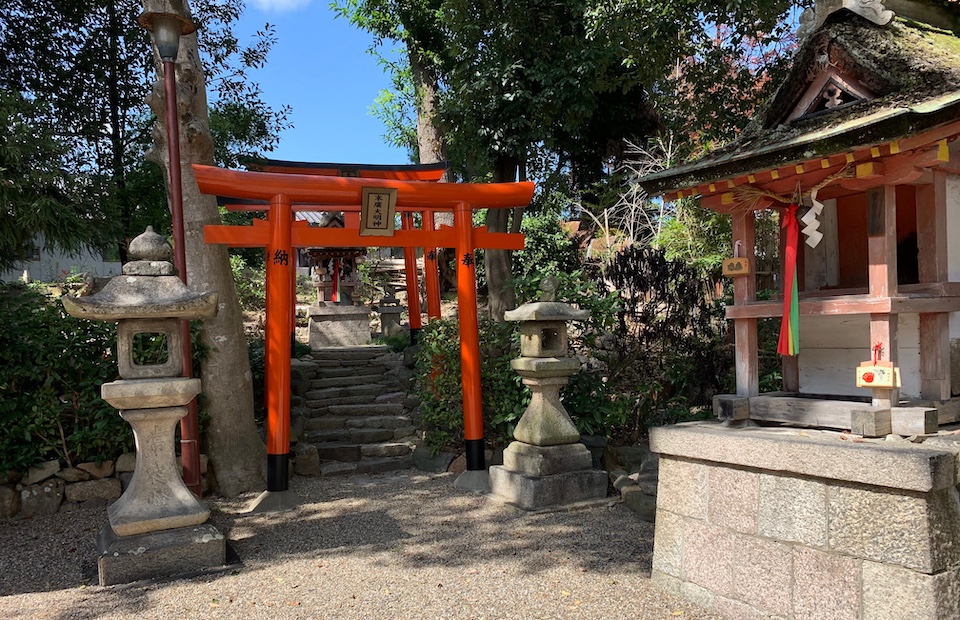
A Japanese baby is taken to a Shinto shrine weeks after birth for a blessing called miyamairi. That same person’s wedding might take place at a shrine, or at a Christian-style chapel (more on that later). When they die, the funeral will almost certainly be Buddhist. The ashes will go to a Buddhist temple. The memorial services, on the seventh day, the forty-ninth day, and then at intervals for years afterward, will be conducted by a Buddhist priest.
To someone from a culture where you pick one religion and stick with it, this looks incoherent. To a Japanese person, it is simply how life works.
Two traditions, one culture
Shinto is indigenous to Japan. It has no founder, no scripture, and no fixed doctrine. It centers on kami, the sacred presences found in nature, ancestors, and remarkable phenomena. Shinto is concerned with this world: purity, fertility, community, the rhythms of the seasons, the well-being of the living.
Buddhism came to Japan from mainland Asia in the sixth century, arriving primarily through the Korean peninsula. It brought with it a rich philosophical tradition, a concern with suffering and liberation, a highly developed monastic system, and a clear framework for understanding death and what follows it.
The two traditions are genuinely different. Shinto does not have much to say about the afterlife. Buddhism does not focus much on the kami. Shinto is rooted in specific places: this mountain, this river, this shrine. Buddhism, at its origin, is universal: the Four Noble Truths apply everywhere.
And yet, from almost the moment Buddhism arrived, the two began to blend.
How the blending happened
The first recorded conflict over Buddhism in Japan was political, not theological. In the sixth century, powerful clans at the Imperial court argued about whether to accept the new religion from the continent. The Soga clan supported Buddhism. The Mononobe and Nakatomi clans opposed it, arguing that the native kami would be angered. The Soga won, and Buddhism received official support.
But the winning side did not simply replace Shinto with Buddhism. What happened instead was more interesting. Buddhist monks began building temples near Shinto shrines. Kami were explained as local manifestations of universal Buddhist deities. A doctrine called honji suijaku (本地垂迹) proposed that the kami were actually Buddhas and bodhisattvas who had taken Japanese forms to guide the people.
The reverse happened too. Buddhist figures were welcomed into shrine compounds. Priests performed both Shinto and Buddhist rituals. The two systems wove together so thoroughly that, by the medieval period, many religious sites were genuinely both shrine and temple at the same time. The term for this blending is shinbutsu shūgō (神仏習合), literally “the merging of kami and buddhas.”
This was not a neat theological compromise. It was messy, local, and organic. Different regions did it differently. Some shrines remained purely Shinto. Some temples remained purely Buddhist. But the general pattern was coexistence and mutual borrowing, not competition.
The forced separation
For over a thousand years, Shinto and Buddhism lived together. Then, in 1868, the Meiji government tried to pull them apart.
The shinbutsu bunri (神仏分離) decree ordered the separation of kami and buddhas. Buddhist elements were to be removed from shrines. Shinto elements were to be removed from temples. Priests who had served both traditions were forced to choose one.
The reasons were political. The new Meiji government wanted to build a modern nation-state around the figure of the Emperor, and the Emperor’s legitimacy was rooted in Shinto mythology. Shinto was elevated to a special status. State Shinto (kokka shintō) became a tool of national identity, linked to patriotism and Imperial authority.
The separation was enforced with varying degrees of violence. In some regions, Buddhist statues were smashed. Temples that had existed inside shrine compounds for centuries were demolished. Monks who refused to convert to the Shinto priesthood were expelled.
This period left scars that are still visible. Many shrines that had been mixed-religion sites for a millennium were stripped of their Buddhist elements. The boundary between shrine and temple that tourists in Japan see today is partly a product of this nineteenth-century political decision, not an ancient tradition.
After Japan’s defeat in 1945, State Shinto was abolished, and the Emperor publicly declared that he was not divine. Shinto returned to being a private religious practice rather than a state ideology. But the physical separation of shrines and temples mostly remained.
What coexistence looks like today
Despite the forced separation, the old instinct for blending never fully went away. Today, most Japanese people move between Shinto and Buddhist practices without any sense of switching religions.
New Year’s Day (Hatsumōde): Tens of millions of Japanese visit a shrine in the first days of January. Some go to temples instead, or visit both. The point is the fresh start, not the denomination.
Weddings: Traditionally held at Shinto shrines (shinzen shiki), though Christian-style chapel weddings have been popular since the 1990s. Most couples who choose a chapel are not Christian. They simply like the aesthetic. Nobody finds this strange.
Funerals: Overwhelmingly Buddhist. Over 90% of Japanese funerals follow Buddhist rites, even for families who rarely visit a temple otherwise. Buddhism’s framework for understanding death, the journey of the soul through intermediate states, the practice of memorial services at set intervals, fills a space that Shinto does not address in detail.
Obon (mid-August): Families welcome the spirits of their ancestors back to the home. The practice blends Buddhist theology (the idea that the dead can be helped by the prayers of the living) with Shinto sensibility (the idea that ancestors are kami who watch over the family). Nobody pauses to sort out which element came from which tradition.
Daily life: A household might have both a kamidana (a Shinto shelf shrine with an ofuda from the local shrine) and a butsudan (a Buddhist altar with photos of deceased family members). Morning offerings might be made to both.
The question Westerners keep asking
“But how can you be both? Don’t you have to pick one?”
This question reveals more about the questioner’s culture than about Japan. In the Abrahamic traditions (Christianity, Islam, Judaism), religions are mutually exclusive. You cannot be both Christian and Muslim. The very structure of these faiths demands a choice: there is one God, one truth, one path.
Japan’s religious landscape operates on different logic. Shinto and Buddhism are not two rival answers to the same question. They are answers to different questions.
Shinto asks: How do we live well in this world? How do we stay in right relation with the kami, the land, the community, the seasons?
Buddhism asks: What is the nature of suffering? How do we find liberation? What happens when we die?
A person can hold both sets of questions without contradiction, because the questions do not compete with each other. It is like asking whether you are a citizen of your city or your country. Both. The answer is both.
What the West gets wrong about Japanese “syncretism”
Western religious studies often describe Japan’s blending of Shinto and Buddhism as “syncretism,” a term that carries a faintly negative connotation, as if the Japanese were not rigorous enough to keep their religions straight.
This misses the point. The coexistence of Shinto and Buddhism in Japan is not a failure of logical consistency. It is a different model of what religion is for.
If you think religion is primarily about truth claims (God exists, the soul is immortal, this book is divinely inspired), then mixing two religions does look sloppy. How can both be true?
But if you think religion is primarily about practice (how you mark birth, how you grieve, how you relate to the natural world, how you maintain community bonds), then blending two traditions is not a contradiction. It is common sense. Different tools for different jobs.
The Japanese approach does not work for everyone, and I am not suggesting that it should. But understanding it can loosen the grip of an assumption that many Westerners do not even realize they are carrying: the idea that spiritual practices must be exclusive to be genuine.
How to tell a shrine from a temple
For visitors to Japan, here is a practical guide:
Shinto shrines (jinja, 神社): Marked by a torii gate at the entrance. The building style is typically simpler, with unpainted wood and clean lines. You will see shimenawa (thick sacred ropes), komainu (guardian lion-dogs), and often fox statues at Inari shrines. Purification with water at the entrance. Prayer involves bowing twice, clapping twice, bowing once.
Buddhist temples (tera/ji, 寺): Marked by a sanmon gate (no torii). Architecture tends to be more ornate, with tiled roofs and painted wood. You will see Buddha statues, incense burners, and often a bell tower. Prayer involves pressing the palms together (gasshō) and bowing. No clapping.
The exceptions: Some sites still blur the line. Sensō-ji in Tokyo’s Asakusa district is a Buddhist temple, but it sits right next to Asakusa Shrine, and most visitors move between the two without noticing where one ends and the other begins. This is the old pattern, surviving despite the separation.
Frequently Asked Questions (FAQ)
-
Do Japanese people consider themselves Shinto or Buddhist?
-
Most Japanese people do not identify strongly as either. In surveys, the majority describe themselves as non-religious (mushūkyō), even while participating in both Shinto and Buddhist practices throughout the year. A common way to put it: Japanese people are Shinto for life and Buddhist for death, but they would not necessarily describe themselves using either label.
-
Why are Japanese weddings sometimes held in Christian chapels?
-
The trend began in the 1980s and 1990s. Many Japanese couples find the aesthetic of a white wedding dress, a chapel, and an exchange of vows appealing. Most of these couples are not Christian and have no plans to become Christian. This is a reflection of the same cultural flexibility that allows Shinto and Buddhist practices to coexist. The ceremony is borrowed for its beauty and its emotional resonance, not for its theology.
-
Did the merging of Shinto and Buddhism ever cause conflict in Japanese history?
-
The biggest conflict was not about the merging itself but about the forced separation. The Meiji-era shinbutsu bunri decrees of 1868 destroyed Buddhist property at many shrine-temple complexes and caused real harm to Buddhist communities. Before that, the long period of shinbutsu shūgō was largely peaceful, with occasional tension but no sustained religious war comparable to what occurred in Europe.
If this article brought a moment of peace or insight to your day, consider supporting my work.
Thank you.