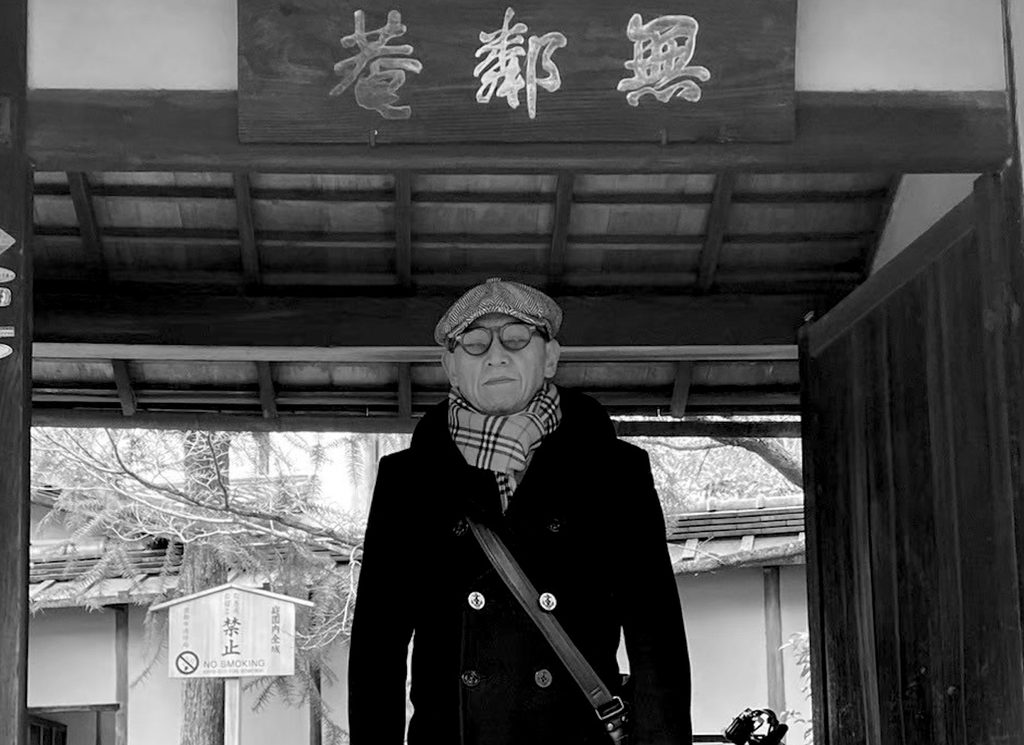
Who I Am
My name is Takeshi Kitagawa. I’m a designer and writer based in Osaka, born in Kobe in 1965.
I write about Zen, Shinto, Bushido, and Japanese aesthetics — not as cultural artifacts sealed behind glass, but as living structures that still shape how people think, act, and sit with uncertainty.
Where This Started
When I was six years old, I began training in Kendō(剣道)at a police station near my house in Kobe. I trained there for about ten years, until I was sixteen.
Kendō at a police station is not a graceful affair. The floors are cold. The instructors are police officers who do not explain why you must bow before stepping onto the floor, or why you fold your hakama(袴)a certain way after practice. You simply do it, and somewhere in the doing, something takes root.
I didn’t know the word Bushidō(武士道)then. But looking back, that decade of practice gave me my first glimpse of its entrance — not through books or philosophy, but through the body. How to stand when you want to move. How to wait when you want to strike. How to lose without it breaking something inside you.
The Education I Didn’t Know I Was Getting
There is something else that may have laid the groundwork for everything that followed, though I only recognized it much later.
In Japanese public schools, students clean their own classrooms. Every afternoon, after the last lesson, you pick up a rag, wring it in cold water, and wipe the floor on your hands and knees. You sweep the hallways. You scrub the toilets. No janitor comes. It’s your school, so you clean it.
Nobody calls this Zen. Nobody frames it as mindfulness training. It is simply what everyone does — a small, repeated act of responsibility toward a shared space. But the structure is there: attention without purpose, effort without reward, care given to something that will only get dirty again tomorrow.
I sometimes think that the foundation of Zen was being built inside me during those years, without anyone — least of all me — knowing it.
From Kobe to Kyoto
During my university years, I began studying at Zen temples in Kyoto.
My family temple is Konkai Kōmyō-ji(金戒光明寺), a Jōdo-shū(浄土宗)temple — Pure Land Buddhism, the Buddhism of tariki(他力), reliance on something beyond oneself. I grew up hearing dharma talks from the priests there, watching my grandparents pray, and reciting Namu Amida Butsu(南無阿弥陀仏)before I understood what the words meant.
As I grew older, the idea that faith alone could carry you began to feel incomplete. I needed something that met me where I was — sitting, breathing, watching my own mind fail to be quiet. That search brought me to Rinzai Zen at Nanzen-ji(南禅寺)in Kyoto, and to years of studying classical Japanese literature and history alongside it.
My path, then, has been one from tariki to jiriki(自力)— from other-power to self-power. Now, in my sixties, I find myself somewhere else entirely: a place where it no longer matters which door you enter through. Nembutsu, zazen(坐禅), or something with no name at all — I believe each person’s way, whatever it is, can shift something quietly inside them.
I am still changing. I expect I will keep changing.
Where Buddhism Meets Shinto
The deeper I went into Zen, the more I noticed something I hadn’t expected.
Buddhism and Shinto, which I had always thought of as separate traditions — one imported, one native — began to feel less like two things and more like two ways of saying something similar. The Zen attention to impermanence, mujō(無常), and the Shinto sense that something dwells in old trees, in rivers, in stones worn smooth by centuries of rain — these are not the same idea, but they breathe in the same rhythm.
I do not use the word “god” for what I feel at a mountain shrine or beside an ancient cedar. But I am half-serious — perhaps more than half — when I say something lives there.
When I travel in Japan, I stop at the local shrine wherever I am. Not out of obligation or performance, but because it would feel wrong not to. It is a kind of greeting — an acknowledgment that I have entered someone else’s place, and that someone may not be human.
This is the perspective I write from: not Buddhism alone, not Shinto alone, but the space where they overlap, contradict, and quietly reinforce each other.
What I Write and Where
I publish essays in English on Medium under the project name SHIBUMIWORKS, and in Japanese on note. Same questions, different languages, sometimes different answers.
The English essays are written for readers who already sense that the Western conversation around Zen and mindfulness has become thin — optimized, packaged, stripped of the strangeness that makes these traditions worth sitting with. I’m not here to correct anyone. I’m here to put something back that got lost when these ideas crossed the ocean.
Some of these ideas are genuinely difficult to translate. Not because they are mystical, but because the logic underneath them is built differently. For those topics, I write dialogue pieces alongside the essays — conversations between myself, Nicholas (an American businessman living in Osaka), and Catherine (an American graduate student at Osaka University). These dialogues are not simplifications. They are the same idea, held up to a different light.
What I Don’t Do
I don’t romanticize Japan. This country produced extraordinary philosophy and extraordinary cruelty, sometimes in the same century, sometimes in the same person. Pretending otherwise would dishonor the very tradition I’m trying to pass on.
I don’t promise results. Zazen is not a productivity tool. Bushidō is not a leadership framework. Reading about wabi-sabi(侘び寂び)will not make your apartment look better. If something in these essays changes the way you move through a day, that change will come on its own schedule, in its own shape, and it may not look like what you expected.
I don’t teach. I practice, I study, I write.
A Note on AI
Japanese is a language of indirection. What is left unsaid often carries more weight than what is spoken. Translating that into English — without flattening it into something blunt, or worse, something falsely poetic — is genuinely difficult.
For that reason, I use AI as a tool in the writing process: to find the right phrasing in English, to test whether a nuance survives translation, and to catch moments where the meaning has quietly slipped.
The thinking is mine. The words are a collaboration.
Takeshi Kitagawa — Osaka SHIBUMIWORKS