The Stone at the Heart of Shimogamo Shrine and Japan
A growing stone and the meaning behind a line in Japan’s national anthem
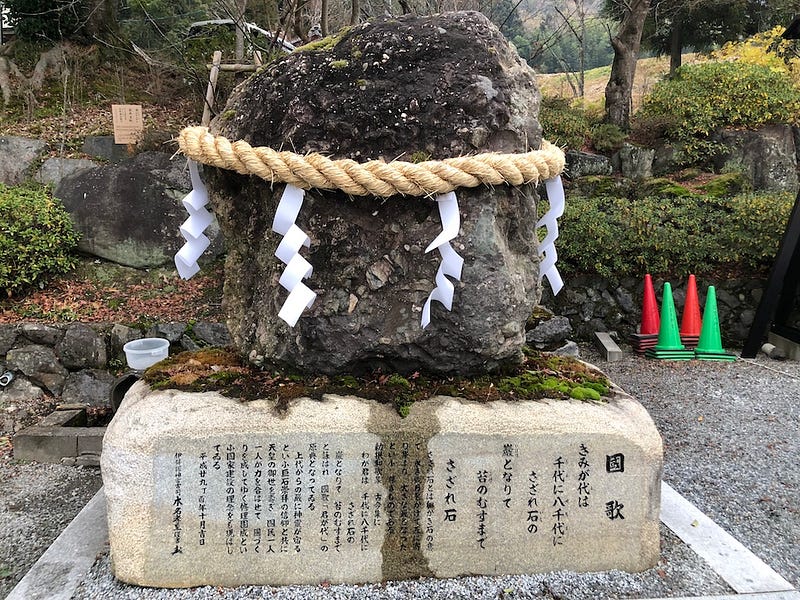
The sazare-ishi (pebble-conglomerate stone) at Shimogamo Shrine. Stones of various sizes fused over a long period to form a single massive rock. (Author’s photo)
君が代は千代に八千代にさざれ石の巌となりて苔の生すまで
May your reign continue for a thousand, eight thousand generations, until the tiny pebbles grow into massive boulders lush with moss. (Japanese National Anthem)
Once a year, when I have time in Kyoto, I used to visit all the famous shrines. Now, I only take the time to walk out to Shimogamo Shrine.
Recently, so many Foreign tourists sit on the ground to eat that those places have started to feel like something to look at rather than somewhere to stand. I do not blame the crowds for this. I only notice that I no longer stop.
Yet, there are still places at Shimogamo that are quiet. Its approach runs through Tadasu no Mori, an old forest whose name carries the sense of setting something straight, and a few steps in, the city drops away behind you.
I go here to greet the two enshrined kami: Kamo Taketsunumi-no-mikoto (賀茂建角身命) and his daughter Tamayori-hime-no-mikoto (玉依媛命). But before I reach them, I stop at a stone almost everyone walks past. It sits low near the entrance, unremarkable, and in all my visits I have never once seen another person pause in front of it. It is a sazare-ishi (細石).
A sazare-ishi is a mass of small stones bound into one. Over a very long time, lime and iron seep into the gaps between the pebbles and set, and the loose gravel hardens into a single boulder, an iwao (巌). The shrine keeps one because of a line in Kimigayo (君が代), Japan’s national anthem, whose words are far older than its melody. The poem wishes for an age that lasts until the sazare-ishi grows into an iwao and moss covers it.
The poem was written in the Heian period by an author no one can name. What stops me every time I stand there is a simple question: how did they know?
The chemistry of it was invisible to them. No one in the tenth century could have described cementation, or the slow work of groundwater in the spaces between stones. And yet the image in the poem is exactly right. Small stones do, given enough centuries, become one stone. The poet cannot have known the mechanism.
The poet knew the outcome. To carry that image without any science behind it, you have to believe something about stones: that they are not finished objects, that they grow, that a rock sits closer to a living thing than to a dead one.
I grew up frightened of stones. The stories I heard as a boy were not gentle. There was the weeping stone (yonaki-ishi) of Sayo no Nakayama, where a murdered woman’s spirit was said to have entered a roadside rock and cried through the night. There was the killing stone (Sesshō-seki) of Nasu, a boulder that struck dead any creature that came near it. In those stories, a stone was a place a spirit could go and stay. So when I kept goldfish and turtles as a child and wanted a stone from the riverbed for the tank, I would bow to it first and say, under my breath, “let me borrow this.” I laugh at it now. At the time I meant it completely.
A stone was not mine to take without asking.
That child is still there in the gesture I make at Shimogamo. Standing in front of the sazare-ishi, I tell it, silently, where I have come from. I have come from Osaka. I was in the area, so I stopped in. I will pay my respects to Kamo Taketsunumi-no-mikoto and Tamayori-hime-no-mikoto, and then I will head home. I introduce myself the way I would at the door of an unfamiliar house. Then I bow and go on to the main hall.
The shrine has other stones with stories, if you look. Among the old wonders told of this place, there is a sacred stone in the Mitarashi stream said to make small pebbles leap when the water is stirred in times of drought. Whether pebbles leap or not, someone once watched a stone closely enough to believe it might answer.
For most of my life I read the anthem’s line in the ordinary way. Small stones gathering into a boulder meant people drawing together, standing as one. That is the reading I was taught, and it is a good one. Since I began stopping at the sazare-ishi, another reading has settled over it, and I want to be clear that this one is mine, not a scholar’s.
If a single stone can hold a spirit, then a boulder made of countless small stones is a gathering of countless small presences. Here we speak of yaoyorozu no kami (八百万), the eight million gods: a sense that the divine is scattered through the whole world rather than seated in one place, present in trees and mountains and, yes, in stones.
Sazare-ishi at Izumo Daijingu Shrine in Kameoka City, Kyoto Prefecture. The lyrics of “Kimigayo” (Japan’s national anthem) are inscribed on the stone’s base (Author’s photo))
Read that way, the line holds more than people uniting. The sazare-ishi becoming an iwao is people and kami gathering into one, and staying gathered until the moss grows. Even the first word carries a doubleness. Kimi can mean a particular person, a lord or a loved one; some also read the old ki and mi as man and woman. I do not press the point.
I have no idea whether the poet meant any of this. Probably not in the words I would use. But the turn of mind that could hold such an image, the same turn that lets a person kneel by a river and ask a stone’s permission, has shaped how people here move through the world.
It shows up as a reflex more than a belief. You bow at the entrance of a shrine before you have decided anything about the gods. You greet a mountain before you climb it. You treat the non-human world as if it might be paying attention. Whether or not anything is listening, the person who bows already stands differently in the place than the person who does not.
I cannot promise that stopping at a stone will do anything for you. It has never promised me anything. I return to the sazare-ishi each year, and it looks exactly as it did, low and grey and overlooked, growing at a speed no life can watch. I bow, I say where I have come from, I move on. Nothing announces itself. And still, on the walk back out through the trees, something sits a little differently than it did on the way in. I have stopped trying to name it.
Takeshi Kitagawa heads the SHIBUMIWORKS PROJECT, which aims to introduce Japanese culture. Rooted in his years of Kendo, Zen, and Shinto practice, the project explores whether these traditions have anything real to offer modern life — without pretending they have all the answers.
Shinto Without Belief: Why the Japanese Still Bow at Shrines
I have prayed at shrines all my life and believe almost none of it
The Kungaishō, a camphor tree said to be over a thousand years old, at Mishima Shrine in Osaka. Beside it stands a small shrine to the tree’s own kami. No statue, no idol. Only the tree (My picyure)
I have visited Shinto shrines since before I can remember. The shrine of my childhood, in Nishinomiya, is called Koshikiiwa. Its object of worship is not a statue or a scripture but an enormous rock, and around it, scattered through the grounds, stand smaller sacred stones, each honored in turn. I bow at the main hall first, then walk to the great rock, then to the others, one by one. I have done this for decades.
If I am honest, I feel almost nothing.
I say this plainly, because the truth here is more interesting than the reverence a Western reader might expect. The bowing is habit. The order of the stones is form. I am not visited by the sacred. I am simply doing what I have always done, as automatically as I brush my teeth.
And yet there is one thing I do feel, and it took me most of my life to notice it. At my childhood shrine, I feel at home. When I travel and stop at a shrine in some distant province, I feel like an uninvited guest, as if the place were saying, I didn’t call for you, or I don’t know who you are. A few shrines have unsettled me outright. Heitate Jingū in Kyushu, Ōmiwa in Nara, Hokura here near Kobe. At each of these I felt something close to fear.
So the feeling is real. It is simply not the feeling the word “religious” prepares you for; it is closer to the difference between your own house and a stranger’s. Shinto has never asked me what I believe. It asks how I behave in a particular place, and that turns out to be a very different question.
A religion you do, not a religion you believe
Western observers have long been puzzled by a particular Japanese habit: we will say, flatly, “I have no religion,” and then go to a shrine at New Year, buy a protective charm, and bring our children for the shichi-go-san blessing. To an outsider this looks like hypocrisy, or confusion.
Scholars of religion draw a useful line here. Some faiths are built on orthodoxy: right belief, the correct creed held in the mind. Others are built on orthopraxy: right practice, the correct action performed with care. Shinto sits firmly on the side of practice. What matters is less what you privately believe than what you do with your body: you bow at the gate, you rinse your hands, you observe the courtesy of the place.
Let me describe how it actually feels to me. When I visit a shrine in a town I do not know, it is like arriving at a company for a meeting. Even if I could walk straight to the right department, I stop at the front desk, I say where I have come from, I write my name in the book. Reading the shrine’s founding history at the entrance (ah, so that is how this place came to be) is like greeting the head of the neighborhood association before holding a small event on their turf. It is not a confession of faith. It is manners.
Or consider something even more ordinary. Most Japanese bathe every day. I do too, before dinner or before bed, so that I do not carry the day’s dust into my sheets. Is that a rite of purification (Shinto has always disliked kegare, defilement), or just hygiene? It is both, and the honest answer is that the question “which is it, really?” is the wrong question. My visits to unfamiliar shrines are exactly that ambiguous.
I will confess something that makes the point sharper. When my mother died, the priest asked whether we wanted a posthumous Buddhist name for her. I said we did not need one. I do not believe, not by a millimeter, that chanting the right formula opens the gate to paradise. And yet, though our family’s ancestral graves lie in Yokkaichi, I placed my mother’s remains at Konkai-Kōmyōji, a temple a short walk from the center of Kyoto. I chose it, frankly, for its convenience: so that when work brings me to the city, I can slip away by taxi, stop in for a few minutes, and tell her how things are going. I believe none of the doctrine. I keep every one of the practices.
The contradiction that isn’t one
Here is the puzzle that makes people call Shinto illogical. It honors a rock and a dead statesman in the same breath: a mountain and the scholar Sugawara no Michizane, a waterfall and a fox. Nature worshipped as sacred, standing beside human beings who once actually lived and were later made into gods. To a mind trained to sort the world into clean categories, this is not a religion. It is a filing error.
I felt that objection myself, once. Japanese companies often keep a small household shrine, a kamidana, in the office. As a child I thought nothing of it. As I grew up I began to wonder what it was for (a shrine is a sacred place; what is the point of a shelf in an accounting office?), and I noticed people fussing over which way it faced, careful not to point it north, which is really the territory of a quite different tradition. It struck me as incoherent.
What changed my mind was standing in the grounds of Hokura Shrine, above Kobe. The shrine enshrines Susanoo and Ōkuninushi, deities of myth. But its grounds also hold ancient stone arrangements used in worship long before those myths were written down, and pottery has been dug from the same earth dating to centuries before Christ. Standing between the two, I came to think (and I offer this as my own reading, not as scholarship) that the ancient people did not draw the line we draw. Between what feeds you, what frightens you, and what you wish to become, they built no fence. Whether a thing was a mountain or a man who once lived did not decide which side of a boundary it fell on, because there was no boundary to fall on.
The moment that felt like understanding was not when I finally saw the contradiction. It was when I began to suspect that the one pointing at it might be the one who is mistaken.
Japanese philosophers, like Kitarō Nishida, spent their lives trying to render this refusal to choose into rigorous language, affirming reality with all its contradictions. I am not one of those philosophers. I only know it from the inside, as you know your own house in the dark.
A ginkgo in the middle of an Osaka street, revered as Ryūō-Ōkami, the dragon god. The road was built to cavoid around it. No one was willing to cut it down (My picture)
Merciless nature, and why people made offerings
On New Year’s Day in 1995, I made my first visit of the year to Heitate Jingū in Kyushu, the very shrine that had once frightened me. Sixteen days later, the Great Hanshin Earthquake destroyed my house. Not one of my relatives was hurt.
I still believe it was because of that visit. I also know, perfectly well, that the survivors were not all devout and the dead were not all faithless. Both of these things are true for me at the same time, and long ago I stopped trying to reconcile them.
What the earthquake gave me was not a doctrine but a posture. Disaster is not an accident waiting for an explanation; it is a certainty to be lived beside. And nature, I learned in my own body, is not cruel. It is indifferent, which is somehow harder to bear.
Consider what New Year’s Day means to a Japanese family. It is the most important day of our year. On the last night of the old year we gather and eat toshikoshi soba, the long buckwheat noodles, quietly grateful to have come through another year unharmed. When the sun rises we eat osechi from its lacquered boxes; even the children take a sip of otoso, the spiced sake, to mark the new year’s arrival. It is a day of homecoming, of relief, of blessing.
On New Year’s Day in 2024, moments after families across the Noto Peninsula had performed exactly these rites, the ground convulsed and took their houses and hundreds of their lives. To the earth beneath them, it was not New Year’s Day. It was not any day. The date that means everything to us meant nothing whatsoever to the force that killed them. That is the indifference I mean. Nature does not hate us; it simply does not notice that we are here.
And it does not end. In the summer of 2026 the ground tore open again in Kumamoto, on Kyushu, and again it killed. Prepare as we might, stay as watchful as we can, the earth still takes someone each time it moves. Suffer that loss over enough centuries and something settles into a people. Not faith, I would hesitate to call it faith, but a slow turning toward the ground itself, an impulse to enshrine the very earth as a kami and to keep, as best we can, the peace with it.
Once you have felt that indifference from the inside, the old rites stop looking primitive. People offered the first rice of the harvest to the sun and the soil. They were not naive. Having no power at all over the ground beneath them, they chose relationship over helplessness. The harvest festival that had always puzzled me suddenly had a reason to exist, and the word animism, which until then I had only known, I now understood.
Why do people do this?
That question (why do people do this?) is what quietly replaced belief for me.
My grandmother was devout. Every day she lit incense at the family altar and recited the sutras from memory. My mother, whom I never once thought of as religious, began murmuring the nenbutsu only after my grandmother was gone. I do little more than change the water on the altar. But when my mother died, I understood, at last, why the two of them had done what they did.
As a boy at the family grave, I pressed my palms together and thought nothing at all. After my grandparents were laid there, I began cleaning the stone carefully each time I came, without ever deciding to.
I did not reach any of this by believing. I reached it by doing, and by feeling, always too late, why others had done the same before me. Belief was the shallow question. This was the one that went all the way down.
The margin in the heart
I have contradicted myself throughout this essay, and I know it. A philosopher might reasonably ask me to point to exactly where the contradiction lies. I do not mind the question. Human beings live holding contradictions; the Zen koan is built out of them on purpose.
To accept a contradiction is almost to say “either is fine.” But to leave a contradiction unresolved on purpose, you need somewhere to stand that leans toward neither side. I have come to think of it as a margin in the heart. Kokoro no yohaku: the blank space left intentionally on the page. It is not the shrug of “whichever, I don’t care.” It is room to breathe, room a settled mind no longer leaves itself.
I promise you nothing. I cannot tell you what will change if you keep such a margin, or that anything will change at all. But I do not believe it changes nothing. Laozi wrote that through non-doing, nothing is left undone. Perhaps refusing to force a contradiction closed is not resignation but space, space to notice what a mind in a hurry to be right walks straight past.
I still feel almost nothing when I stand before the great rock of my childhood. I still go. Not to be answered. Only to keep showing up. And, maybe, to live a little more like a human being.
Takeshi Kitagawa heads the SHIBUMIWORKS PROJECT, which aims to introduce Japanese culture. Rooted in his years of Kendo, Zen, and Shinto practice, the project explores whether these traditions have anything real to offer modern life―without pretending they have all the answers. English is not my first language; I use AI as a linguistic tool to bridge that gap. The thinking is mine. The words are a collaboration.
All of Osaka Performs a Rite that No One Quite Believes In
Tenjin Matsuri and the god who began as a curse
Rikutogyo (My Picture)
Every July the river through the middle of Osaka fills with lantern-light and drums. This year I went down to watch again, as I have most summers, and stood among the crowd on the bank while the boats of the funatogyo (the boat procession) moved upstream against the dark water.
Earlier in the day the rikutogyo (the land procession) had carried Sugawara no Michizane, the deity at the heart of this festival, out through the streets: three thousand people in Heian court dress, a portable shrine crowned with a phoenix, taiko rolling ahead of it like weather.
All of it to escort one man home for the night. A scholar who has been dead for eleven hundred years.
I looked at the faces around me. Families, office workers still in their shirts, teenagers filming the fireworks on their phones. Somewhere among them stood friends of mine who help organize the festival, who give it weeks of their year.
And I found myself thinking a plain, slightly rude question: does anyone here actually believe that Michizane is coming down the river tonight?
I don’t think so. I don’t think a single person on that bank believes it in the way one believes the train will arrive or the rent is due. And yet there they were. There I was. The Tenjin Matsuri has been performed since the year 951 — one of the oldest festivals in Japan — and it was not being performed by a handful of priests. It was being performed by a city.
Belief had drained out of the rite somewhere over a thousand years, and the rite had not collapsed. That is the thing worth sitting with.
Funatogyo and Fireworks (My Picture)
The god who began as a curse
To understand why the question is strange, you have to know who Michizane was, and how he became a god.
He was a real man — a scholar, poet, and minister of the Heian court, born in 845. He rose high, made powerful enemies, and in 901 a rival faction accused him of plotting against the throne. He was exiled to Dazaifu in the far southwest, and he died there two years later, in disgrace, far from the capital he loved.
Then the capital began to suffer. Drought, plague, fire. His accusers died. In the year 930 lightning struck the Seiryōden, the emperor’s own hall, and killed courtiers where they stood. The court read the sky and understood: this was the dead man collecting what he was owed.
Michizane had become an onryō (a vengeful spirit) — one of the three most feared in Japanese history.
So they did what the age did with a furious dead nobleman.
They tried to calm him.
His titles were restored, the order of exile burned, and in time he was enshrined and elevated to a god: Tenman Daijizai Tenjin, lord of thunder.
This is the logic of goryō shinkō (belief in vengeful spirits): a soul wronged in life returns as disaster, and the way to survive it is not to defeat the spirit but to honor it — to promote it, quite literally, into a god.
Here is the part I never fail to find astonishing. That thundercloud of a spirit, enshrined out of fear, slowly became something else. Over centuries the terror faded and the scholar remained, and Michizane settled into his present role: Tenjin, the gentle patron of learning, to whom students across Japan now pray before their exams.
There are more than twelve thousand shrines to him. Children hang wooden plaques asking him for good marks.
They are praying to a man who was deified because the living were afraid of him. Almost no one who prays there knows this. The fear has been forgotten, and the affection has stayed.
The plaque I hung at thirteen
I know those children because I was one of them.
When I was thirteen, sitting for the entrance exam to the school I wanted, my family took me to Osaka Tenmangū — Michizane’s shrine, the heart of this whole festival — to hang an ema (a small wooden votive plaque), asking to pass.
I remember writing my wish on the wood. I also remember what I privately thought, because I was a certain kind of boy: If hanging a plaque got you into school, everyone would get in. All these plaques, and only some of us pass. So the plaque does nothing.
I was not wrong about the mechanics. The plaque does nothing to the exam.
But I have carried that morning for fifty years now, and I understand it differently. The plaque was never a lever on the outcome. It was a way of setting something down. I had studied as much as I was going to study; the exam would do what it would do. Hanging the ema drew a line under the effort and handed the rest over. Whatever happens now, I have done my part, and I will take the result cleanly. It was, I think, a small rite of finishing — a way to stop carrying what I could no longer change.
The plaque’s uselessness and its usefulness are the same fact seen from two sides. Had I believed the wood could pass me, it would have closed nothing — I’d have spent the spring anxiously waiting on it to work. Because I did not believe, it could serve as an ending.
I want to be careful here, because this is the exact place where an essay like this goes wrong. It is tempting to finish the thought and say: so ritual is really just a psychological tool, a commitment device, a tidy way to manage your own anxiety. That explanation is clean, and I distrust it.
It is the same move that has hollowed out meditation in the West — the reduction of something old and strange into a technique for self-improvement, a productivity hack with incense. If the ema were only a private mind-trick, I could have written my wish on any scrap of paper at my desk. I did not. I took it to a shrine, to a particular dead man, and hung it where he could see it.
You already do this
Whenever I raise this with Western friends, I watch them reach for the word hypocrisy, or at least inconsistency. If you don’t believe, why perform? Isn’t the honest thing to stay home?
But scholars of religion have a useful distinction here: orthodoxy versus orthopraxy. Orthodoxy asks what you believe. Orthopraxy asks what you do. Much of Japanese religious life runs on the second and is largely indifferent to the first — the practice is the point, and the metaphysics behind it is left politely unexamined.
And once you see it that way, the Western reader stops being an outsider to this. You may not believe a word of the liturgy yet still stand for a funeral. You may keep no faith at all and still put up a tree in December, still say “bless you” to a stranger’s sneeze, still touch the mezuzah, still not walk over a grave. None of these survive because the people performing them have checked the doctrine and found it sound. They survive as things done, and the doing carries a meaning the believing has long since stopped supplying.
The Tenjin Matsuri is not a Japanese mystery, then. It is the same human act you already perform — only here it is done by an entire city, out loud, on the river, without embarrassment, and without interruption since the tenth century.
Neither believed nor denied
So what is left, if not belief?
Standing on that bank, I don’t think what moved through the crowd was faith in Michizane’s return. Nor was it mere fondness, or gratitude, or civic pride, though all of those were in the air. It was something with no clean name — a low, steady sense that someone, somewhere, is watching. The god, the ancestors, the dead we owe. Not a proposition anyone would defend in daylight. Not a proposition anyone would deny, either.
This is the register I find most honest and hardest to translate. It is not belief. It is not disbelief. It is a relationship held deliberately at low intensity, never forced to resolve into true or false. My friends who carry the shrine do not believe a spirit rides in it. They also do not, for one second, treat it as an empty box.
This is my own reading, and I offer it as that. But I suspect this is what a culture gains when it declines to demand that its rituals be literally true: it gets to keep the relationship without paying for it in belief. The dead are not argued about. They are attended to.
What the refusal shaped
There is a habit of mind underneath all this, and I think it has shaped the people it raised — including me.
Much of the world, faced with the dead and the divine, wants a verdict. Is it real or not; do you believe or not; draw the line and stand on one side of it.
That instinct built extraordinary things — theology, law, science. It is also the same instinct that meets grief with the demand to reach “closure,” to settle the account with the dead and move on.
Japan, on this one matter, mostly declined to draw the line. Nobody quite settled whether Michizane is a god or a ghost or a great man remembered, and nobody convened the trial that would decide it. The question was left open on purpose, and a thousand-year festival grew in the space the open question left.
I don’t offer this as proof that one way is wiser. I only notice what it seems to have made: people who can hold a thing unresolved without needing to resolve it — who can keep the dead close without deciding exactly what the dead now are.
I still cannot tell you where devotion ends and habit begins, or where a ghost becomes a god. I have been standing in these shrines my whole life and the line has never once shown itself to me. For a long time I took that as a failure of understanding on my part. Now I am not so sure the line is there to be found.
The boats came up the river, the drums went on, and the crowd stayed to the last of the fireworks. No one was waiting to be told what any of it meant. They had come to do it, and they did it, and the doing was enough.
I went home. Nothing was proven. But something had moved, quietly, and it is moving still.
Glossary
船渡御 (Funatogyo) — the boat procession The boat procession, held on the Ōkawa River (大川). Dozens of decorated boats carry the mikoshi, along with musicians and performers, upstream through the middle of Osaka after dark. It continues the deity’s journey by water and closes with fireworks over the river — the scene most people picture when they think of the Tenjin Matsuri.
陸渡御 (Rikutogyo) — the land procession The land procession of the Tenjin Matsuri. Hundreds of participants in Heian-period (平安時代) court dress carry a mikoshi (神輿), a portable shrine, together with sacred objects, escorting the deity out from Osaka Tenmangū (大阪天満宮) and through the streets down to the river. It is the first half of the festival’s main event, and it delivers the procession to the waiting boats.
絵馬 (Ema) — votive plaques Small wooden plaques offered at Shinto shrines. A visitor writes a wish or a word of thanks on the back and hangs the plaque at the shrine. The name means “picture horse”: worshippers once gave live horses to the gods, and over the centuries a painted wooden tablet took the horse’s place. Today the plaques often carry the year’s zodiac animal or a symbol of the shrine’s deity.
SHIBUMIWORKS PROJECT explores Japanese philosophy, aesthetics, and culture ― not as a guide, but as a mirror. The views in this piece are my own ― shaped by how I grew up, what I practiced, and what I noticed. They are not the correct interpretation of Zen, or of anything else. English is not my first language; I use AI as a linguistic tool to bridge that gap. The thinking is mine. The words are a collaboration.
Do you have an intercultural story or experience you want to share? We would love to hear it! Contribute to A-Culturated and join the community!
What a mountain with no gods and a god with no face taught me about the way things actually are
Sumiyoshi Taisha, located in Osaka, was founded in 211 AD. (My picture)
There Are No Gods Inside a Shinto Shrine
If you visit a Shinto shrine for the first time expecting to find what you find in a church or a temple (e.g. an image or figure of the divine), you will be sadly disappointed.
The honden, the inner sanctuary, contains no paintings, no statues, and no face. What it contains, in most shrines, is a shintai — a sacred object. The most common shintai are mirrors, swords, or stones. The object is not the god. It is more like an antenna — a focal point through which something that cannot be depicted makes itself available to human attention.
Near the shrine there is almost always something older such as a mountain, tree, or a rock formation that has been there longer than anyone can remember. This is where the kami resides. Not in the building. In that place.
This is the animistic sensibility at the heart of Shinto — the ancient, indigenous worldview of Japan. Shinto, unlike Western religions, is not a dogma. It has no founding text, no creed to recite, and no deity whose will must be obeyed. It is closer to a way of paying attention to the world around us and recognizing that it is already alive in some sense that exceeds easy explanation.
The Mountain That Is the God
In Nara Prefecture, there is a shrine called Ōmiwa Jinja (大神神社). It is among the oldest in Japan — some say the oldest. What makes it unusual, even among Shinto shrines, is that it has no honden at all. No inner sanctuary. Because the sanctuary is the mountain behind it.
Mount Miwa is the shintai (神体). The mountain itself is the sacred object.
The current haiden — the hall of worship — was rebuilt in 1664 (Kanbun 4) under Tokugawa Ietsuna, the fourth shogun of the Edo period. But the form of worship it preserves is far older: worshippers face the mountain directly through the mitsu-torii, the triple torii gate, without any image or statue as intermediary. The mountain is what you face. The mountain is what you address.
For most of its history, the mountain was kinsokuchi (禁足地) — forbidden ground. No one entered. The shrine existed simply as the place where humans could approach the boundary of something that did not belong to the human world.
In recent years, entry has been permitted. But the conditions are strict. No photography. No sketching. No conversation. And whatever you see or hear on the mountain, you do not speak of afterward.
There are no penalties for breaking these rules. No authority enforcing them. No surveillance cameras in the cedar forest.
Only this: you made a promise. To the mountain. And you know whether you kept it.
I have been inside that forest. I made that promise, and I intend to keep it — so I will not recount what I saw or heard there. What I can say is that the air was different. The quality of silence was different. Something in my body registered a change that I could not explain and did not try to.
You could tell me that this was suggestion — that I felt what I expected to feel because I had been told the mountain was sacred. Perhaps. I cannot disprove that. But I also cannot unfeel what I felt. And I have learned, over the years, to take seriously the things my body notices before my mind has had time to have an opinion about them.
The God in the Tool Drawer
There is a concept in Japanese culture called tsukumogami (付喪神).
The idea is this: objects that have been used and cared for over a long period of time acquire a spirit. A needle used by a seamstress for decades. A kitchen knife that has prepared ten thousand meals. A writing brush worn down to its last few hairs. These things, the tradition says, become inhabited.
I want to be careful here, because it would be easy to present this as charming folklore — the kind of thing that gets printed on the packaging of Japanese souvenirs. That would miss the point entirely.
The point is not that tools are literally alive. The point is the orientation that the concept produces in the person who holds it.
If you believe — or even half-believe, or find it natural to act as if — the knife in your hand has accumulated something through years of use, then you handle it differently. You clean it. You store it properly. You do not throw it across the kitchen in frustration.
No one is watching you. No one will know. There is no penalty.
But you will know.
“Returning to the root is called stillness. Stillness is called returning to one’s destiny.” — Lao Tzu, Chapter 16
The Japanese hold ceremonies for worn-out objects — kuyō (供養) — in which needles, brushes, kitchen knives, and even factory machinery are thanked and formally retired. Not because anyone requires it. Because something in the relationship between a person and the things they use deserves acknowledgment before it ends.
This is not religion in the Western sense. There is no theology behind it, no doctrine. It is closer to a habit of attention — a way of moving through the world that keeps alive the sense that nothing is merely a means to an end.
What This Has to Do with Lao Tzu
Chapter 25 of the Tao Te Ching contains a line that I have returned to more times than I can count:
人法地、地法天、天法道、道法自然。
Humanity follows the earth. The earth follows heaven. Heaven follows the Tao. The Tao follows only itself — which is to say, it follows what is natural.
The Tao takes nature itself as its standard.
When I read this alongside everything I have described above — the mountain that is the god, the tool that accumulates spirit, the shrine that points toward a place rather than a face — I do not feel that I am encountering two different ideas. I feel that I am encountering the same idea in two different languages.
What Lao Tzu is saying, in his compressed and difficult way, is that the deepest order is not something imposed from outside. It is not a commandment. It is not a system. It is what was already there before any system was invented — the structure of things as they actually are, which does not need your belief or your approval to continue operating.
The Shinto sense of kami — the recognition that certain places, certain objects, certain encounters carry a quality that exceeds ordinary explanation — is, I think, a way of staying in contact with that order. Not through doctrine. Through attention.
The world is sacred. It cannot be improved.If you tamper with it, you will ruin it. — Lao Tzu, Chapter 29
How Shinto Changed What Zen Became
Before exploring how Shinto shaped Japanese Zen, it is worth noting that the relationship between these two traditions has never been one of simple conflict or separation.
Through a centuries-long process known as shinbutsu-shūgō (神仏習合) — the syncretism of kami and buddhas — the divine figures of Shinto and the bodhisattvas of Buddhism came to be understood not as rivals but as overlapping expressions of the same underlying reality. This blending was not confusion. It was a distinctly Japanese way of holding two things at once without forcing them into contradiction.
Chinese Chan Buddhism, from which Japanese Zen descends, was a tradition shaped by the encounter between Indian Buddhist thought and the Taoist philosophy of Lao Tzu and Zhuangzi. Its emphasis on the ineffable, on paradox, on the limits of language — all of this carries the imprint of that earlier meeting. In that sense, Zen arrived in Japan already bearing Lao Tzu’s fingerprints.
But something changed when it reached Japanese soil.
The Chinese tradition, particularly in its Linji (Rinzai) form, placed great weight on the koan — those paradoxical exchanges and riddles designed to exhaust the rational mind and force a breakthrough beyond language. There is a certain intellectual sharpness to this, a willingness to push the limits of what words can do by using them aggressively against themselves.
Japanese Zen, especially in the Sōtō school founded by Dōgen in the thirteenth century, moved in a different direction: shikantaza (只管打坐) — just sitting. Nothing more. No goal. No breakthrough to achieve. The practice is the practice.
My own sense — and I hold this as personal conviction — is that this shift was made possible in part by Shinto’s deep-rooted suspicion of words. The Japanese concept of kotodama (言霊), the spirit of language, carries within it an awareness that words are powerful precisely because they are dangerous — that saying too much risks diminishing what is real. The Shinto tradition of kotoage sezu (言挙げせず) — not making things explicit, not declaring what need not be declared — found a natural resonance with the silent, embodied practice of just sitting.
And there is something else. Chinese Chan spoke of sunyata — emptiness — as an abstract philosophical category. Japan already had a different relationship with emptiness: the emptiness of the shrine interior that points toward the mountain, the emptiness of the tea room that makes space for the encounter between host and guest, the emptiness of the raked gravel garden in which a single stone carries the weight of an island.
These were not philosophical abstractions. They were lived forms. And when Zen encountered them, it did not so much transform them as recognize itself in them — and, in doing so, became something that could take root not only in the monastery but in the kitchen, the garden, the tearoom, and the dojo.
The Buddhist teaching of mujo (無常) — impermanence — underwent a similar transformation. In its original Indian context, impermanence is primarily a teaching about suffering: things pass away, attachment to them causes pain, liberation requires releasing that attachment. This is not pessimism, but it carries a certain orientation away from the world as it is.
Japan already had mono no aware (物の哀れ) — the bittersweet recognition that things are beautiful precisely because they do not last. The cherry blossom is not tragic. It is perfect. Its falling is not a failure but a completion.
When Buddhist impermanence met this sensibility, something shifted. The teaching did not lose its depth, but it changed its direction — from a turning away from the world toward a deeper turning toward it. Impermanence became not a reason to detach but a reason to pay attention, now, to what is here.
This, I think, is one of the most distinctive things about Japanese Zen — and I believe it is inseparable from the Shinto ground in which it grew.
The Ordinary Is Not the Opposite of the Sacred
Here is where I want to be direct about something, because I think it is the most important point in this essay and also the one most easily misunderstood.
The important takeaway is that the Shinto orientation toward the sacred is not reserved for mountaintops and ancient shrines. It is not a special mode that one enters at the shrine gate and exits on the way home.
When I say that the sacred is in ordinary things, I mean this literally.
The meal that begins with itadakimasu — a word that acknowledges the life given so that you could eat, the labor of the people who grew the food, the chain of relationships that brought it to your table. The morning sweep of the path outside the house — not because anyone requires it, not because guests are coming, but because the space around you is part of the world and the world deserves that attention. The careful washing of a bowl after tea.
These are not spiritual practices in the sense of being elevated above daily life. They are daily life, conducted with a particular quality of attention.
And that quality of attention — this is what I find most interesting — does not require that you believe anything specific. You do not need to believe in kami. You do not need to have read Lao Tzu. You only need to be willing to treat the things in front of you as if they matter. As if the knife deserves to be cleaned. As if the path deserves to be swept. As if the mountain deserves silence.
What happens when you do this consistently, over time, is not dramatic. It does not announce itself. But something in your relationship to the ordinary world quietly shifts.
What I Actually Believe
I want to be honest about my own position, because I think honesty is more useful here than a tidy philosophical conclusion.
I do not know whether kami exist in any literal sense. I cannot tell you what I encountered on Mount Miwa — whether it was something real or something I constructed from expectation and silence and the particular quality of cedar forest light on an autumn morning.
What I can tell you is that the framework — the habit of approaching the world as if things matter, as if places carry histories that deserve respect, as if the objects in my life have accumulated something through use — has changed how I move through my days. Quietly. Without drama. In ways that I would find difficult to measure and do not particularly want to.
Lao Tzu wrote that the Tao that can be named is not the eternal Tao. I take this seriously. I am not going to tell you that what I experienced on the mountain was the Tao, or kami, or anything else with a name. Names are what we reach for when we want to stop paying attention.
What the mountain asked of me was to stop reaching. To be in that place, in that silence, without converting the experience into something portable.
Do you have the patience to wait until your mud settles and the water is clear? — Lao Tzu, Chapter 15
I am still practicing.
A Note on Practice
If any of this resonates — and I say this without prescription, because this essay is not a set of instructions — the entry point is simpler than it might seem.
All you have to do the next time you use something is just notice it.
The next time you enter a place, notice what changes in you. The next time you prepare a meal, let the moment before eating be a moment of actual acknowledgment rather than habit.
Someone reading this might reasonably ask: and what has this practice changed in you? It is a fair question, and I find I cannot answer it — not because nothing has changed, but because these habits began so early, and have been so continuous, that I have no version of myself without them to compare against.
I cannot see the change the way you can see a before and after. It is more like asking someone who has always lived near the sea what it is like to smell salt air. They may not notice it at all. But take it away, and something essential would be missing.
That is all. It may amount to nothing. Or it may be the beginning of a very long and quiet conversation with the world you already live in.
About the Author
Takeshi Kitagawa was born in Kobe in 1965 and now lives in Osaka. He practiced kendo for nearly a decade at a police dojo in Kobe, and studied Zen and Buddhist philosophy at temples in Kyoto, where he had the opportunity to listen directly to Sōtō and Rinzai priests over many years. His writing explores Japanese philosophy, aesthetics, and the dō traditions — not as cultural artifacts to be admired from a distance, but as living orientations toward how to be in the world.
It is the practice of appreciating the ‘life’ within rice and crops, rooted in the Shinto belief that deities reside in all things.
Onigiri (rice balls) from Japanese convenience stores (Photo by Takeshi Kitagawa)
A few weeks ago, I watched a young woman from France sitting on the bench outside a Lawson near Shinsaibashi. She was holding a tuna mayo onigiri with both hands, reading the back of the package with the kind of focused attention most of us reserve for something genuinely important. When she finally unwrapped it — that distinctive three-step ritual with the plastic — she took her first bite and just stopped. Eyes closed—something like quiet disbelief on her face.
I had just walked out of the same store, holding my own onigiri. I’d already eaten three that week without once stopping to think about what I was eating.
I’m not telling this story to romanticize a tourist moment. I’m telling it because something about watching her made me uneasy — and it took me a few days to understand why. It wasn’t that the experience moved her. It was that I wasn’t.
The Ordinary Is Never Actually Ordinary
That onigiri she was holding — the one that stopped her in her tracks — is rice. Shaped by hand, or by a machine that imitates a hand. Salt. A sheet of nori. Maybe some tuna mixed with mayonnaise.
But rice in Japan is not simply rice.
Recent archaeological findings have pushed back the timeline of rice cultivation in Japan further than we once believed — into the Jomon period, long before the Yayoi era that textbooks traditionally cite. This means that somewhere around three thousand years ago, possibly more, people on these islands were already tending rice paddies, watching the water levels, reading the sky.
They were also eating shellfish. We know this because their kitchen middens — kaizuka, shell mounds — are scattered across Japan even today as place names. Kaizuka in Osaka. Kaizuka in Chiba. Fragments of a diet embedded permanently into the geography of the country.
What strikes me about this is not the antiquity of it. It’s the attention. These were people who paid close attention to what the land and the sea gave them. They had to. Their lives depended on it.
When Gods Ate With People
The ancient Japanese didn’t just eat what the land gave them. They gave it back — symbolically, ritually, as an acknowledgment that what they received was not owed to them.
In the Kojiki, Japan’s oldest chronicle of myth and history, two goddesses appear in one of its stranger passages: Kisagaihime, the clam shell goddess, and Umugihime, the ark shell goddess. They are summoned to restore the god Okuninushi after he is killed. They do so by grinding shell into a paste that becomes mother’s milk. It’s a peculiar myth, but it preserves something: the sea’s gifts were understood as having their own divine agency. The shellfish didn’t belong to humans. They were on loan.
The rice, too, arrived with a story. Ninigi no Mikoto, the grandson of Amaterasu, the sun goddess, descended from the heavens to the Japanese islands carrying with him seeds of sacred rice — the same rice, in a theological sense, that grows in Japan today. The Niiname-sai, the harvest festival held each autumn, and the Daijosai, performed once in the reign of each new Emperor, re-enact this moment: the first rice of the season offered to the gods before anyone eats.
But here is the part of Shinto that often gets lost in translation: the gods don’t keep the offering. In a practice called shinku — sometimes translated as “communal eating with the gods” — the food offered to the deities is brought down from the altar and shared among the community. The gods eat first. Then the people eat what the gods have eaten.
This is not a metaphor. It’s a practice still observed at shrines across Japan. The distance between the divine and the human, in Shinto, was never meant to be infinite.
A Word With No English Translation
Before every meal in Japan, we say itadakimasu.
Most Japanese children learn it as table manners. You say it before you eat, the same way you say please and thank you. But the word itself means something more specific: I humbly receive. It comes from the verb itadaku, which means to receive something from someone above you, with both hands, with your head slightly bowed.
You are not just acknowledging the food. You are acknowledging everything that made the food possible. The farmer who grew it. The fisherman. The truck driver. The person who cooked it. And further back — the soil, the rain, the sea, the sun.
When you trace itadakimasu back far enough, you arrive at the shrine altar. At Ninigi’s seeds. At the clam goddess grinding shell into something that could restore life.
This is what I mean when I say that Shinto offers a different shape of mindfulness. It doesn’t ask you to empty your mind. It asks you to fill it — briefly, honestly — with the full weight of what you’re about to receive.
What We’ve Stopped Noticing
I don’t want to be the person who says things were better before. They weren’t, not simply, not across the board. People in Jomon Japan died from things we now cure in a weekend. The abundance we live inside — the ability to walk into a Lawson at midnight and buy a perfectly made onigiri for 130 yen — is genuinely extraordinary. It represents centuries of agricultural refinement, infrastructure, refrigeration, logistics, and labor.
But that’s exactly the problem. It’s so extraordinary that it has become invisible.
Somewhere in the gap between extraordinary and invisible, itadakimasu became a reflex. A sound you make before eating, the way you say “fine” when someone asks how you are. The word is still there. What it was pointing at has quietly left the room.
I don’t think this is unique to Japan. I think it’s what happens when scarcity disappears. You stop noticing what you have because the effort of obtaining it is no longer visible to you. The fish arrives in a plastic tray. The rice is microwaveable. The sea and the soil are somewhere behind the packaging, behind the supply chain, behind the convenience.
What I can speak to is Japan specifically, and to my own generation — people old enough to remember when rice was something your grandmother made with visible intention, something you didn’t waste, something that arrived at the table with a certain weight. That weight has not disappeared. We have just stopped feeling it.
The Frenchwoman’s Onigiri
I keep coming back to the woman at Lawson.
She didn’t know about Ninigi no Mikoto. She almost certainly didn’t know the word itadakimasu or what it meant. She had no framework for Shinto, no understanding of Niiname-sai or the ritual logic of shrine offerings.
And yet she stopped. She paid attention. She received what she was given with something resembling gratitude, even if she couldn’t have named it that.
I had the framework. I had grown up with the word, the rituals, the stories. I walked past all of it to check my phone.
I’m not drawing a lesson from this. I’m not sure what the lesson would be, or who it belongs to. What I’m left with is the discomfort of the gap — between what I know and what I actually practice, between the tradition I was given and how casually I’ve come to carry it.
Maybe that discomfort is where it starts. Or maybe this is just what happens to every generation, and the generation after us will feel it fresh again.
The rice doesn’t change. Only our relationship to it does.
What to Take Away
There are two ways to be present with what you eat.
One is to empty yourself — to let the meal be simply what it is, in this moment, without history or story. The Zen direction.
The other is to fill yourself — to let the full weight of what arrived on the table actually land. Where it grew. What moved it from the field to the plate. Whose hands were involved, seen and unseen. The Shinto direction, if you want to call it that.
Itadakimasu was designed for the second kind. Whether it still performs that function depends entirely on who is saying it and whether anyone is home when they say it.
What I can tell you is that a French woman eating an onigiri on a bench outside a Lawson in Shinsaibashi stopped completely — without knowing any of this history — because something in the experience was too present to ignore.
And I walked past her, heading somewhere.
I said itadakimasu this morning. I think I meant it.
I’m fairly sure I’ll forget to mean it tomorrow. And probably remember again the day after.
That might be what practice actually looks like, rather than the version I prefer to imagine — where the understanding arrives once and stays.
Takeshi Kitagawa is a graphic and textile designer based in Osaka, and the author of SHIBUMIWORKS PROJECT — a publication exploring Japanese philosophy and culture for Western readers.
This essay is a companion piece to the dialogue The Mindfulness That Asks You to Fill Your Mind, Not Empty It.
Before There Were Shrines, There Was Just the Mountain
Ancient animism didn’t disappear from Japan. It just changed its clothes.
Sunrise — People waiting for the sunrise at the mountaintop (Image generated with AI assistance by Takeshi Kitagawa)
There is a practice in Japan called goraikō — watching the sunrise from a mountain summit. I’ve done this a few times in my life. You start climbing before midnight, in the dark, your flashlight throwing a small circle of yellow on the path ahead. The mountain is cold and quiet in a way that nothing in a city ever is. You reach the summit and you wait.
When the first sliver of light appears above the horizon, something happens that I’ve never been able to describe adequately. Not peace, exactly. More like recognition — as if the part of you that runs deepest suddenly realizes it is being spoken to.
I’m not a particularly religious person in the organized sense. I don’t follow prescribed rituals with perfect consistency, and I hold my beliefs loosely. But I believe in yaoyorozu no kami — the eight million gods — not as theology but as something closer to what I’d call a felt reality. Mountains hold something. Rivers hold something. Certain old trees and certain large, unusually shaped rocks hold something. Whether that’s “spiritual energy” or simply the accumulated weight of human attention concentrated in one place over thousands of years, I honestly cannot say with certainty.
What I know is that when I stood on a summit and watched the sun emerge, the question felt less important than usual.
An ancient boulder wrapped in thick twisted rope — shimenawa (Image generated with AI assistance by Takeshi Kitagawa)
If you walk through older parts of a Japanese city, or through the countryside, you’ll occasionally come across something that stops you. A boulder by the road. An enormous old camphor tree in someone’s garden. A gnarled pine at the edge of a park. And wrapped around it, a thick rope made of twisted straw.
That rope is called shimenawa. Most foreign visitors encounter it at shrines and assume it marks a sacred boundary — which it does. But the ropes you find on roadside rocks and old trees that have nothing to do with any official shrine are telling a different, older story.
They say: something lives here.
Not metaphorically. The people who first wrapped those ropes believed, in the most literal sense available to them, that a kami — a presence, a spirit, a concentrated form of life — had taken up residence in that particular stone or tree. The rope was not decoration. It was a marker, a kind of fence between the ordinary world and something that required a different quality of attention.
What strikes me is that nobody removes those ropes. Nobody questions them. Neighbors — often without knowing the theological explanation, often without thinking of themselves as religious at all — maintain them quietly, sometimes for generations. The rock stays marked. The tree stays bound.
This, I think, is what I mean when I say that animism in Japan never really ended. It didn’t evolve into something new. It just kept going, beneath everything built on top of it.
The Shrine Is the Latecomer
The research I’ve been doing recently made something clear that I think most modern Japanese people — including me — tend to forget: the shrine buildings came late.
For most of what archaeologists call the Jōmon period — roughly ten thousand years of continuous human habitation on these islands — there were no shrine structures. No priests in white robes, no formal ritual codified in written texts, no institutional religion in any recognizable sense.
There was the mountain. The river. The rock that was shaped differently from all the others. The tree that had outlived every human who’d ever passed beneath it.
The people who lived here simply noticed. They paid attention to places where something felt more concentrated than elsewhere — where the quality of the air, or the sound, or the weight of light seemed different. They marked those places. They came back to them. Over thousands of years, some of those places accumulated enough layers of human attention that they became formalized. The rope became a torii gate. The improvised offering became an established ritual. The rock that someone’s great-grandmother had set flowers in front of became an altar, and eventually a shrine.
But the rock was always there first.
Archaeological evidence confirms this in ways that continue to surprise me. The grounds of Kashima Jingū in Ibaraki, one of the oldest shrines in the Kantō region, overlap with Jōmon-period shell mounds and sites. The area around Katori Jingū has yielded pottery, clay figurines, and stone tools from the middle and late Jōmon periods. These aren’t coincidences. The places that became shrines were, in many cases, already considered significant before anyone could write down why.
Sacred tree (Image generated witu AI assistance by Takeshi Kitagawa)
Eight Million Gods — What That Actually Means
The phrase yaoyorozu no kami tends to trip up Western visitors. Are these gods like the gods of Greece — figures with names, personalities, stories? Do Japanese people literally believe a spirit lives inside a rock?
The honest answer is: mostly, not literally. Not in that way.
What the eight million gods describe is better understood as a sensibility — a way of moving through the world in which the boundary between “alive” and “not alive” is much less firm than it is in most Western thinking. A mountain isn’t alive in the way an animal is. But it isn’t entirely not alive either. It changes with the seasons. It catches water and releases it. Things are born from it and die on it. It was here before any human who has ever looked at it, and it will be here after the last one.
If that’s not a form of life, what word do we use for it?
The Jōmon people didn’t have a word for animism. They didn’t need one. They just noticed that the world was full of presences, and they acted accordingly — with attention, with care, with offerings. Modern Japanese people mostly don’t think about this consciously. But when they pause in front of an unusually large old tree, or climb a mountain before dawn to watch the sun come up, or drive past a rope-wrapped boulder and feel — something — they are doing a version of what their ancestors did.
The language has changed. The feeling hasn’t.
Why the Rope Gets Replaced
I want to stay with the shimenawa for a moment, because I think it reveals something that abstract discussions of Shinto often miss.
There is a large, oddly shaped rock near where I grew up. It’s nothing dramatic — not the size of a house, not particularly beautiful. It sits at the edge of a narrow street, and it has had a rope around it for as long as I can remember. Longer than that, according to the older people in the neighborhood.
I’ve asked a few of them who replaces the rope when it wears out.
Nobody could quite say. Someone does it. It gets done.
That, to me, is the most honest description of how animism persists in contemporary Japan. Not through formal belief, not through religious commitment, not through anyone deciding to maintain a tradition consciously. But through a shared intuition — still present, still operating — that certain things warrant attention, that the relationship between people and a particular place needs to be maintained, even when nobody can fully articulate why.
The rope keeps getting replaced because, at some level beneath conscious thought, something in the community still knows the rock is there.
A Note on Goraikō
I want to return to goraikō, because I think it gets to the heart of what I’m trying to say.
Watching the sunrise from a mountain is not uniquely Japanese. People all over the world do it, and many find it moving. The experience of witnessing the return of light from a high place is one of the most ancient and universal human experiences there is.
But in Japan, there is a specific practice of doing this deliberately, as a form of greeting — not recreation. You are not going to watch a pretty sunrise. You are going to receive the sun. To be present when it arrives. The Japanese New Year tradition of hatsu hinode — viewing the first sunrise of the year — is the most formalized version of this, but the sensibility behind it runs through goraikō more broadly.
I think what I feel on a mountain at dawn, when the light breaks, is something very close to what the people who first wrapped ropes around rocks were feeling when they did it. A recognition that we are very small, and the world is very old, and that some things — light returning, water moving, a tree that has been growing for eight hundred years — deserve to be met with full attention rather than casual glance.
Whether that’s religion, I don’t know. Whether it’s Shinto, I’m not sure the label captures it.
It feels, to me, more like a very old form of paying attention. One that happened to survive in Japan in a particularly visible form.
What This Means to Me
I’m aware that writing like this risks sounding as if I’m claiming Japanese people have access to something other cultures have lost. That is not what I believe, and it’s not what I’m trying to say.
What I am saying is narrower: that there are ways of perceiving the natural world — an alertness to its presence, an intuition that certain places and things warrant particular attention — that Japan has kept more visible than many other modern societies. The containers for those perceptions — the ropes, the torii gates, the practices of goraikō — were never fully dismantled. The old forms kept the old feelings alive, even when the theological explanation around them grew thin.
Japan is full of people who walk past rope-wrapped rocks without feeling anything at all. The animistic inheritance that quietly shapes one person’s relationship with the natural world sits completely dormant in another’s. I’m not claiming uniformity.
But the last time I climbed a mountain and stood at the summit before sunrise, waiting for the light, the part of me that went quiet felt genuinely ancient. Not in a grandiose sense. More like recognizing a frequency that had always been there, underneath everything else.
And when I came back down and drove past the rock in my old neighborhood, I noticed the rope had been recently replaced. The straw was still pale, not yet darkened by rain.
Someone had been there.
They always are.
This essay is part of the SHIBUMIWORKS PROJECT. A companion dialogue — in which Nicholas and Catherine push back on some of what’s written here, and end up somewhere I didn’t expect — is available here
If you found this useful or thought-provoking, consider following SHIBUMIWORKS PROJECT for more writing at the intersection of Japanese philosophy and contemporary life.
We set out to talk about Japanese animism. We ended up somewhere else.
It was a Sunday in late autumn, and we were at a small coffee shop near the Nakanoshima canal — one of those places that feels like it was designed for conversations that take longer than expected. Nicholas had read my essay about goraikō and the rope-wrapped rocks. I could tell he’d been sitting with it.
He put his cup down and looked at me with the expression he uses when he’s trying to be diplomatic about the fact that he’s not fully convinced.
Nicholas: So I read your piece. The one about the ropes and the sunrise.
Takeshi: And?
Nicholas: It was good. But I kept waiting for the part where you explain why any of this isn’t just… nostalgia.
Takeshi: Nostalgia for what?
Nicholas: For a time when people didn’t know what rocks were made of. When you didn’t understand why the sun came up in the morning, so you went and bowed at it because what else were you going to do? I’m not being dismissive — I genuinely think there’s something in the practice. But isn’t the rock just a rock?
Takeshi: Maybe. I’ve thought about that. But then why does the rope keep getting replaced?
Nicholas: Habit. Tradition. The same reason people in my family put up a Christmas tree even though nobody in the house actually believes in the virgin birth.
Takeshi:(laughing) Fair. That’s actually a fair comparison.
Nicholas: I just think there’s something a little romantic about calling it animism when really it might just be humans being humans. We attach to things. We mark things. We don’t like to throw things away that feel important. That’s not spiritual — that’s psychology.
Takeshi: I’m not sure those are different.
Nicholas considered that for a moment. He refilled his coffee from the small carafe on the table.
Nicholas: Okay. The goraikō thing — that I get more. I’ve watched some incredible sunrises. There’s something about the scale of it that just… shuts your brain up for a second. That I buy. But the rock is harder for me.
Takeshi: What if the rock is doing the same thing? The rope is just a way of saying — this particular thing, in this particular place, has that quality. Pay attention here.
Nicholas: Like a push notification.
Takeshi:(pause) I was going to say something more dignified than that, but… yes, actually. Something like that.
Catherine arrived about twenty minutes late, slightly breathless, still wearing her university lanyard. She’d been at the library.
Catherine: Sorry, sorry. The elevator was broken and I took the wrong exit from the subway. (sitting down) What did I miss?
Nicholas: Takeshi is defending his theory that rocks have feelings.
Takeshi: That is not what I said.
Catherine: Oh, I read the essay! I actually wanted to talk about it. (to Nicholas) And honestly, I think you might be approaching it from the wrong angle.
Nicholas: Here we go.
Catherine: No, listen. (she pulls out her phone, clearly having thought about this) Okay. Stonehenge.
Nicholas: What about it?
Catherine: Stonehenge is roughly five thousand years old. The people who built it — we don’t know exactly, but the best evidence suggests they oriented it very deliberately toward the midsummer sunrise and midwinter sunset. They moved stones weighing up to twenty-five tons from Wales, which is over two hundred miles away. Why?
Nicholas: Because they were impressed by sunrises? I don’t know. Religion?
Catherine: Exactly. Religion. Which at that point in human history probably looked a lot like what Takeshi is describing. Paying attention to where the sun rises. Marking certain places as significant. The stones are the shimenawa.
A brief silence settled over the table.
Nicholas: Huh.
Catherine: And then the pyramids — same thing. Oriented to cardinal points with extraordinary precision, connected to solar cycles. The Nazca Lines in Peru — enormous geoglyphs drawn into the desert floor, some of which are only visible from the air, and several of which align with astronomical events. There’s almost no culture in the ancient world that didn’t do something like this. Find a significant place or phenomenon in the natural world, and mark it. Pile rocks around it. Wrap something around it. Point something at it.
Takeshi: I didn’t know you’d been thinking about this.
Catherine: It’s actually pretty central to my research right now. The relationship between what we call “religion” and what we call “environmental awareness.” They’re not as separate as modern people tend to assume.
Nicholas: Okay. So your argument is — animism isn’t a Japanese thing. It’s a human thing. Every culture had it.
Catherine: Had it, or still has it, depending on how you look. It just became less visible in some places than others.
Nicholas: So why is it still so visible in Japan?
Catherine looked at Takeshi.
Takeshi: I’ve been thinking about that too. My honest answer is that the containers didn’t get broken. The ropes, the shrines, the practices — they kept the habit of attention alive even when the underlying belief got vague. In a lot of Western countries, those containers — the specific places and practices that kept people paying attention to the natural world — got dismantled. Not through any conspiracy. Just through urbanization, secularization, the shift of life indoors and into abstract systems.
Nicholas: So Japan just… didn’t break the containers.
Takeshi: Not entirely. Some of them survived. And a surviving container keeps the possibility alive, even if the content goes thin for a while.
Nicholas:(leaning back) You know what this sounds like to me?
Catherine: I have a feeling you’re about to say something with a technology metaphor.
Nicholas:(grinning) It’s humanity’s OS. The base layer. The factory settings. Animism — this tendency to notice the living quality of the natural world, to mark significant places, to pay attention to light and water and old trees — that’s in the firmware. It was installed by evolution or experience or whatever you want to call it, somewhere deep. And then different cultures put different operating systems on top. Christianity, Buddhism, secularism, whatever. Some of those systems ran on top of the base layer in a way that kept it accessible. Others kind of… buried it.
Catherine: And Japan kept a path back to the base layer.
Nicholas: Something like that.
Takeshi was quiet for a moment.
Takeshi: I don’t completely disagree with that. But I want to push back on one thing.
Nicholas: Go ahead.
Takeshi: When you call it an OS — a base layer, factory settings — it implies that the experience of it is separable from the explanation. Like, you can understand the mechanism and still have the experience. But I’m not sure that’s how it works. The moment I start thinking of goraikō as “accessing humanity’s pre-installed animism firmware,” I think I would ruin it. The whole thing depends on not knowing quite what it is.
An ancient camphor tree wrapped in a Shimenawa (Image generated with AI assistance by takeshi Kitagawa)
Nicholas: I don’t know. I can watch a perfect baseball game and understand the physics of a curveball and still feel something when Yamamoto throws one that nobody can touch. Understanding the mechanism doesn’t have to kill the feeling.
Catherine: Yamamoto is incredible. Even I know that, and I don’t really follow baseball.
Nicholas: He’s terrifying. (back to Takeshi) But seriously — I don’t think naming a thing destroys it. That’s almost superstitious, isn’t it? The thing either has the quality or it doesn’t.
Takeshi: Maybe. Or maybe the naming creates a distance that changes what the experience is. I’m genuinely not sure. It’s something I think about.
Catherine: Can I say something that might be slightly uncomfortable?
Nicholas: Never stopped you before.
Catherine:(to Takeshi) The essay you wrote — I think it was beautiful. But it was also slightly partial, wasn’t it? It made it sound like this sense of presence in the natural world is something that Japan preserved while other cultures forgot. But if Stonehenge and the pyramids and Nazca are all evidence of the same underlying impulse, then maybe no culture really forgot. Maybe it just went underground in some places. And maybe people in those cultures are also replacing the rope around their rocks — just in ways we don’t always recognize as that.
Takeshi thought about this for longer than either of them expected.
Takeshi: You might be right about that.
Catherine: I’m not saying your essay was wrong. I’m saying it might be the beginning of a question rather than an answer.
Nicholas: Welcome to every conversation with Takeshi.
The afternoon went on. The carafe got refilled twice. At some point Nicholas checked the baseball scores on his phone — the Dodgers had won, which meant something about a pitching rotation that he tried to explain to Catherine, with limited success.
But I kept turning over what Catherine had said.
If the impulse to mark significant places, to wrap ropes around things that feel particular, to climb mountains before dawn and face the direction of the rising sun — if all of that is something humanity came with, then what exactly is it that Japan preserved? Not the impulse itself. Something else.
Maybe the permission to take it seriously. The social and cultural infrastructure that says: yes, this counts. Yes, the rock matters. Yes, it is worth getting up before midnight and climbing in the cold to stand on a summit when the light comes.
I’m not sure if that’s more or less interesting than what I thought I was writing about.
Nicholas drained the last of his coffee and looked at his watch.
Nicholas: I need to get back. But for what it’s worth — I think Catherine’s right. Every culture has this. The question isn’t who has it. It’s who kept the habit.
Catherine: And whether we want to rebuild it where it got lost.
Takeshi: That I don’t know how to answer.
Nicholas:(standing, putting on his jacket) You never do.
He meant it kindly. I think.
Instead of a Conclusion
We didn’t resolve the central question. We weren’t going to.
What I walked away with was something more useful than a resolution, maybe: the suspicion that what I was describing in my essay as Japanese animism might be better understood as the human capacity for animism — one that Japan has kept unusually visible, through a particular set of practices and forms that survived into the present.
If that’s true, then the rope around the rock near my old neighborhood isn’t a distinctly Japanese thing. It’s a human thing, wearing Japanese clothes.
Catherine would probably say that’s the more interesting version of the story. Nicholas would probably say it makes the whole thing more efficient — you don’t need to import the practice, you just need to find where yours got buried.
I’m still not entirely sure what I think.
But the rope is still there.
This dialogue is a companion to the solo essay “Before There Were Shrines, There Was Just the Mountain,” in which I write about goraikō, shimenawa, and the animistic inheritance in modern Japanese life. If you haven’t read it, that’s a reasonable place to start:
A note on the characters: Nicholas and Catherine are composite figures based on real conversations. Their words are reconstructed and shaped for clarity — but the questions they ask are real questions I’ve been asked, and the pushback is real pushback I’ve received.
If this conversation raised something for you, I’d be curious to hear it in the comments.
The Hidden Code Behind Japanese Behavior: What Onmyodo Taught Me About My Own Culture
Before you can understand Zen, Shinto, or why a Japanese person pauses before walking through a doorway — you need to understand this.
この図は五行を表しています(北川武氏作成)。
Every January 1st, before the sun rises over Osaka, the Emperor of Japan steps outside, faces the four cardinal directions, and bows. He offers prayers to the deities of heaven and earth, the stars of the Big Dipper, and the spirits presiding over the new year. This ritual, called Shihōhai (四方拝), has been performed continuously by the imperial family for well over a thousand years.
Most people who witness it — even many Japanese — see it as a quaint ceremonial relic. But to understand what it actually represents, you need to travel back about fourteen centuries, to a moment when Japan was busy absorbing one of the most ambitious intellectual systems ever imported from the Asian continent.
That system is called Onmyodo (陰陽道) — the Way of Yin and Yang.
And whether you’ve ever heard of it or not, if you’ve spent any time in Japan — or simply consumed Japanese culture from a distance — Onmyodo has already shaped how you experience it.
I Had to Leave Japan to Understand It
I’m a designer. I’ve spent decades thinking about form, proportion, color, and the invisible values embedded in objects. I’ve practiced Kendo and Judo since I was a child. I’ve studied Zen Buddhism and Shintoism in Kyoto. And yet, for most of my adult life, I walked past the evidence of Onmyodo every single day without truly seeing it.
It wasn’t until I began explaining Japanese culture to Western friends — Americans, mostly, pragmatic and curious — that I started noticing how many of my own instincts, habits, and gut feelings traced back to a philosophical system I couldn’t fully name. Why do I feel uneasy about certain directions when I set up a workspace? Why does setsubun (the bean-throwing festival in February) feel spiritually significant to me, even though I couldn’t have told you why until recently? Why do I instinctively visit a local shrine when I travel somewhere new — not to pray for something, but just to… announce myself?
Onmyodo is a large part of the answer.
What It Actually Is (Not What You Might Expect)
Let me be honest about something upfront: Onmyodo is not easy to categorize. Western languages tend to push it into boxes — “occultism,” “astrology,” “folk magic” — and every one of those labels is simultaneously half-right and completely misleading.
Onmyodo arrived in Japan from the Korean peninsula sometime in the 5th or 6th century, as part of a broader wave of continental knowledge that included Buddhism, Confucianism, medical science, and calendar-making. At its intellectual core was the Chinese theory of Yin and Yang (陰陽) — the idea that all phenomena in the universe arise from the interplay of two complementary forces: active and passive, light and dark, expansion and contraction.
Layered on top of this was the Five Elements theory (五行説): the belief that all matter and all processes flow through five phases — Wood, Fire, Earth, Metal, and Water — in cycles of generation and destruction. Each element corresponds to a direction, a season, an organ in the body, a color, and a quality of character.
On paper, this might sound abstract. But in practice, it was extraordinarily systematic. The Five Elements gave ancient Japanese intellectuals a unified framework for understanding astronomy, medicine, agriculture, architecture, and governance — all at once. It was, in a very real sense, the science of its time.
When Japan’s early rulers institutionalized this knowledge in the late 7th century, they created a government bureau called the Onmyoryo (陰陽寮). This was not a temple. It was a ministry — staffed by technical specialists who tracked celestial events, managed the official calendar, monitored the water clocks that kept state time, and assessed the cosmic auspiciousness of political decisions.
Think of it as something between NASA, the National Weather Service, and the Office of Strategic Planning — all run through the lens of Yin-Yang cosmology.
When Science Became Ritual
The shift happened during the Heian period (794–1185 CE), and it’s one of the most fascinating transformations in Japanese cultural history.
Heian-era aristocrats were, in many ways, deeply anxious people. The capital had been relocated to what is now Kyoto to escape the spiritual pollution of the previous site. Epidemics, political violence, and sudden deaths were common. And the dominant belief of the time held that these misfortunes were caused by onryo — vengeful spirits of the wronged dead, wandering the city and attaching themselves to the living.
In that climate, the cool astronomical precision of the Onmyoryo was not enough. People didn’t just want to understand the universe. They wanted protection from it.
So Onmyodo evolved. It absorbed elements of Taoist ritual, esoteric Buddhism, and ancient Japanese folk belief. The specialists who had once been bureaucratic astronomers became something far more charged: ritual intermediaries between the human world and the invisible forces pressing against it.
The most famous of them was Abe no Seimei (安倍晴明), who lived from around 921 to 1005 CE. Seimei served at the imperial court for decades, advising emperors and powerful nobles, interpreting celestial omens, and performing purification rituals to deflect curses. Legends accumulated around him like sediment — that he could summon spirit-servants called shikigami, that he had once neutralized a curse aimed at the powerful regent Fujiwara no Michinaga by redirecting it back to its source.
The historical Seimei was almost certainly a brilliant astrologer and an exceptionally skilled political operator. The mythological Seimei became something else: the archetype of the onmyoji, the Yin-Yang master — a figure so deeply embedded in Japanese imagination that he still appears in manga, novels, films, and video games more than a thousand years after his death.
But what interests me more than the legend is the structure underneath it: a system sophisticated enough to serve as the operating system for an entire civilization’s relationship with time, space, and the unseen.
How It Shaped the Lives of Emperors — and Everyone Else
The influence of Onmyodo on daily life during the Heian period was total — and I mean that almost literally.
The Emperor’s movements were governed by the principle of katatagae (方違え): if the direction of his intended destination was cosmically inauspicious on a given day, he would first travel in a different direction, spend the night elsewhere, then approach his destination from a new angle the following morning. An unfavorable direction was not merely unlucky — it was a genuine strategic threat, like walking into enemy territory.
Then there was monoimi (物忌み): a period of ritual seclusion observed when a person had been contaminated by spiritual pollution — a nightmare, a death in the family, or contact with something impure. During a monoimi, the Emperor withdrew entirely from public life. Courtiers sealed themselves indoors and hung paper signs on their gates. The machinery of state paused.
And before the Emperor took any significant journey, an onmyoji would walk ahead of him performing henbai (反閉): a specific stamping ritual derived from an ancient Chinese walking pattern attributed to the legendary sage-king Yu. The rhythm of the stamping was believed to suppress malevolent energies lurking in the earth.
I want to be clear: I’m not telling you this to suggest that Heian Japan was irrational. Every culture has its operating metaphysics — its invisible framework for what is safe, what is dangerous, what is clean, and what is polluted. Onmyodo was Japan’s. It was internally coherent, institutionally supported, and taken completely seriously by people who were, by any measure, highly intelligent.
What makes it fascinating is how much of it survived — in transformed, often unrecognized form — into the present.
What Was Banned in 1870 Is Still Alive Today
In 1870, two years into the Meiji government’s drive to modernize Japan along Western lines, Onmyodo was formally abolished. The Tenshū Kinshirei — the “Prohibition of the Heavenly Shrine” — made the practice of Onmyodo illegal. The following year, Japan switched to the Gregorian calendar.
The government’s reasoning was straightforward: Onmyodo was superstition, and superstition was incompatible with a modern nation-state. After roughly 1,200 years as a recognized institution, the tradition was erased from official existence almost overnight.
But here’s the thing about ideas that have spent twelve centuries weaving themselves into a culture’s daily rhythms: they don’t disappear when you ban them. They go underground. They embed themselves in habit. They survive as custom, as instinct, as things people do without quite knowing why.
Open a Japanese calendar today — a real one, printed for everyday use — and you’ll find small notations in the corner of each date. They cycle through six designations: Taian (大安, “great peace”), Butsumetsu (仏滅, “Buddha’s death”), Tomobiki (友引, “pulling a friend”), and three others. These are the rokuyō (六曜) — a system for determining whether a given day is auspicious, inauspicious, or neutral for specific activities.
Taian is the most favorable day: Japanese couples book wedding venues based on it months or years in advance. Butsumetsu is the most dangerous: many Japanese people will not schedule funerals on Tomobiki (“pulling a friend”), because of the fear that the deceased might pull a companion into death.
The rokuyō are not official. They have no legal standing. Japanese society is not particularly religious in any conventional sense. And yet: the calendars include them. The wedding venues charge premium prices on Taian days. Funeral directors field calls about Tomobiki every week.
This is Onmyodo in its current form — not a belief system you consciously hold, but a grammar of time and space that shapes behavior from below.
The Shinto Connection (And Why It Matters to Me Personally)
I practice Shinto — or more accurately, I live in a way that Shinto has always described. I believe in yaoyorozu no kami: the eight million deities that inhabit natural phenomena, places, and the world around us. I don’t go to shrines to ask for things. I go to report back — to say “I was here this month, things went reasonably well, thank you.” When I travel, I visit the local shrine to announce my arrival, the way you might introduce yourself to a neighbor.
Onmyodo and Shinto grew up together, and they shaped each other in ways that are nearly impossible to fully separate now.
The Shinto concept of kegare (穢れ) — spiritual pollution, impurity — gained its structured ritual grammar largely through Onmyodo. The specific purification ceremonies, the periods of avoidance, the logic of which substances and events create contamination: these were systematized through Yin-Yang cosmology. The great annual Oharae (大祓い) purification ritual, still performed at shrines across Japan every June and December, bears the fingerprints of Onmyodo in its structure.
Even the setsubun bean-throwing ceremony in February — where Japanese families drive away evil spirits by shouting “Oni wa soto! Fuku wa uchi!” (“Demons out! Fortune in!”) — originated as a formal imperial court ritual called Tsuina, performed by onmyoji to expel malevolent energies at the turn of the year.
I throw beans every February. My children find it entertaining. I find it right, in a way I can’t fully articulate — a way that has something to do with the rhythm of the year, the sensation of performing an action that millions of people before me also performed, the satisfying seriousness of a thing done for no practical reason except that it matters.
That, I think, is what Onmyodo ultimately bequeathed to Japanese culture: a felt sense that the universe has a structure, that human beings are embedded within that structure, and that the small acts of daily life — the direction you face, the day you choose, the threshold you cross carefully — are not trivial. They are how you participate.
Why I’m Telling You This
If you’re reading this as someone who came to Japan — or to Japanese culture — drawn by Zen, or wabi-sabi, or the clean minimalism of Japanese design: Onmyodo is part of the water those ideas swim in.
When a Japanese architect thinks carefully about which direction a building faces, that’s not purely aesthetic instinct. When a Japanese person feels genuine unease about an inauspicious calendar date, that’s not simple superstition. When a craftsperson treats even a mundane tool with a kind of reverent attention — cleaning it, storing it with care, refusing to use it carelessly — there is a cosmology underneath that behavior. A sense that things have their proper position within a larger order.
I’m not asking you to believe what I believe. I’m not sure I “believe” in Onmyodo in any intellectually tidy sense. But I’ve come to understand that the Japanese relationship with the invisible — with direction, time, purity, spirit, and the animating force in things — was not assembled randomly or inherited passively.
It was designed. Over centuries. By remarkably serious people.
And understanding that design is the beginning of understanding Japan.
What to Take Away
Onmyodo is not astrology. It was Japan’s first institutionalized system for understanding the relationship between cosmic order and human behavior — simultaneously a science, an administrative technology, and a ritual practice. Dismissing it as superstition means missing what it actually did: it gave an entire civilization a coherent framework for navigating time, space, and the unseen.
It shaped Shinto from the inside.
The purification rituals, the directional logic, the calendar customs you’ll encounter in a contemporary Japanese shrine — many of these were systematized through Yin-Yang cosmology, even though they’re rarely presented that way.
Its official abolition in 1870 did not erase it.
The rokuyō calendar markings, the setsubun ritual, the careful attention to direction in architecture and daily planning — these are Onmyodo in civilian clothes, operating beneath the surface of a country that officially replaced it with Gregorian rationalism 150 years ago.
For Japanese people, much of this isn’t conscious.
That’s precisely what makes it interesting. The deepest cultural software runs invisibly. The goal of this project — SHIBUMIWORKS — is to make some of that invisible software visible, without flattening it into something easier than it actually is.
There’s more to explore here. I hope you’ll stay with me.