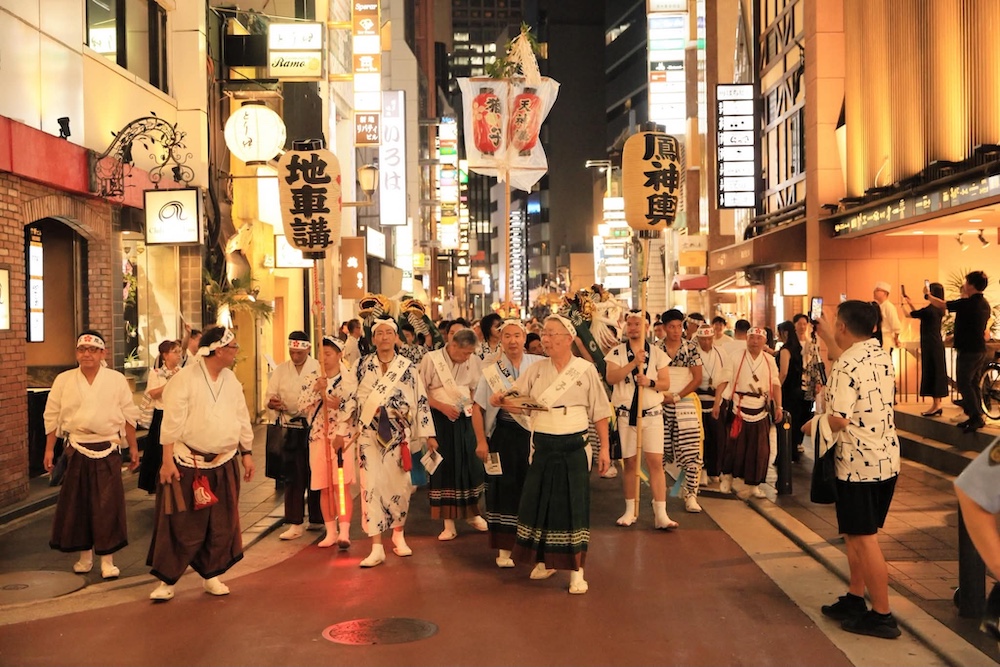
Every July the river through the middle of Osaka fills with lantern-light and drums. This year I went down to watch again, as I have most summers, and stood among the crowd on the bank while the boats of the funatogyo (the boat procession) moved upstream against the dark water.
Earlier in the day the rikutogyo (the land procession) had carried Sugawara no Michizane, the deity at the heart of this festival, out through the streets: three thousand people in Heian court dress, a portable shrine crowned with a phoenix, taiko rolling ahead of it like weather.
All of it to escort one man home for the night. A scholar who has been dead for eleven hundred years.
I looked at the faces around me. Families, office workers still in their shirts, teenagers filming the fireworks on their phones. Somewhere among them stood friends of mine who help organize the festival, who give it weeks of their year.
And I found myself thinking a plain, slightly rude question: does anyone here actually believe that Michizane is coming down the river tonight?
I don’t think so. I don’t think a single person on that bank believes it in the way one believes the train will arrive or the rent is due. And yet there they were. There I was. The Tenjin Matsuri has been performed since the year 951 — one of the oldest festivals in Japan — and it was not being performed by a handful of priests. It was being performed by a city.
Belief had drained out of the rite somewhere over a thousand years, and the rite had not collapsed. That is the thing worth sitting with.

The god who began as a curse
To understand why the question is strange, you have to know who Michizane was, and how he became a god.
He was a real man — a scholar, poet, and minister of the Heian court, born in 845. He rose high, made powerful enemies, and in 901 a rival faction accused him of plotting against the throne. He was exiled to Dazaifu in the far southwest, and he died there two years later, in disgrace, far from the capital he loved.
Then the capital began to suffer. Drought, plague, fire. His accusers died. In the year 930 lightning struck the Seiryōden, the emperor’s own hall, and killed courtiers where they stood. The court read the sky and understood: this was the dead man collecting what he was owed.
Michizane had become an onryō (a vengeful spirit) — one of the three most feared in Japanese history.
So they did what the age did with a furious dead nobleman.
They tried to calm him.
His titles were restored, the order of exile burned, and in time he was enshrined and elevated to a god: Tenman Daijizai Tenjin, lord of thunder.
This is the logic of goryō shinkō (belief in vengeful spirits): a soul wronged in life returns as disaster, and the way to survive it is not to defeat the spirit but to honor it — to promote it, quite literally, into a god.
Here is the part I never fail to find astonishing. That thundercloud of a spirit, enshrined out of fear, slowly became something else. Over centuries the terror faded and the scholar remained, and Michizane settled into his present role: Tenjin, the gentle patron of learning, to whom students across Japan now pray before their exams.
There are more than twelve thousand shrines to him. Children hang wooden plaques asking him for good marks.
They are praying to a man who was deified because the living were afraid of him. Almost no one who prays there knows this. The fear has been forgotten, and the affection has stayed.
The plaque I hung at thirteen
I know those children because I was one of them.
When I was thirteen, sitting for the entrance exam to the school I wanted, my family took me to Osaka Tenmangū — Michizane’s shrine, the heart of this whole festival — to hang an ema (a small wooden votive plaque), asking to pass.
I remember writing my wish on the wood. I also remember what I privately thought, because I was a certain kind of boy: If hanging a plaque got you into school, everyone would get in. All these plaques, and only some of us pass. So the plaque does nothing.
I was not wrong about the mechanics. The plaque does nothing to the exam.
But I have carried that morning for fifty years now, and I understand it differently. The plaque was never a lever on the outcome. It was a way of setting something down. I had studied as much as I was going to study; the exam would do what it would do. Hanging the ema drew a line under the effort and handed the rest over. Whatever happens now, I have done my part, and I will take the result cleanly. It was, I think, a small rite of finishing — a way to stop carrying what I could no longer change.
The plaque’s uselessness and its usefulness are the same fact seen from two sides. Had I believed the wood could pass me, it would have closed nothing — I’d have spent the spring anxiously waiting on it to work. Because I did not believe, it could serve as an ending.
I want to be careful here, because this is the exact place where an essay like this goes wrong. It is tempting to finish the thought and say: so ritual is really just a psychological tool, a commitment device, a tidy way to manage your own anxiety. That explanation is clean, and I distrust it.
It is the same move that has hollowed out meditation in the West — the reduction of something old and strange into a technique for self-improvement, a productivity hack with incense. If the ema were only a private mind-trick, I could have written my wish on any scrap of paper at my desk. I did not. I took it to a shrine, to a particular dead man, and hung it where he could see it.
You already do this
Whenever I raise this with Western friends, I watch them reach for the word hypocrisy, or at least inconsistency. If you don’t believe, why perform? Isn’t the honest thing to stay home?
But scholars of religion have a useful distinction here: orthodoxy versus orthopraxy. Orthodoxy asks what you believe. Orthopraxy asks what you do. Much of Japanese religious life runs on the second and is largely indifferent to the first — the practice is the point, and the metaphysics behind it is left politely unexamined.
And once you see it that way, the Western reader stops being an outsider to this. You may not believe a word of the liturgy yet still stand for a funeral. You may keep no faith at all and still put up a tree in December, still say “bless you” to a stranger’s sneeze, still touch the mezuzah, still not walk over a grave. None of these survive because the people performing them have checked the doctrine and found it sound. They survive as things done, and the doing carries a meaning the believing has long since stopped supplying.
The Tenjin Matsuri is not a Japanese mystery, then. It is the same human act you already perform — only here it is done by an entire city, out loud, on the river, without embarrassment, and without interruption since the tenth century.
Neither believed nor denied
So what is left, if not belief?
Standing on that bank, I don’t think what moved through the crowd was faith in Michizane’s return. Nor was it mere fondness, or gratitude, or civic pride, though all of those were in the air. It was something with no clean name — a low, steady sense that someone, somewhere, is watching. The god, the ancestors, the dead we owe. Not a proposition anyone would defend in daylight. Not a proposition anyone would deny, either.
This is the register I find most honest and hardest to translate. It is not belief. It is not disbelief. It is a relationship held deliberately at low intensity, never forced to resolve into true or false. My friends who carry the shrine do not believe a spirit rides in it. They also do not, for one second, treat it as an empty box.
This is my own reading, and I offer it as that. But I suspect this is what a culture gains when it declines to demand that its rituals be literally true: it gets to keep the relationship without paying for it in belief. The dead are not argued about. They are attended to.
What the refusal shaped
There is a habit of mind underneath all this, and I think it has shaped the people it raised — including me.
Much of the world, faced with the dead and the divine, wants a verdict. Is it real or not; do you believe or not; draw the line and stand on one side of it.
That instinct built extraordinary things — theology, law, science. It is also the same instinct that meets grief with the demand to reach “closure,” to settle the account with the dead and move on.
Japan, on this one matter, mostly declined to draw the line. Nobody quite settled whether Michizane is a god or a ghost or a great man remembered, and nobody convened the trial that would decide it. The question was left open on purpose, and a thousand-year festival grew in the space the open question left.
I don’t offer this as proof that one way is wiser. I only notice what it seems to have made: people who can hold a thing unresolved without needing to resolve it — who can keep the dead close without deciding exactly what the dead now are.
I still cannot tell you where devotion ends and habit begins, or where a ghost becomes a god. I have been standing in these shrines my whole life and the line has never once shown itself to me. For a long time I took that as a failure of understanding on my part. Now I am not so sure the line is there to be found.
The boats came up the river, the drums went on, and the crowd stayed to the last of the fireworks. No one was waiting to be told what any of it meant. They had come to do it, and they did it, and the doing was enough.
I went home. Nothing was proven. But something had moved, quietly, and it is moving still.
Never Miss an Update
New articles and exclusive cultural insights are announced first on LinkedIn. If you want to keep expanding your understanding of Japanese philosophy and modern resilience, let’s stay in touch.
[Follow My LinkedIn Profile Here]
If this article brought a moment of peace or insight to your day, consider supporting my work.
Thank you.