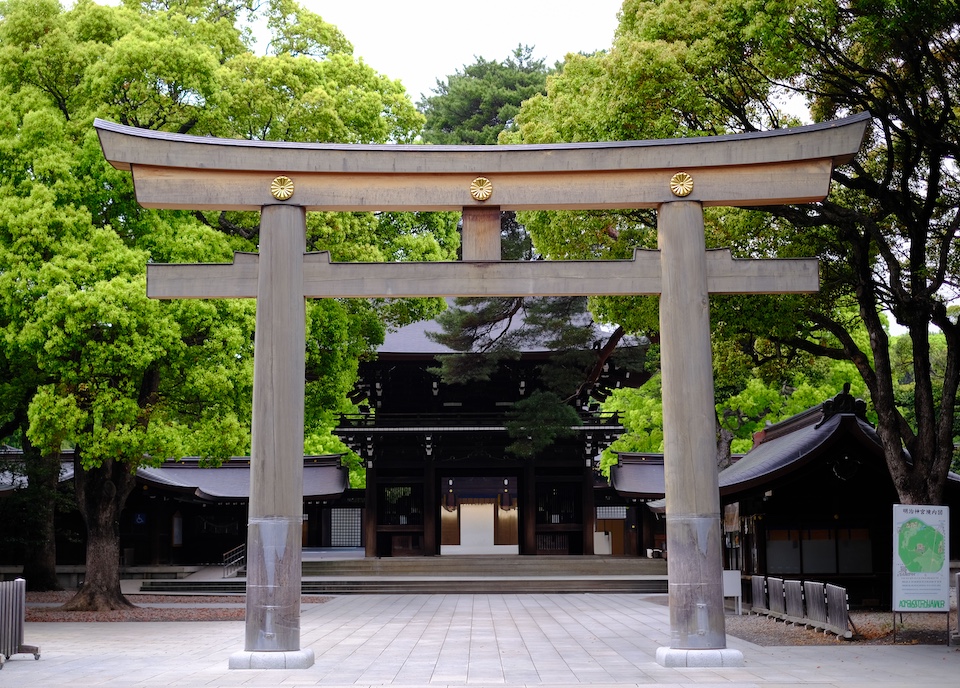
Ask a Japanese person what Shinto is and watch what happens. There will be a pause. Then something like, “Well, it’s kind of our tradition,” followed by a vague hand gesture. Ask a follow-up question, and you may get an apologetic smile and a change of subject.
This is not ignorance. Many of these people visit shrines on New Year’s Day, clap their hands in prayer when something big is happening in their lives, and feel genuinely uneasy when a neighborhood shrine is neglected. They practice Shinto. They just cannot put it into a sentence.
I have spent years studying Shinto, Buddhism, and traditional aesthetics in Kyoto. I practice Zen. And I still find the question “What is Shinto?” one of the most difficult to answer honestly, because the honest answer resists the shape that English-language explanations want to give it.
The problem starts with the word “religion”
When an English speaker hears that Shinto is Japan’s indigenous religion, a set of assumptions clicks into place. There must be a founder. There must be a holy book. There must be a set of beliefs you agree to. There must be a clear line between members and non-members.
Shinto has none of these.
There is no founder. There is no single sacred text. There is no creed to recite, no baptism, no conversion process. There is no central authority that decides what Shinto teaches. The Association of Shinto Shrines (Jinja Honchō) coordinates the roughly 80,000 shrines across Japan, but it does not issue doctrine the way the Vatican does for Catholics.
What Shinto has is practices. You visit a shrine. You purify your hands with water at the entrance. You bow, clap, and pray. You tie a paper fortune to a tree branch. You buy a small charm for safe travel or success in exams. You do these things because they feel right, because your grandmother did them, because the shrine has been in your neighborhood for three hundred years and it would feel strange to ignore it.
This is why Japanese people struggle with the question. They are being asked to explain a system that does not work like a system. It works like breathing.
Shinto is older than its own name
The word “Shinto” (神道) literally means “the way of the kami,” but for most of its history, nobody called it that. Before Buddhism arrived from mainland Asia in the sixth century, the Japanese relationship with kami, with sacred places, with ritual purification, simply was. It did not need a name because there was nothing to distinguish it from.
The label “Shinto” was created largely to separate these older practices from the imported Buddhist ones. This is a useful thing to remember: Shinto became a named category partly because someone needed to say, “No, that other thing.”
Before the name, there were people who noticed that certain trees felt different from other trees. That certain rocks or waterfalls or mountains carried a presence. That the boundary between this world and something else was thin in certain places, at certain times. They marked those places. They left offerings. They developed rituals for staying in good relation with whatever was there.
That impulse is older than any organized religion, and it is still the core of what happens at a Shinto shrine today.
What the word “kami” actually means
Any explanation of Shinto runs into trouble the moment you translate kami (神) as “god.” In English, “god” points at a very specific idea: a supreme being, a creator, an all-knowing judge. The Abrahamic God.
Kami is not that.
The eighteenth-century scholar Motoori Norinaga wrote that kami refers to anything that inspires awe, anything that possesses an extraordinary quality beyond the ordinary. A towering cedar tree can be kami. A waterfall can be kami. A mountain. A fox. A deceased ancestor who is felt to watch over the family. Even a particularly impressive person could be spoken of as possessing kami-like qualities.
The number usually cited is “eight million” (yaoyorozu no kami), but this is not a census. It means “too many to count.” The world is full of kami in the same way that a forest is full of life. You do not need to catalog every insect and fungus to know the forest is alive.
This is the single most important thing to understand about Shinto: it is not about believing in the right set of gods. It is about recognizing that the world is alive with presences that deserve respect.
Related: [Eight Million Gods: How Japan Worships Without Conflict]]
The religion that doesn’t ask you to believe
Most religions begin with belief. Do you believe this happened? Do you accept these teachings? Faith comes first, and practice follows.
Shinto works in the opposite direction. Practice comes first. Belief, if it comes at all, arrives later, and it is not required.
Nobody at a Shinto shrine will ever ask what you believe. Nobody will quiz you on theology. The priest (kannushi) performs rituals, maintains the shrine, and serves the kami. Whether you personally believe that kami are real supernatural entities, or simply powerful symbols, or something in between, is entirely your own business.
This confuses Western visitors, who are used to religions that draw a line: you are either in or you are not. Shinto does not draw that line. It simply invites you to participate.
I sometimes think of it this way: Shinto is less like a religion you join and more like a landscape you enter. The shrine is there. The kami are there. You walk through the torii gate, you wash your hands, you bow. Something happens in that process, something shifts in your attention, and that shift is the point. Whether you call it spiritual or psychological or aesthetic is up to you.
Why “non-religious” Japan is actually deeply spiritual
Surveys consistently show that most Japanese people describe themselves as non-religious (mushūkyō). To Western ears, this sounds like Japan is a nation of atheists. It is not.
What Japanese people mean by “non-religious” is closer to “I don’t belong to a specific religious organization” or “I don’t believe in any particular doctrine.” This does not stop them from doing the following, often within the same year:
Visiting a shrine on January 1st (hatsumōde) to pray for a good year. Having their new car blessed by a Shinto priest for traffic safety. Attending a Buddhist temple for a family funeral. Putting up a small Christmas tree in December.
A Western observer might call this inconsistent. A Japanese person would not see any contradiction at all. Each practice serves its moment. The shrine visit is for this-worldly blessings. The funeral is for the transition to the next life. The Christmas tree is fun. None of these require you to sign up for an exclusive package of beliefs.
This is Shinto’s influence, even when people do not use the word. The idea that spiritual practices can coexist, that you can honor kami at a shrine and a Buddha at a temple without choosing sides, runs through Japanese culture like water through sand. You cannot always see it, but it shapes everything.
Related: [Shinto and Buddhism in Japan: Partners, Not Rivals]]
How modern Japanese people live with Shinto every day
If you only look at shrine visits, you might think Shinto is limited to special occasions. It is not. It sits inside daily life in ways that most Japanese people never think to mention, because they have never known anything else.
Jichinsai (ground-breaking ceremony): Before a new house or building goes up, a Shinto priest is often called to purify the ground and ask the kami of the land for permission. Construction companies build this into their standard process. It is not unusual. It is procedure.
Salt at the doorway: After a funeral, family members sprinkle salt on themselves before entering their home. This is not superstition in the way Westerners might understand it. It is a physical gesture that marks the boundary between the space of death and the space of daily life, a way of saying, “I am returning to the ordinary world now.”
Ōsōji (year-end deep cleaning): The intense cleaning that happens across Japan at the end of December is not just hygiene. It carries an echo of harai, purification. You clean the house to sweep away the old year’s accumulated kegare (spiritual heaviness) and welcome the new year fresh.
The kamidana (household shrine shelf): Many Japanese homes, and especially traditional businesses, have a small shelf high on the wall where an ofuda (a paper talisman from a shrine) is placed. The family makes brief offerings there, sometimes daily. It is no more dramatic than checking the mailbox.
None of these practices require theological conviction. They do not ask you to believe anything. They ask you to do something, and in the doing, a particular relationship with the world is maintained.
So what is Shinto, really?
If I had to answer in one sentence, I would say this: Shinto is the Japanese practice of recognizing that the world is alive, and acting accordingly.
It is not a belief system you subscribe to. It is a set of practices that maintain a certain kind of attention. An attention to purity, to boundaries between the sacred and the everyday, to the presence of kami in trees and rivers and mountains, to the ancestors who came before and the connections that hold a community together.
It cannot be explained in a creed because it was never meant to be a creed. It is something you do with your hands and your body and your attention, and it makes sense from the inside in a way that definitions from the outside always miss.
That is why Japanese people struggle to explain it. Not because they do not understand their own tradition, but because the tradition lives below the level of explanation.
Frequently Asked Questions (FAQ)
-
Is Shinto monotheistic or polytheistic?
-
Neither term fits well. Shinto does not have a single supreme god (which would make it monotheistic), but calling it polytheistic suggests a fixed pantheon of named deities, like Greek mythology. Shinto recognizes kami everywhere, in nature, in ancestors, in places. The closest Western concept might be animism, the idea that spirit or sacred power is present throughout the natural world, but even that is only an approximation.
-
Can you be Christian (or Buddhist, or atheist) and still practice Shinto?
-
Yes, and many people do. Shinto does not require exclusive membership. In Japan, it is completely normal for someone to participate in Shinto rituals at a shrine and Buddhist rituals at a temple, sometimes on the same day. Shinto does not ask you to reject any other tradition. It asks you to be present, to purify, and to show respect. What you believe while doing so is your own matter.
-
How many people practice Shinto today?
-
Depending on how you count, the number ranges from about 3 million (people who formally identify as Shinto believers) to over 80 million (people who participate in Shinto practices like shrine visits). The gap between those numbers tells you everything about how Shinto works: most practitioners do not think of themselves as religious, yet they maintain the practices.
If this article brought a moment of peace or insight to your day, consider supporting my work.
Thank you.