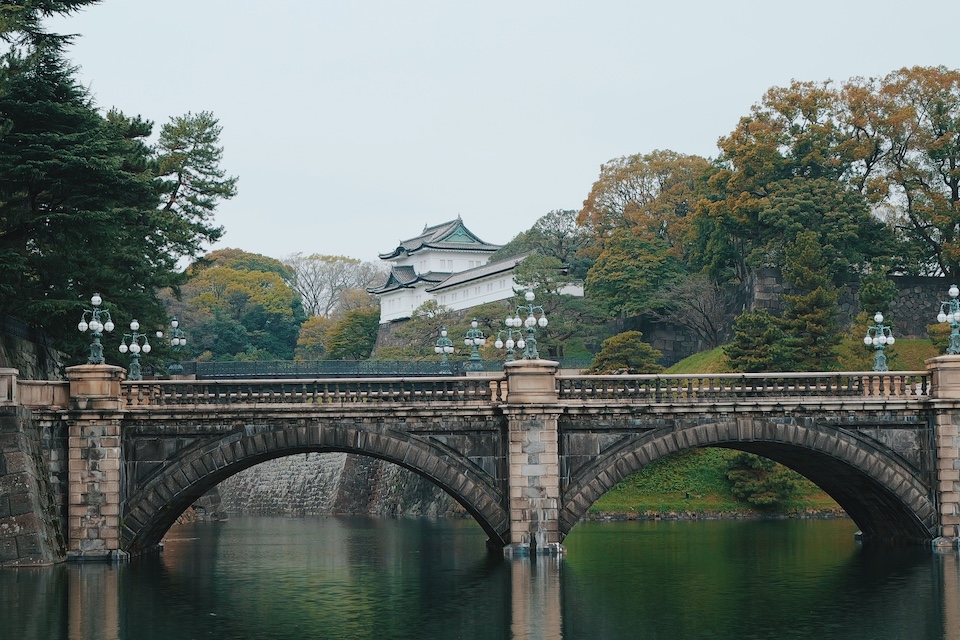
Whether you take that 2,600-year lineage at face value or treat the earliest figures as legendary, the continuity is real and extraordinary. The Chrysanthemum Throne has outlasted every other royal house on the planet. And the reason it has survived, through civil wars, foreign invasions, and the total reorganization of Japanese society, has everything to do with Shinto.
The Emperor is not merely a political figure who happens to be Japanese. He is the highest ritual figure in Shinto, the living link between the kami and the Japanese people. Understanding that connection is essential to understanding both Shinto and Japan.
The mythological foundation
The story begins with Amaterasu Ōmikami (天照大御神), the kami of the sun and the central deity of Shinto.
According to the Kojiki (712 CE) and Nihon Shoki (720 CE), Japan’s oldest historical chronicles, the Japanese islands were created by the divine couple Izanagi and Izanami. After Izanami’s death, Izanagi performed a purification, and from this purification three kami were born: Amaterasu from the washing of his left eye, Tsukuyomi (the moon kami) from his right eye, and Susanoo (the storm kami) from his nose.
Amaterasu was given dominion over the heavens. Her grandson, Ninigi no Mikoto, was sent down to earth to rule the Japanese islands. Ninigi’s great-grandson, Jimmu, became the first Emperor.
This makes the Imperial family, in Shinto mythology, direct descendants of the sun goddess. The Emperor’s legitimacy is not based on military conquest, democratic election, or feudal land ownership. It is based on divine ancestry. The Emperor is the head of the nation because the sun goddess is the ancestor of the Imperial line, and the sun goddess is the supreme kami of Shinto.
The Emperor as priest
What most foreign observers miss is that the Emperor’s primary role, historically and even today, is not political. It is ritual.
The Emperor performs Shinto ceremonies throughout the year. These ceremonies are private, conducted within the Imperial Palace precincts, and are rarely covered by media. Most Japanese citizens are only vaguely aware that they happen.
The most important annual ritual is the Niiname-sai (新嘗祭), the harvest thanksgiving ceremony, held each November. The Emperor personally makes offerings of newly harvested rice to Amaterasu and other kami, giving thanks for the harvest and praying for the prosperity of the nation.
When a new Emperor ascends the throne, a more elaborate version called the Daijō-sai (大嘗祭) is performed. This is the single most important ceremony in the Imperial transition. The Emperor enters a specially constructed hall at night, makes offerings to the kami, and, according to tradition, spends the night in communion with Amaterasu. The exact nature of what occurs inside is not publicly disclosed.
The Daijō-sai for Emperor Naruhito was performed in November 2019, at a cost of approximately 2.7 billion yen. The ceremony drew attention because it was the first Imperial transition in over 200 years to occur through abdication rather than death (Emperor Akihito abdicated in April 2019).
State Shinto: When religion became politics
The connection between the Emperor and Shinto was transformed in the Meiji era (1868-1912) into something very different from what it had been before.
For most of Japanese history, the Emperor was a ceremonial and ritual figure. Real political power was held by shoguns, regents, and military rulers. The Emperor prayed, performed rituals, and legitimized the authority of whoever was actually governing. This arrangement lasted, with variations, for roughly a thousand years.
The Meiji Restoration of 1868 changed everything. The new government dismantled the shogunate and placed the Emperor at the center of a modern nation-state. Shinto was reorganized into a state religion (kokka shintō, 国家神道) designed to unify the nation under Imperial authority.
State Shinto elevated the Emperor from a ceremonial figure to a living god. Schoolchildren were taught that the Emperor was divine. Shrine visits became expressions of patriotic duty. The mythology of Amaterasu and Jimmu was taught as historical fact. Questioning the Emperor’s divinity was, in the most extreme periods, treated as thought crime.
This fusion of religion and nationalism had devastating consequences. State Shinto provided the ideological framework for Japanese militarism in the 1930s and 1940s. Dying for the Emperor was framed as a sacred act. Conquered peoples were forced to worship at Shinto shrines. The kamikaze pilots were, as their name (“divine wind”) suggests, embedded within a Shinto-nationalist mythology.
It is impossible to discuss Shinto and the Emperor honestly without acknowledging this history. State Shinto was not a natural outgrowth of traditional Shinto practice. It was a political construction, a deliberate instrumentalization of religious symbolism for national purposes. But it used Shinto’s real elements (the mythology, the rituals, the emotional connection between the people and the kami) to achieve political ends, and the damage was real.
The postwar transformation
After Japan’s defeat in 1945, the Allied Occupation under General Douglas MacArthur moved quickly to dismantle State Shinto.
The most dramatic moment came on January 1, 1946, when Emperor Hirohito issued what is known in English as the “Humanity Declaration” (ningen sengen, 人間宣言). In this statement, the Emperor denied his own divinity, saying that the relationship between Emperor and people was not based on the myth that the Emperor was a living god.
The new postwar constitution, adopted in 1947, established several key principles. The Emperor became a “symbol of the state,” with no political power. The separation of religion and state (seikyō bunri, 政教分離) was enshrined in law. Government funding of religious organizations, including Shinto shrines, was prohibited.
These changes fundamentally altered the Emperor’s position. He continued to perform Shinto rituals within the Imperial Palace, but these were classified as private religious observances, not state functions. The Emperor could pray to Amaterasu, but the government could not require anyone else to.
The Emperor today
Emperor Naruhito, who ascended the throne in 2019, occupies a unique position. He is the head of an institution that is simultaneously the oldest monarchy in the world, the symbolic center of Shinto, and a constitutional figurehead with no political authority.
In practice, the Emperor’s public role involves ceremonial duties: receiving foreign dignitaries, opening sessions of the Diet (parliament), and attending state functions. He and the Empress participate in public events related to disaster relief, cultural preservation, and international goodwill.
Behind the scenes, the Emperor continues to perform the annual cycle of Shinto ceremonies. The Niiname-sai, the seasonal festivals, the prayers for the nation’s well-being. These rituals are conducted by the Emperor personally, assisted by the shrine staff of the Imperial household.
There is something quietly remarkable about this. While the political system has changed entirely, while the mythology of divine descent has been publicly disavowed, the ritual practice continues. The Emperor of Japan still stands before the kami, makes offerings of rice, and prays for the country. He does so not because the law requires it, but because the tradition does.
The uncomfortable questions
Any honest discussion of the Emperor and Shinto must address several uncomfortable topics.
Yasukuni Shrine. This Tokyo shrine, dedicated to Japan’s war dead, includes among its enshrined spirits fourteen Class A war criminals from World War II. Whether the Emperor or the Prime Minister should visit Yasukuni is one of the most politically charged questions in Japan, and it directly involves the intersection of Shinto practice and political symbolism. Imperial visits to Yasukuni effectively ceased after the 1978 enshrinement of the war criminals, and neither Emperor Akihito nor Emperor Naruhito has visited.
Gender and succession. Current law (the Imperial Household Law) permits only male-line succession. Emperor Naruhito has one daughter, Princess Aiko, but no sons. His younger brother, Prince Fumihito, and Fumihito’s son, Prince Hisahito, are the current heirs. Whether to allow female succession is a subject of ongoing public debate, but no legal change has been made.
The cost of ritual. The Daijō-sai ceremony in 2019 cost approximately 2.7 billion yen of public funds. Critics argued that using tax money for a Shinto religious ceremony violated the separation of religion and state. Supporters argued that the ceremony was a legitimate part of the Imperial succession, inseparable from the institution itself.
These questions have no easy answers, and I will not pretend to offer them. They are, in a sense, the unresolved tensions that emerge when an ancient religious tradition meets a modern democratic state. How much of the Emperor’s Shinto role should be preserved? How much should be reformed? Where is the line between cultural heritage and state religion?
Why it still matters
A visitor to Japan might spend two weeks in Tokyo, Kyoto, and Osaka without thinking about the Emperor once. He is not on television giving speeches. He is not making policy decisions. His face is not on the currency (historically, Japanese banknotes have featured other figures).
And yet the institution persists, and it persists because the connection between the Emperor, Shinto, and the Japanese people runs deeper than politics. It is a connection to the land, to the ancestors, to the mythological origins of the country itself. Even people who are completely secular, who never visit shrines and do not think about kami, feel something when they see the Emperor performing a ceremony in his white robes. It is not worship. It is recognition. A sense that something very old is still here, still functioning, still connecting the present to a past that extends beyond historical memory.
Whether that feeling is a healthy cultural inheritance or a residue of dangerous nationalism depends entirely on what is done with it. Japan’s postwar history suggests that the answer can be both, depending on the decade and the question.
What Shinto offers to this conversation, the oldest Shinto, the pre-State Shinto, is a reminder that the Emperor’s connection to the kami was originally not about power. It was about service. The Emperor prayed for the harvest. He maintained the rituals that kept the community in right relation with the kami. His role was priestly before it was political.
Recovering that understanding, separating the ritual from the nationalism, the service from the authority, is perhaps the most important work that Shinto and Japan’s Imperial institution face in the century ahead.
Frequently Asked Questions (FAQ)
-
Is the Japanese Emperor considered divine today?
-
No. Emperor Hirohito explicitly denied his divinity in January 1946. The postwar constitution defines the Emperor as a “symbol of the state and of the unity of the people,” with no political authority and no claim to divine status. The Emperor continues to perform Shinto rituals as private religious observances, but these are not treated as evidence of divinity.
-
How does the Japanese Imperial family compare to European royal families?
-
European monarchies historically derived their authority from a combination of military power, feudal land ownership, and the blessing of the Christian church (the “divine right of kings”). The Japanese Emperor’s authority is rooted specifically in Shinto mythology, the claim of descent from Amaterasu. Unlike most European royal families, the Japanese Imperial line has never been overthrown or replaced by a different dynasty, though the Emperor’s actual political power has fluctuated dramatically over the centuries.
-
Why is the Imperial chrysanthemum emblem significant?
-
The sixteen-petal chrysanthemum (kikumon, 菊紋) has been the symbol of the Japanese Imperial family since the thirteenth century. It appears on the Japanese passport, on the Diet building, and on various government documents. In Shinto context, the chrysanthemum is associated with longevity and renewal, fitting for an institution that emphasizes continuity across generations. The Imperial chrysanthemum is legally restricted from unauthorized commercial use, making it one of the most protected symbols in Japan.
If this article brought a moment of peace or insight to your day, consider supporting my work.
Thank you.