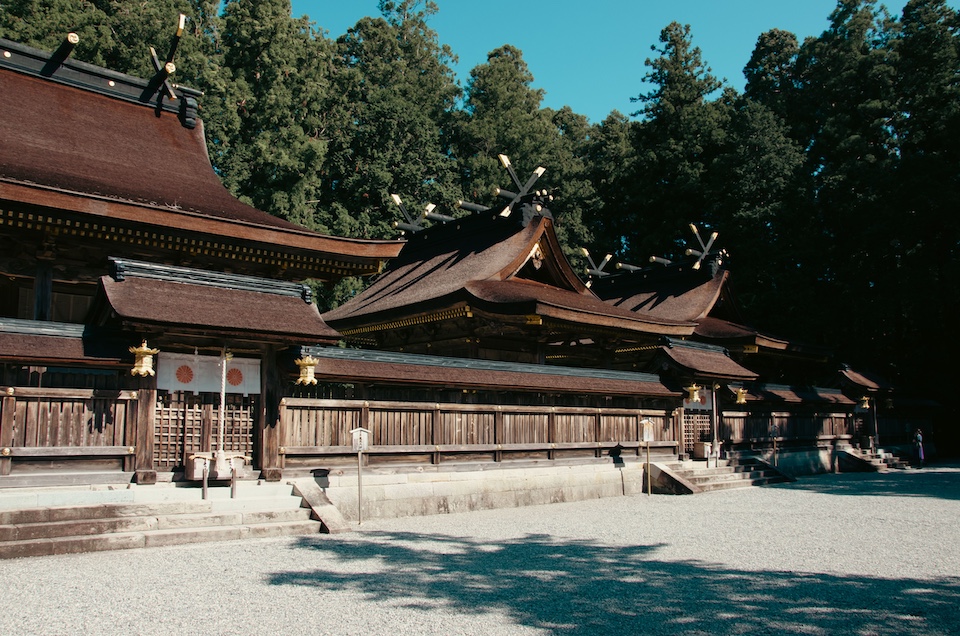
Every twenty years, the empty lot becomes the site of a new building, constructed from scratch using the same design, the same techniques, and the same type of Japanese cypress (hinoki) as the one beside it. When the new building is complete, the kami is ritually moved from the old to the new. The old building is then disassembled, and its timber is distributed to other shrines across Japan for use in repairs and reconstruction. The lot where it stood is cleared, purified, and left to rest for the next twenty years.
This cycle is called shikinen sengū (式年遷宮), and it has been performed at Ise Grand Shrine (Ise Jingū) for over 1,300 years. The most recent ceremony took place in 2013. The next is scheduled for 2033.
To a Western mind trained to value preservation, this seems like an extraordinary waste. Why tear down a perfectly good building? Why not maintain it, reinforce it, and let it accumulate the patina of age that makes European cathedrals and ancient temples feel so powerful?
The answer tells you something fundamental about how Japan thinks about time, permanence, and what it means for something to last.
The Western instinct: preserve forever
Western civilization is built, literally, on stone. The Parthenon. The Colosseum. Notre-Dame. Chartres Cathedral. The Tower of London. These structures were designed to endure, and enormous effort has been spent keeping them standing. When Notre-Dame burned in 2019, the reaction was immediate grief, followed by a massive campaign to restore it as closely as possible to its pre-fire state.
The underlying assumption is clear: old things are valuable because they are old. The original stones, the original beams, the original glass carry the weight of history. They are witnesses. Replacing them with new materials, even identical new materials, would lose something essential.
This is a coherent and beautiful philosophy. But it is not the only one.
The Japanese instinct: renew forever
Ise Grand Shrine is dedicated to Amaterasu Ōmikami, the kami of the sun and the ancestor of the Imperial family. It is the most sacred site in Shinto. And it has been deliberately destroyed and rebuilt at least sixty-two times.
The buildings at Ise are made entirely of wood. Unpainted Japanese cypress, with a thatched roof of miscanthus grass. No nails. No paint. No varnish. The architectural style is called shinmei-zukuri, and it is the oldest known form of shrine architecture in Japan, predating continental Buddhist influence.
Wood does not last the way stone does. Left alone, a wooden building in Japan’s humid, typhoon-prone climate would deteriorate within decades. But the point of shikinen sengū is not that the wood cannot last. It is that it should not.
The philosophy behind the cycle is layered, and no single explanation captures all of it. But several threads are worth following.
Thread one: Eternal freshness
In Shinto, purity is paramount. The kami should be housed in a space that is clean, fresh, and vital. A brand-new building, made from fresh timber, with pristine thatch and unweathered pillars, is a purer dwelling than a twenty-year-old structure, no matter how well maintained.
This is not about dirt or structural integrity. It is about vitality. In the same way that misogi (purification under a waterfall) restores a person’s spiritual freshness, the shikinen sengū restores the shrine itself. The cycle of decay and renewal is not a problem to be solved. It is the natural rhythm of the world, honored rather than resisted.
Thread two: Transmitting craft
Rebuilding the shrine every twenty years means that every generation of carpenters, thatchers, and metalworkers gets to practice the full construction process. If the shrine were built once and preserved, the skills needed to build it would eventually be lost. There would be no one left who had actually shaped a pillar, fitted a joint, or layered a thatched roof.
Twenty years is roughly the span of one working generation. A young apprentice who participates in one rebuild will be a master craftsman leading the next one. The skill passes through hands, not through books. The building is, in a sense, a living textbook. Each rebuild teaches the next generation how to make the next rebuild.
This is strikingly practical. Japan sits in an earthquake zone. It faces typhoons, volcanic eruptions, and fires. The ability to rebuild from scratch is not an abstract philosophical position. It is a survival strategy. When the Great East Japan Earthquake hit in 2011, or when fires destroyed castle towns in earlier centuries, the knowledge of how to build with traditional techniques was what allowed communities to rebuild.
Thread three: Nothing is permanent (and that is fine)
The deepest thread connects shikinen sengū to a concept that runs through Japanese aesthetics and philosophy: mujō (無常), impermanence.
All things change. All things pass. The cherry blossom is beautiful precisely because it falls. The tea ceremony is beautiful precisely because this gathering will never happen again. The shrine is beautiful precisely because it is temporary.
This is not a pessimistic idea, though it is often misread that way by Western interpreters who encounter it through Buddhist texts about suffering. In the context of Shinto and Japanese aesthetics, impermanence is simply a fact about the world. Resisting it, trying to make things permanent, is what causes suffering. Accepting it, and even celebrating it, is what creates beauty.
The shrine at Ise embodies this acceptance in physical form. It says: we know this building will not last forever. We are not going to pretend otherwise. Instead, we will build it again. And again. And again. The design endures. The craft endures. The relationship with the kami endures. The building itself is allowed to come and go, like a breath.
The economics and logistics of a 1,300-year tradition
Shikinen sengū is not a small project. The most recent rebuild, completed in 2013, took eight years of preparation and construction, involved thousands of workers, and cost an estimated 55 billion yen (roughly 500 million USD at the time).
The timber comes from forests managed specifically for this purpose. Ise Jingū maintains its own forest reserves, where cypress trees are planted and harvested on cycles calibrated to the twenty-year rebuild. Some of the trees used in the reconstruction are 200 years old. The planning horizon for the timber alone extends centuries into the future.
The tools used are traditional. Many of the techniques cannot be replicated with modern power tools because the wood responds differently to machine cutting than to hand cutting. The carpenters (miyadaiku, 宮大工) who work on Ise are among the most skilled craftspeople in Japan, and the project represents the pinnacle of their profession.
Every item used in the shrine, from the textiles to the metalwork to the sacred treasures housed inside, is also remade from scratch. Over 700 items of art, craft, and ritual equipment are recreated for each shikinen sengū, ensuring that traditional production techniques survive.
What happens to the old timber?
When the old shrine is disassembled, the wood does not go to waste. Timber from the inner shrine (naikū) and outer shrine (gekū) is sent to shrines across Japan for use in torii gates, fences, and buildings. The Ujibashi, the bridge that crosses the Isuzu River at the shrine entrance, is also rebuilt every twenty years, and its old timber is recycled in the same way.
This distribution network means that pieces of Ise’s sacred cypress end up embedded in shrines throughout the country. A torii gate at a small countryside shrine might be made from wood that once housed Amaterasu. The material disperses, carrying a trace of the center to the periphery, binding the network of shrines together through shared substance.
Stone versus wood: Two philosophies of time
The difference between Ise Grand Shrine and Notre-Dame is not just a difference in building materials. It is a difference in how two civilizations relate to time.
The stone cathedral says: I will stand against time. I will resist change. My endurance is the proof of my value.
The wooden shrine says: I will move with time. I will change by being renewed. My continuity is in the pattern, not in the material.
Both are valid responses to the same problem: how do you make something last? One answer is to build it so strong that time cannot destroy it. The other is to build it so that it can be reborn.
As a designer, I find the second answer fascinating because it separates the design from the object. The shrine at Ise is not a building. It is a set of instructions for making a building. The instructions are what endure. The physical structure is a temporary expression of them, like a performance of a piece of music. The score survives. Each performance is unique and transient.
What visitors experience at Ise today
If you visit Ise Grand Shrine, you will not see the inner sanctuary. It is hidden behind multiple layers of fencing, and only the Imperial family and the highest Shinto priests are permitted inside.
What you will see is the approach: a long walk through a forest of enormous cedars and cypresses, across the Ujibashi bridge, past formal gates and curtains, toward a set of thatched roofs that rise above the innermost fence. The buildings are small compared to European cathedrals or even some other Japanese shrines. There is no gold, no paint, no ornamentation. Just wood, thatch, and the simplest possible architectural forms.
The experience is one of subtraction rather than addition. The further you walk, the quieter everything gets. The forest absorbs sound. The architecture offers nothing to grab your attention. There is nothing spectacular to photograph. What remains, after everything extra has been stripped away, is a quality of attention that is difficult to describe and impossible to fake.
That quality is what shikinen sengū protects. Not a building. A relationship.
Frequently Asked Questions (FAQ)
-
When is the next shikinen sengū?
-
The next shikinen sengū is scheduled for 2033, twenty years after the most recent ceremony in 2013. Preparation work typically begins about eight years in advance, so initial activities are already underway. The public transfer ceremony, when the kami is moved from the old building to the new, is a major event, though access to the innermost areas remains restricted.
-
Can tourists visit Ise Grand Shrine?
-
Yes. The outer areas of both the inner shrine (naikū) and the outer shrine (gekū) are open to the public year-round, free of charge. The inner sanctuary is not accessible to the general public, but the forest paths, bridges, and outer shrine buildings create a complete and powerful experience. Ise is about three hours from Osaka or two hours from Nagoya by train.
-
Is Ise the oldest shrine in Japan?
-
Ise is the most sacred shrine in Shinto, but calling it the “oldest” is complicated by the fact that the buildings are rebuilt every twenty years. The tradition of worship at the site dates back over 2,000 years, making it one of the oldest continuously venerated sacred sites in Japan. In terms of physical structure, the current buildings are always less than twenty years old. This paradox, ancient practice in a perpetually new building, is precisely the point.
If this article brought a moment of peace or insight to your day, consider supporting my work.
Thank you.