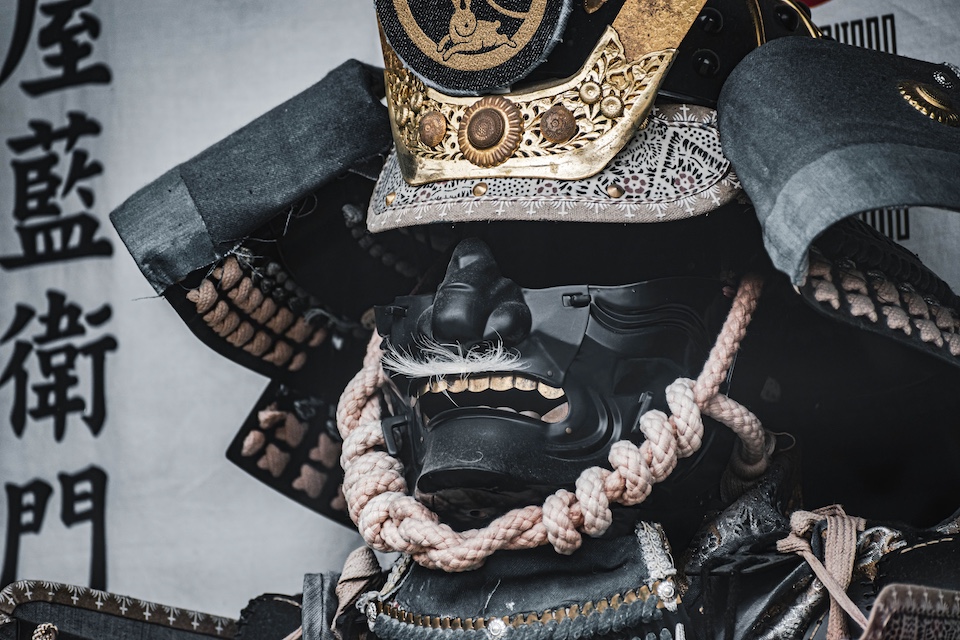
Most of the things that made Bushido specific to its time no longer exist. There are no feudal lords to serve unto death. There is no sword that must be maintained as a matter of personal honor. The particular social structure that gave Bushido its shape — rigid hierarchy, lifelong service to a single lord, the samurai class as a distinct caste — disappeared with the Meiji Restoration in the 19th century.
And yet Bushido continues to attract serious attention in Japan and, increasingly, outside it. The reason is not nostalgia. It is that the inner disciplines Bushido cultivated are not dependent on the social structure that originally housed them. The virtues remain interesting precisely because they are portable — they can be practiced without a sword, without a lord, and without any connection to medieval Japan.
In 1900, the diplomat and writer Nitobe Inazo published Bushido: The Soul of Japan in English, for a Western audience. He identified seven core virtues at the heart of the samurai code. His framing was deliberately comparative — he wanted to show that Japan had its own tradition of ethics and honor that could stand alongside Western moral philosophy. The book shaped how the West came to understand Bushido, and its seven virtues remain the clearest entry point for anyone approaching the tradition today.
The Seven Virtues: What They Actually Ask
1. Gi (義) — Righteousness
Gi is sometimes translated as justice, but the core meaning is closer to doing what is right, as opposed to what is convenient, profitable, or socially expected. In Bushido, the samurai who acted from gi did the right thing regardless of whether it was observed, rewarded, or even understood by others.
The practical application is simpler than it sounds: it is the difference between behavior that changes depending on who is watching and behavior that does not. Most people have a somewhat higher standard when they know they are being evaluated. Gi demands the same standard when the meeting is over, when no one is looking, and when the correct action costs you something.
In contemporary professional contexts, this shows up most clearly in the small decisions that no one will audit: the honest assessment of a project that is going wrong, the credit given to a colleague whose contribution might otherwise go unnoticed, the admission that you do not know something you are expected to know.
2. Yu (勇) — Courage
Yu in Bushido is not recklessness. The samurai tradition distinguished between the courage that acts correctly in the face of fear and the bravado that does not fear in the first place because it has not understood the situation. True yu requires first seeing clearly what the situation is — including what is genuinely at risk — and then acting correctly anyway.
The Hagakure would add that the deepest form of yu is not the courage to face an enemy in battle but the courage to tell your lord something he does not want to hear. Flattery is easy. Honest counsel to someone with power over you requires a different kind of nerve.
This maps directly onto contemporary contexts: the willingness to raise a concern in a meeting where everyone else is agreeing, to give feedback that is true rather than comfortable, to challenge a decision that is wrong even when the person making it has authority. These are small acts of yu, and they are rarer than they should be.
3. Jin (仁) — Benevolence
Jin is the Confucian concept of benevolence or human-heartedness — the genuine care for other people that moderates the harder edges of a warrior code. Without jin, righteousness becomes harshness and courage becomes cruelty. Jin is what makes the other virtues livable, for both the person practicing them and the people around them.
In Bushido, jin was particularly associated with the treatment of opponents and the weak. A warrior who was technically skilled but without benevolence was, in the Bushido framework, a danger rather than a virtue. Power without care for those it affects is not a samurai ideal. It is its failure.
For a modern reader: jin is the willingness to attend to the actual human situation of the people you work and live with, not only to your objectives in relation to them. It is the difference between treating people as the roles they occupy and treating them as people.
4. Rei (礼) — Respect and Courtesy
Rei is the visible expression of inner respect — the forms and rituals that make the social world work. In Japanese culture generally, and in Bushido specifically, rei is not superficial formality. It is the external manifestation of an internal attitude: the recognition that others have dignity that deserves acknowledgment.
The samurai who was internally respectful but who expressed it carelessly — through inattention to form, through the kind of casual rudeness that is often excused in the West as “just being direct” — was not fully practicing rei. The form matters because it is how the inner attitude reaches another person.
Contemporary application: the quality of attention you bring to how you greet someone, how you enter and leave a room, how you respond to communications that deserve a response. None of this is the most important thing in the world. But the aggregate of these small choices creates the environment other people experience around you, and rei insists that this environment is your responsibility.
5. Makoto (誠) — Sincerity and Honesty
Makoto is perhaps the most demanding of the seven virtues in practice. It means that your words and your actions are consistent — that you do not say things you do not mean, and that what you say you will do is what you actually do. In Bushido, a samurai’s word was his bond. No written contract was necessary because the word of a person with makoto was sufficient.
The contemporary standard is more modest than this, and perhaps more achievable: simply that you mean what you say and say what you mean, that commitments are kept, and that when they cannot be kept you say so immediately and honestly rather than managing the appearance of keeping them.
What makoto does not permit is the kind of managed communication that has become standard in most professional environments — where what is said is carefully calibrated to produce a desired impression rather than to accurately represent reality. The gap between managed communication and makoto is usually visible to the people on the receiving end, even when they cannot name it.
6. Meiyo (名誉) — Honor
Meiyo in Bushido had both internal and external dimensions. The external dimension — reputation — mattered because the samurai existed within a social world where others’ perception of his character had real consequences for his lord as well as himself. The internal dimension — the standard he held himself to — was primary.
The version of honor most relevant to a contemporary reader is the internal one: the sense of self that does not depend on external validation, but that also cannot be bought off. The person with meiyo knows when they have fallen short of their own standard, regardless of whether anyone else notices. They cannot convince themselves, through rationalization, that something they know was wrong was actually fine.
This is psychologically demanding. The capacity to be honest with yourself about the gap between what you did and what you knew you should have done, without either excessive self-punishment or the kind of rationalization that makes the gap disappear, is something Bushido training was explicitly designed to cultivate.
7. Chugi (忠義) — Loyalty
Chugi is the virtue most specific to Bushido’s feudal context, and the one that requires the most translation to remain useful outside it. In the samurai world, loyalty was owed to one’s lord, and it was the organizing principle around which the other virtues were expressed.
In a contemporary context, the relevant form of loyalty is not to an institution or a title but to the people and commitments that define your actual obligations. Loyalty to a team, to the people who depend on you, to a shared project — these are real forms of chugi that do not require a feudal lord. What Bushido emphasizes is that this loyalty is not contingent on outcomes. You do not perform loyalty when it is convenient and withdraw it when circumstances change. Loyalty, in the Bushido frame, is a quality of how you show up, not a calculation you perform.
Zen as the Foundation: Why the Inner Work Matters
The seven virtues are the structure. Zen is the foundation.
The samurai’s engagement with Zen was not primarily spiritual in the sense of seeking enlightenment. It was practical: Zen training produced a specific quality of mind — calm, unattached, fully present — that made all the other virtues possible at their highest level.
A person practicing gi under pressure, or yu in a genuinely difficult situation, or makoto when the truth is unwelcome — the capacity to do those things consistently depends on a mind that is not being driven by fear, by the desire for approval, or by attachment to a particular outcome. That quality of mind does not arise automatically. It is trained.
You do not need to practice Zen to benefit from this insight. But Bushido is asking something that cannot be satisfied by learning the seven virtues intellectually and trying to apply them. It requires, as Musashi would say, the cultivation of heijosin — the ordinary mind that holds steady regardless of what the situation is. That is an inner practice, not an outer technique.
What Bushido Is Not
Before closing, two things Bushido is sometimes mistaken for:
It is not a productivity system. The contemporary Western market for samurai-influenced content often frames it as a framework for performance, efficiency, and competitive advantage. This misses what Bushido is actually about. The goal of Bushido is not to perform better in the sense of producing more output. It is to become a particular kind of person — one whose actions are grounded in virtue rather than in calculation of advantage. Performance is a downstream effect, not the point.
It is not nostalgia for a simpler time. Bushido developed in and for a specific historical context that was not simple, was not egalitarian, and produced real suffering alongside its ideals. Taking the philosophical core seriously does not require romanticizing the historical reality.
Frequently Asked Questions (FAQ)
-
Is practicing Bushido cultural appropriation for a non-Japanese person?
-
The same answer applies here as to Japanese aesthetics more broadly: genuine engagement with the ideas — their history, their philosophical roots, what they actually demand — is different from surface borrowing. Nitobe Inazo wrote Bushido: The Soul of Japan specifically for a Western audience, explicitly comparing its virtues to Christian and Stoic traditions. He wanted the ideas to travel. Engaging seriously with what Bushido asks of a person, without appropriating the cultural forms (dress, ceremony, martial arts you have not trained) for aesthetic purposes, is generally received in Japan as appreciation rather than appropriation.
-
Are there practical exercises for cultivating Bushido virtues, or is it purely conceptual?
-
Several traditional practices are associated with the cultivation of Bushido’s inner qualities. The martial arts (budo) — kendo, judo, aikido, kyudo — were explicitly designed not only as combat techniques but as paths of self-cultivation. The emphasis in these arts on form, etiquette, and the mental state brought to practice is the Bushido framework in a living context. Beyond martial arts, the death meditation from the Hagakure — spending a few minutes each morning with the genuine acceptance that today might be your last day — is a concrete practice that requires no equipment. Journaling specifically about where your actions fell short of your own stated values (the meiyo and makoto virtues) is another.
-
How is Bushido different from Stoicism, which has become popular in the West?
-
There are real similarities. Both traditions emphasize discipline over comfort, clarity about what is and is not within your control, the importance of acting virtuously regardless of outcome, and the use of mortality contemplation as a grounding practice. The main differences are in their emotional registers and their social context. Stoicism tends toward a kind of rational detachment — the cultivation of equanimity through correct philosophical understanding. Bushido is more embodied — the training is in the body and in repeated practice, not primarily in philosophical argument. And Bushido is oriented toward the social world of obligations and relationships in a way that Stoicism is not. A Stoic sage might withdraw from the world. A samurai with Bushido virtues is precisely in the world — in service, in relationship, in the full complexity of social obligation.
Never Miss an Update
New articles and exclusive cultural insights are announced first on LinkedIn. If you want to keep expanding your understanding of Japanese philosophy and modern resilience, let’s stay in touch.
[Follow My LinkedIn Profile Here]
If this article brought a moment of peace or insight to your day, consider supporting my work.
Thank you.