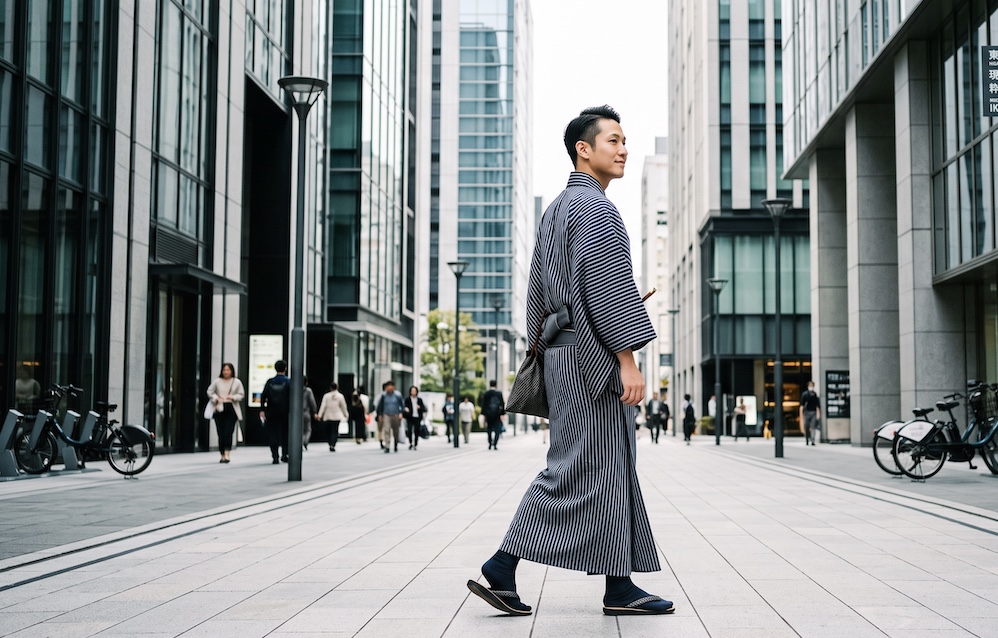
Someone walks into a room. Their clothes are understated — nothing loud, nothing expensive-looking, nothing that announces itself. But the way they move, the way they hold themselves, the ease with which they seem to occupy their own space — something about them draws attention without demanding it. They seem interested in the conversation but not anxious about it. They are not performing for you, but they are fully present.
That quality has a name in Japanese: iki (粋).
Iki is not a famous concept outside Japan in the way that wabi-sabi or kintsugi have become. It does not translate easily, which is probably one reason it has not traveled as far. But for anyone interested in Japanese aesthetic philosophy, it is one of the most interesting and practically applicable concepts in the tradition — because it is not about objects or spaces. It is about how a person is in the world.
The Three Requirements of Iki
The philosopher Kuki Shūzō gave iki its most systematic treatment in his 1930 essay “Iki” no Kōzō (The Structure of Iki). He identified three components, all of which must be present for the quality to be genuine. Any one of them alone produces something different and lesser.
Bitai (媚態): Subtle sensual allure
The first component is bitai, which refers to a kind of erotic charge that is present but never explicit. This is not flirtation in the aggressive or obvious sense. It is something more like the awareness of the possibility of attraction — a slight tension in the air, a quality of attention between people that acknowledges without pursuing. The keyword is subtlety. Anything overt or effortful violates the spirit of iki immediately.
Ikiji (意気地): Dignified indifference to status and wealth
The second component is ikiji, which might be translated as backbone or inner dignity. Specifically, it is the quality of someone who could pursue wealth, status, or social advancement but chooses not to be governed by those pursuits. The person with ikiji has seen through the game, understands its terms, and has decided not to play — not from inability but from a kind of elevated disinterest.
This is a specific and demanding quality. It is not the disinterest of someone who has never been exposed to status games. It is the disinterest of someone who has been exposed to them and found them not worth the energy.
Akirame (諦め): Philosophical acceptance
The third component is akirame, which is often translated as resignation but is better understood as a clear-eyed acceptance of how things are. It is related to the Buddhist understanding of impermanence — the recognition that outcomes are not fully in your control, that attachment to specific results produces suffering, and that accepting this is not defeat but freedom.
In the context of iki, akirame is what allows a person to be completely present without being anxious. They are not trying to secure a particular outcome from the room. They are simply there.
Why All Three Are Necessary
Kuki’s insight was that each of these components, on its own, produces a failure of iki.
Bitai without ikiji and akirame becomes mere flirtation — obvious, needy, aimed at a specific result. Ikiji without bitai and akirame becomes arrogance — disdain for others dressed as self-sufficiency. Akirame without bitai and ikiji becomes passivity — the absence of engagement rather than a free choice to engage on one’s own terms.
The combination of all three produces something genuinely difficult to achieve and recognize: a person who is present, engaged, subtly attractive, completely indifferent to status, and free from anxious attachment to how things will turn out. That is iki.
Iki vs. Chic: Where They Diverge
The closest Western aesthetic concept is probably the French chic — a word that describes a kind of effortless, understated elegance that is not purely about expense or fashion trends. Chic implies a certain independence from obvious trend-following, a refinement that does not need to announce itself.
But chic is primarily about appearance. It is assessed from the outside, and it can be achieved through careful attention to clothing, grooming, and the cultivation of a particular visual image. Someone can be chic through skill and effort, even if they are anxious about whether they are pulling it off.
Iki cannot be achieved this way. The three components of iki make it impossible to perform convincingly. Someone who is anxious about their status — however elegantly dressed — lacks ikiji, and therefore lacks iki. Someone who is working hard to project an image of effortlessness lacks akirame, and therefore lacks iki. The inner state is not hidden behind the outer presentation in iki. The inner state is what produces the outer presentation, and any mismatch between them shows.
This is what makes iki more demanding than chic, and also more interesting philosophically. It is not an aesthetic standard you can meet by getting the clothes right. It is an aesthetic standard that requires you to actually be a certain kind of person.
The Edo Context: Why Iki Developed Where and When It Did
Iki was not an aristocratic ideal. It developed in the chōnin (townspeople) culture of Edo — the merchants, artisans, and entertainers of what is now Tokyo during the Edo period (1603–1868). This is significant.
The Edo social hierarchy placed merchants at the bottom of the official structure, below samurai, farmers, and artisans, despite the fact that many merchants had become considerably wealthier than the samurai class above them in the hierarchy. They could not display wealth or status directly — sumptuary laws restricted the materials and styles available to people of different classes. Ostentatious display was literally prohibited.
In this environment, refinement became the available arena. If you could not express superiority through wealth directly, you could express it through the quality of your aesthetic sensibility — through the way you dressed within constraints, the way you moved, the kind of cultural knowledge you had, and the subtle social skills you brought to interactions. Iki is the aesthetic ideal that emerged from this specific pressure.
This is one reason ikiji — the dignified indifference to wealth and status — is so central to iki. In Edo merchant culture, iki was partly a form of pride that inverted the official hierarchy: the person with real refinement did not need the status games that the official class was playing.
What Iki Might Mean for Contemporary Readers
Iki is, among other things, a description of what it looks like when a person is genuinely free from social anxiety — not through the suppression of feeling but through having actually worked through their relationship with status, outcomes, and the approval of others.
In contemporary professional environments, the three components of iki describe something many people aspire to but rarely achieve. Most professional settings run on anxiety about status and outcomes — who is impressing whom, who is advancing, who has the right relationships. The person who seems genuinely free of this, who is fully engaged without being driven by it, is immediately noticeable. They have something others in the room recognize without being able to name.
The akirame component is perhaps the most practically relevant. It is not nihilism — iki requires full engagement and genuine care. But the acceptance that outcomes are not fully in your control, and that life does not owe you the results you work for, frees a person to work without the particular rigidity that comes from needing a specific outcome too much.
This is the kind of quality that traditional philosophical traditions in both East and West have tried to cultivate. The Stoics had their version of it. The Zen tradition has its version of it. Iki is the Edo townsperson’s version — urban, social, carried in the body rather than arrived at through extended meditation, expressed through how you are in a room rather than through withdrawal from rooms.
Frequently Asked Questions (FAQ)
-
What is the opposite of iki?
-
Kuki identified several opposites and near-misses. Yabo (野暮) is the direct opposite — boorish, uncouth, lacking refinement. But he also described jimi (地味) — plain, dull, lacking any presence — and hade (派手) — flashy, loud, overdone — as failures in different directions. Iki is a narrow path between being too much and being too little, between being too earnest about status and being too withdrawn from engagement.
-
How is iki different from wabi-sabi?
-
They are different registers of Japanese aesthetics with limited overlap. Wabi-sabi is solitary and oriented toward objects, nature, and time — it is about the beauty of worn and aged things and the quality of attention you bring to them alone. Iki is urban and social — it is about how a person is in relation to other people, in the social environments of Edo’s entertainment districts and merchant culture. Wabi-sabi cultivates humility before impermanence. Iki cultivates freedom within social situations. A person deeply committed to wabi-sabi might live in quiet solitude. A person with iki is at their best in a room full of people.
-
Is iki still a living concept in Japan today, or is it historically specific?
-
Both. As a technical aesthetic concept with Kuki’s three-component structure, iki is primarily a historical and academic topic. But the quality it describes — the person who is elegant, socially present, free from status anxiety, and subtly magnetic — is still recognizable and admired in Japanese culture. The word iki is still used in contemporary Japanese as an adjective of aesthetic approval, though with less of the full theoretical weight Kuki gave it. In that sense, the concept lives on even if the formal framework is not always invoked.
Never Miss an Update
New articles and exclusive cultural insights are announced first on LinkedIn. If you want to keep expanding your understanding of Japanese philosophy and modern resilience, let’s stay in touch.
[Follow My LinkedIn Profile Here]
If this article brought a moment of peace or insight to your day, consider supporting my work.
Thank you.