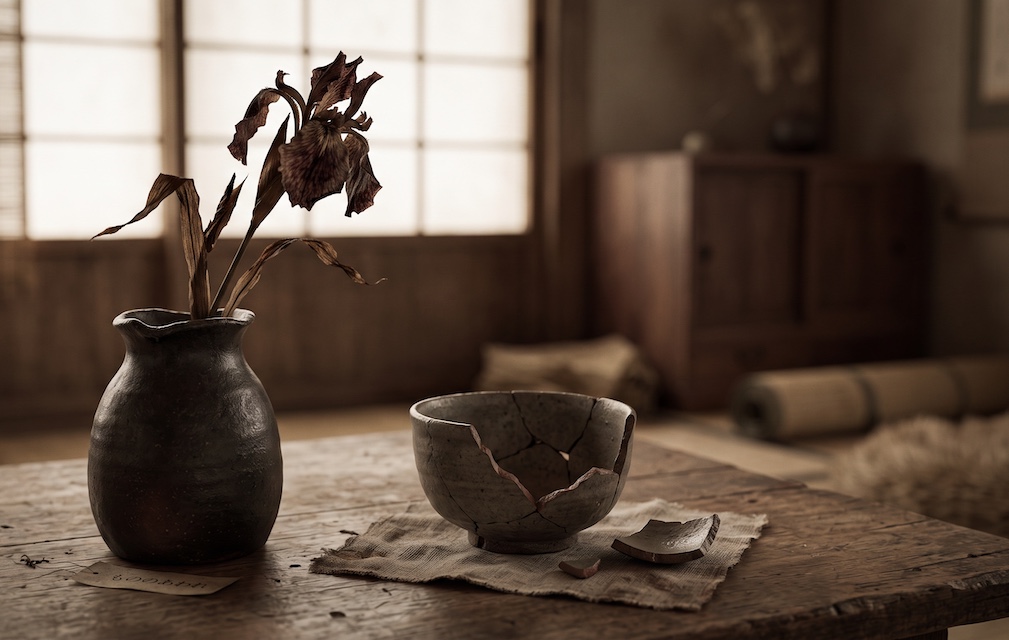
You watch cherry blossoms fall in slow spirals, or you stand at the edge of a lake at dusk as the light goes, or you look at an old photograph of a place that no longer exists. Something moves in you — not quite sadness, not quite happiness, something in between and beyond both. It is familiar, but you have probably never had an exact word for it.
Japanese has at least two.
Mono no aware (物の哀れ) and yūgen (幽玄) are distinct concepts, but they share a territory: the experience of beauty that is inseparable from mystery, depth, or the awareness of impermanence. Understanding them requires letting go of the assumption that every feeling can be neatly sorted into positive or negative, pleasurable or painful.
These are not obscure philosophical abstractions. They are names for things you have already felt. Having a name for something changes your relationship to it — you can notice it more deliberately, attend to it more carefully, and perhaps stop trying to convert it into something simpler and more familiar.
Mono no Aware: The Pathos of Things
The phrase mono no aware combines three elements: mono (物), meaning things or the world of phenomena; no (の), a possessive particle; and aware (哀れ), which is harder to translate. Aware began as an interjection — something like “ah” in English, a sound made when something touches you. Over time it gathered associations of sensitivity, feeling, and the particular quality of being moved by the world.
The scholar Motoori Norinaga (1730–1801) developed the concept of mono no aware as a key to understanding Japanese literature, particularly The Tale of Genji, the 11th-century novel by Murasaki Shikibu. For Norinaga, mono no aware was the emotional sensitivity to the world’s transience that defined the best Japanese poetry and prose — and that distinguished Japanese aesthetic sensibility from Chinese literary aesthetics, which he felt was more didactic and moralizing.
What Norinaga was pointing to is a specific emotional register: not grief, not pleasure, but the feeling that arises when you are fully present with something that will not last. The cherry blossom is the canonical example. The Japanese appreciation for cherry blossoms is explicitly tied to their brevity — they fall within a week. The falling is not the sad ending of a beautiful thing. The brevity is what makes the beauty feel the way it does. You cannot separate the two.
How Mono no Aware Differs from Western Melancholy
Western literary and philosophical traditions have their own versions of melancholy and the bittersweet. The Romantic poets wrote extensively about loss, transience, and the particular beauty of things that are fading. Keats’s “Ode to a Nightingale” and “To Autumn” are full of this register. The Portuguese concept of saudade — a nostalgic longing for something absent — shares some territory.
But there are key differences.
Western melancholy, in most of its literary forms, tends to be oriented toward the self and toward a specific loss. It is about what I have lost, or what will be taken from me. The transience is experienced as something happening to the speaker.
Mono no aware is directed outward, toward the world’s nature rather than personal loss. It is less about what I am losing and more about the quality of existence itself — that all things have this character of arising and passing. The emotion is not primarily about me. It is about the nature of things, and the person feeling it is simply a sensitive instrument for noticing what is already there.
The comparison with memento mori is useful here. The medieval Western tradition of memento mori — “remember that you will die” — was primarily a warning. It carried urgency, even fear, designed to prompt action: fear God, repent, do not waste time. Mono no aware does not warn. It does not urge. It simply rests with the reality of impermanence and finds in that resting a kind of beauty.
Yūgen: The Depth Just Beyond the Visible
Where mono no aware is primarily emotional, yūgen is primarily experiential — it is about a quality that seems to inhere in certain scenes, artworks, or moments, rather than primarily a feeling within a person.
The word yūgen combines yū (幽), suggesting something dim, distant, or mysterious, and gen (玄), dark in the sense of profound or unfathomable. Together they point to something that is present but not fully visible, felt but not fully graspable.
The Noh playwright and theorist Zeami Motokiyo wrote about yūgen as the highest quality a Noh performance could achieve. He described it through images: the feeling of watching a flock of geese disappear into clouds, of the autumn dusk over a mountain village, of a boat vanishing behind distant islands, of a lone figure wandering through winter mist. None of these are supernatural. They are all experiences of the ordinary world in which something extends beyond what the eye can follow.
This is an important distinction from Western mysticism and the sublime.
Yūgen vs. the Western Sublime
The Western concept of the sublime, developed by Longinus, Burke, and Kant, refers to the overwhelming or awe-inspiring quality of certain experiences — vast landscapes, violent storms, towering mountains. The sublime involves a kind of confrontation with something that exceeds human scale. It can be terrifying, humbling, and exhilarating.
Yūgen is quieter than this. It is not about scale or power overwhelming the senses. It is about depth — the sense that something extends further than you can see, that there is more to what you are looking at than what you are looking at contains. It is as much about what is hidden as about what is shown.
The Noh actor standing motionless on stage, doing apparently nothing, can generate yūgen — not through the overwhelming of the senses but through the quality of presence and the space around it. A sumi-e ink painting where most of the paper is left untouched, and a few brushstrokes suggest a branch or a mountain, can generate yūgen through what is withheld.
If the sublime says “you are small and the world is vast,” yūgen says something more like “there is more here than you will ever fully see.” The emotional registers are quite different.
How These Concepts Appear in Art and Literature
Haiku, the form most associated with mono no aware in the English-speaking world, works by placing a specific, concrete moment — usually in nature — in a way that opens onto something beyond that moment. Matsuo Bashō’s famous frog poem (furuike ya / kawazu tobikomu / mizu no oto) places a single sound — the splash of a frog entering an old pond — in a silence that precedes and follows it. The poem is seventeen syllables. What it opens is larger than seventeen syllables.
Noh theater cultivates yūgen in its pace, its costumes, its music, and its use of masks. The mask does not fix the character’s expression — depending on the angle of the actor’s head, the same mask can appear to smile or grieve. This ambiguity is not a technical limitation. It is the source of the yūgen. The meaning that is not pinned down is the meaning that feels deep.
Both concepts depend on incompleteness as a feature rather than a flaw. Mono no aware requires that the beautiful thing not last. Yūgen requires that the beautiful thing not be fully revealed. Completion would close off the response that makes both concepts work.
What These Concepts Offer a Western Reader
The most immediate thing both concepts offer is permission — specifically, permission to feel something without having to resolve it.
Western culture, particularly in its more Protestant and rationalist strains, tends to be uncomfortable with unresolved feeling. Sadness should be worked through. Uncertainty should be eliminated. Ambiguity should be clarified. There is enormous pressure to convert complex emotional states into something legible and actionable.
Mono no aware and yūgen suggest a different approach: that some feelings are not problems to be solved but qualities to be attended to. The ache of impermanence does not need to be converted into grief and worked through, or into gratitude and moved past. It can simply be noticed, and in the noticing, it becomes something that enriches experience rather than troubling it.
This is not a self-help recommendation. It is a different frame for understanding what experiences are for.
Frequently Asked Questions (FAQ)
-
Is mono no aware the same as what Western philosophy calls “the sublime”?
-
They share a territory — both involve an aesthetic response to something that exceeds ordinary experience — but they are not the same. The Western sublime tends toward the overwhelming, the vast, and the terrifying-in-a-way-that-eventually-reasserts-human-dignity. Mono no aware is quieter and more tender. It is not about scale or power. It is about the beauty specific to things that will not last, which can be as small as a falling leaf or a voice that is getting older.
-
Are these feelings unique to Japanese people, or can anyone experience them?
-
The feelings themselves are available to anyone — most people in most cultures have felt something like the bittersweet awareness of transience, and something like the sense of depth beyond what is visible. What is specifically Japanese is the cultural vocabulary for these feelings, and the aesthetic traditions (haiku, Noh, garden design) that have developed specifically to cultivate and honor them. A non-Japanese person can experience something very like mono no aware without knowing the word. Knowing the word, and the tradition behind it, tends to make the experience more available and more legible.
-
Is yūgen a religious concept, or is it purely aesthetic?
-
Yūgen developed in close proximity to Zen Buddhism, and some of its qualities — the sense of depth beyond what can be seen, the value placed on stillness and incompleteness — resonate with Zen sensibility. But yūgen as an aesthetic concept is not a religious doctrine or a spiritual practice. It describes a quality of experience that can be noticed in secular contexts: a piece of music, a landscape, a particular quality of light. The Zen background informs it but does not limit it to religious contexts.
Never Miss an Update
New articles and exclusive cultural insights are announced first on LinkedIn. If you want to keep expanding your understanding of Japanese philosophy and modern resilience, let’s stay in touch.
[Follow My LinkedIn Profile Here]
If this article brought a moment of peace or insight to your day, consider supporting my work.
Thank you.