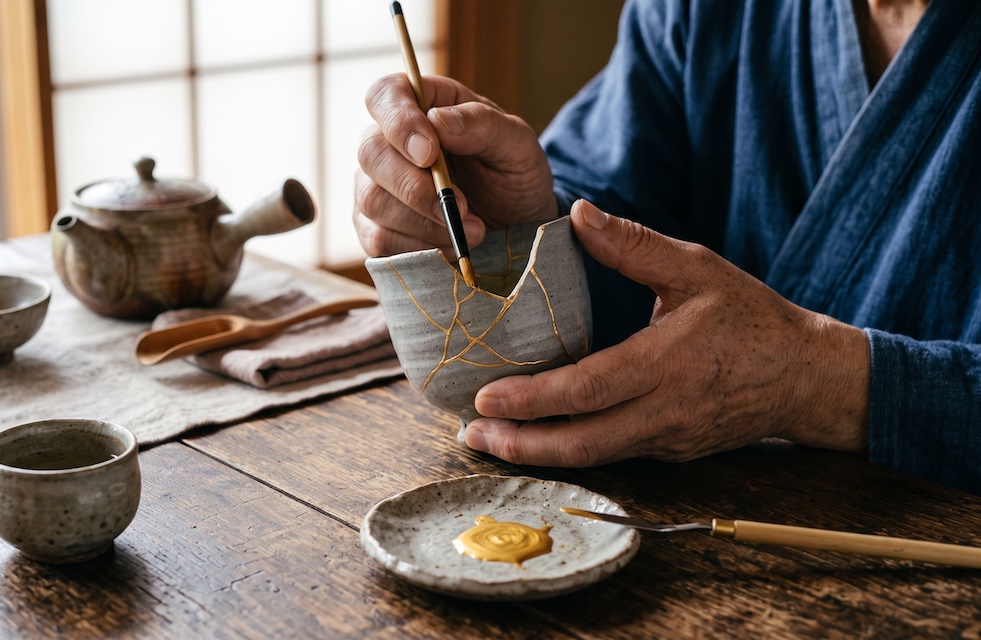
A bowl drops. It breaks into several pieces. You have two options.
The first is to repair it so that the repair is invisible — to return it, as closely as possible, to what it looked like before it broke. The goal is to eliminate the evidence of the break. If the repair is successful, no one needs to know it happened.
The second is to repair it with gold.
Kintsugi (金継ぎ), literally “golden joinery,” is the Japanese practice of repairing broken ceramics with lacquer mixed with powdered gold, silver, or platinum. The gold does not fill the cracks invisibly. It makes them the most visible thing about the bowl. The lines where it broke become luminous seams running across the surface. The repair does not hide what happened. It commemorates it.
These two approaches are not just different techniques. They reflect fundamentally different ideas about damage, history, and what an object is for.
The Technique: What Kintsugi Actually Is
Kintsugi uses urushi, the traditional Japanese lacquer made from the sap of the urushi tree (Toxicodendron vernicifluum). The lacquer is mixed with fine metallic powder — most often gold, but sometimes silver or copper depending on the aesthetic intention — and applied carefully to the broken edges before the pieces are rejoined.
The process is slow. Urushi lacquer requires specific humidity and temperature conditions to cure properly, and a single repair can take weeks through multiple coats. This is not a quick fix or a craft project for an afternoon. It is a deliberate, attentive process that asks the repairer to spend significant time with the broken object before it becomes whole again.
The aesthetic result varies by approach. Honkintsugi uses actual gold dust with traditional urushi lacquer. Urushi-kintsugi uses urushi mixed with bronze or brass powder for a more muted, antique quality. Shin-urushi uses synthetic lacquers that are safer to work with (urushi causes contact dermatitis in many people). Each produces a different quality of repair, but all share the same underlying logic: the break is shown, not hidden.
Kintsugi is closely connected to the aesthetics of the tea ceremony and to the broader sensibility of wabi-sabi — the beauty of imperfection and the marks of time. A kintsugi bowl is not merely repaired. It is, in the view of the tradition, more interesting than it was before it broke.
Western Restoration vs. Kintsugi: The Philosophical Difference
Western conservation and restoration practice, particularly in the professional context of museums and antique dealers, aims at reversibility and invisibility. The gold standard of a restoration is one that cannot be detected — where the repaired object looks as it did before the damage. Damage is understood as a subtraction from the object’s original state, and the goal of repair is to return to that state as closely as possible.
Kintsugi operates from the opposite assumption. The bowl after the break and the repair is not a lesser version of the bowl before the break. It is a different bowl — one with more history. The break is not subtracted from the object’s story. It is added to it.
This is not merely a different aesthetic preference. It reflects a different idea of what an object is. In the Western restoration frame, the object’s identity is fixed at the moment of its making, and everything that happens to it afterward is deviation from that identity. In the kintsugi frame, the object’s identity is cumulative — it includes everything that has happened to it, including the break and the repair.
A human parallel is not hard to see, which is partly why kintsugi has attracted so much attention in Western psychological and therapeutic contexts.
Why the West Reads Kintsugi as a Mental Health Metaphor
In Western popular culture, kintsugi is frequently discussed as a metaphor for human resilience: the idea that people who have been through trauma or failure are not damaged goods but are, like the kintsugi bowl, more interesting and more themselves for having been broken and repaired.
This reading has genuine power. In cultures where failure carries heavy social stigma, and where showing vulnerability is often read as weakness, the image of a bowl made beautiful by its visible repair lines is genuinely moving. It offers a framework in which the evidence of difficulty does not disqualify you.
But there is a difference worth noting between the metaphor as it tends to travel in the West and what the practice itself is doing.
The Western version of the kintsugi metaphor often focuses on strength: you are stronger at the broken places, in the Hemingway formulation. Kintsugi does not quite say that. The bowl is not stronger where it was repaired — urushi is not stronger than intact ceramic. What the bowl is, is marked. It has a visible record of what it went through. The gold does not make the break a triumph. It makes the break honest.
That distinction matters. Kintsugi is not an optimistic claim that suffering makes you stronger. It is a more neutral observation that suffering is part of your actual history, and there is no good reason to hide that.
The Philosophical Root: Mono no Aware and the Object’s Story
Behind kintsugi lies the concept of mono no aware (物の哀れ), usually translated as “the pathos of things” — the gentle sadness and beauty that comes from knowing all things are impermanent.
The break in the bowl is, among other things, a reminder of impermanence. The bowl was whole, then it was broken. It was repaired, and it continues. Eventually it will break again, or it will be lost, or it will outlast everyone who ever used it. None of that is tragedy. It is the actual life of the object.
By making the break visible, kintsugi insists on honesty about what the object has been through. The gold is not decoration applied to damage. It is a way of saying: this happened, and it is part of what this is now.
There is something instructive in this for how we handle the histories of things we care about — objects, relationships, institutions, our own lives. The instinct to restore to a pristine original state is understandable. It is also a kind of falsification. Things have histories. The attempt to erase those histories does not undo them. It just makes them invisible, which is not the same thing.
Frequently Asked Questions (FAQ)
-
Is kintsugi a Zen practice?
-
Kintsugi is not a Zen practice in the formal sense — it has no place in Zen ritual or instruction. But it developed in close proximity to Zen aesthetics, particularly through the tea ceremony, which was heavily influenced by Zen. The Zen sensibility that values directness, honesty about materials, and the beauty of things as they actually are (rather than as we might wish them to be) is clearly present in kintsugi. Whether you call it Zen or not is less important than recognizing the shared philosophical ground.
-
Is the mental health interpretation of kintsugi accurate, or is it a Western projection?
-
Both, in a sense. The Western mental health reading does project onto kintsugi certain ideas (particularly the emphasis on becoming stronger through suffering) that are not really what kintsugi is saying. In that sense it is a projection. But the core observation — that visible damage is not something to be ashamed of, and that an object’s (or person’s) history of difficulty is part of what they are — is genuinely present in the practice. The projection is in the optimistic spin. The underlying observation is accurate.
-
Can I learn kintsugi, or is it something that requires years of training?
-
Traditional kintsugi using genuine urushi lacquer requires significant skill and patience, and urushi can cause severe contact dermatitis in people who are not used to it. Learning it properly takes time. That said, there are introductory workshops and kintsugi kits using synthetic lacquers that make the basic practice accessible. If you want the full traditional experience, seeking out a trained instructor is the better path. If you want to understand the concept through doing, the simplified versions are a reasonable starting point.
Never Miss an Update
New articles and exclusive cultural insights are announced first on LinkedIn. If you want to keep expanding your understanding of Japanese philosophy and modern resilience, let’s stay in touch.
[Follow My LinkedIn Profile Here]
If this article brought a moment of peace or insight to your day, consider supporting my work.
Thank you.