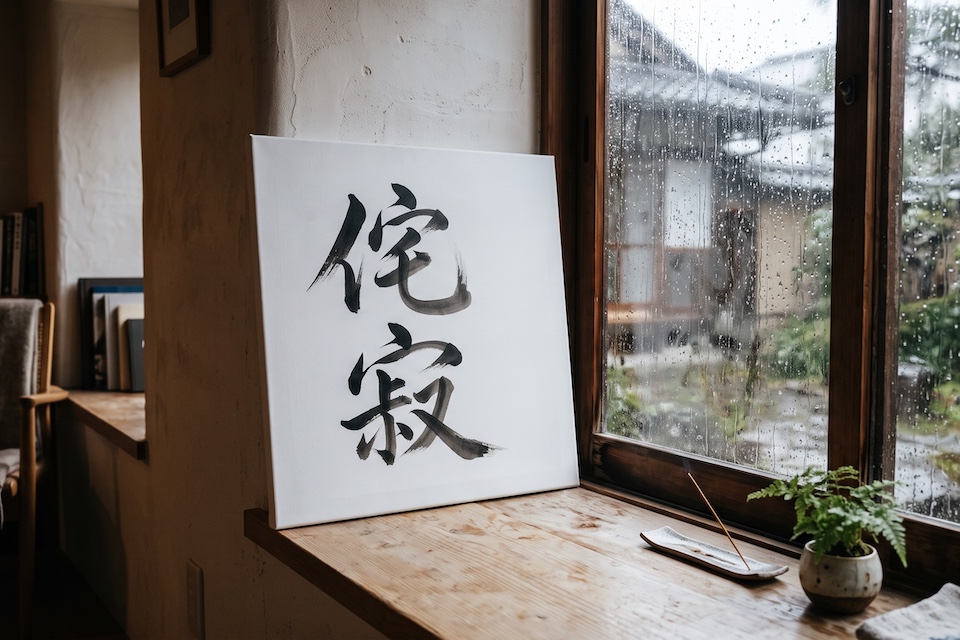
Search “wabi-sabi” in any major Western city and you will find it on candle labels, restaurant menus, interior design accounts, and wellness retreats. The word has become a shorthand for a certain kind of deliberate imperfection: rough textures, neutral colors, hand-thrown ceramics, linen that has been washed until it is soft and slightly uneven.
None of that is entirely wrong. But something gets lost when a concept travels that far from its roots.
The original meaning of wabi-sabi is harder to hold, and more rewarding for that difficulty. It is not primarily a visual style. It is a way of relating to time, to decay, and to the kind of beauty that can only arrive through those two things. Getting that closer to what it is requires looking at where the two words came from.
Breaking Down the Word: Wabi and Sabi Separately
The two characters in wabi-sabi (侘寂) are worth looking at on their own, because they point to different aspects of the same sensibility.
Wabi (侘) originally carried associations that were not pleasant: loneliness, poverty, inadequacy, the state of being without what you needed or wanted. Over time, and particularly through the influence of tea ceremony culture in the 15th and 16th centuries, something shifted. The great tea master Sen no Rikyu and those around him began to find something in that sense of bare simplicity that was not merely acceptable but genuinely valuable. The rough-hewn tea room, the modest wooden utensil, the imperfect clay bowl — these came to embody an honesty that expensive and elaborately finished objects could not.
Sabi (寂) points to something different: the quality that appears in objects through the passage of time. Rust. Patina. The way a wooden floor darkens where people walk. The marks left on a tool by years of use. These are not the signs of deterioration in the sense of losing value — they are the signs of a history that the object now carries visibly.
Together, wabi-sabi describes a sensibility that finds in spare simplicity and the evidence of time a kind of beauty that pristine, new, and expensive things cannot offer. It is not that new things are bad. It is that they have not yet become what they will be.
Wabi-Sabi vs. Vintage and Antique: A Critical Difference
The Western concept of vintage or antique shares some surface area with wabi-sabi but operates from a very different logic.
When something is classified as vintage or antique, its value depends heavily on condition, rarity, historical significance, and provenance. A well-preserved mid-century modern chair is worth more than one that has been repaired or refinished. The goal of antique restoration is to return an object as close as possible to its original state. What happened between its making and now is, in this frame, something to be reversed or minimized.
Wabi-sabi does not work this way. The value is not about historical significance or rarity or how well something has been preserved. A kitchen spoon that has been used every day for thirty years, worn smooth where a hand always grips it, with a slight darkening of the wood near the heat of the stove — that spoon can carry more wabi than a museum-quality antique, because the wabi is in the ongoing relationship between the object and a human life.
The emotional register is different, too. Antique collecting tends toward pride of ownership and connoisseurship. Wabi-sabi tends toward something quieter — a kind of tenderness toward things that have been present for a long time.
What Wabi-Sabi Is Not
Two misunderstandings come up repeatedly in Western discussions of wabi-sabi, and both are worth addressing directly.
The first is that wabi-sabi is an excuse for mess, disorder, or neglect. It is not. The difference between a wabi-sabi aesthetic and a simply neglected or dirty environment is care and intention. A garden that has been tended over many years, where the moss has been allowed to grow but the paths are maintained and the rocks are placed with attention, can embody wabi-sabi. An abandoned lot does not. The imperfection in wabi-sabi is the result of time and natural process working on something that has been cared for. Neglect and carelessness produce a different kind of imperfection entirely.
The second misunderstanding is that wabi-sabi means everything should be old, natural-material, and beige. The visual style associated with wabi-sabi in contemporary Western design is real but limited. The underlying sensibility can show up anywhere that there is genuine honesty about materials and time — it is less about a look than about an attitude toward what things are made of and what they have been through.
Wabi-Sabi and Mortality: The Depth Beneath the Surface
What gives wabi-sabi its real weight is what it is ultimately about, which is mortality — the passage of all things, including people.
The Japanese concept of mujō (無常), impermanence, is not a background idea in wabi-sabi. It is central to it. When you hold an old tea bowl and notice the way it has changed through use, you are also, at some level, noticing that all things change and do not come back. The bowl’s worn edges are a record of time, and time moves only one direction.
This could be a morbid observation. In the wabi-sabi frame, it is not. It is the source of the tenderness that the sensibility carries. Things are worth caring for carefully precisely because they will not last forever. Their impermanence is not a flaw — it is part of their nature, and attending to that nature is a form of honesty.
Western culture tends to handle mortality by either ignoring it or medicalizing it. Wabi-sabi offers a different approach: noticing it in small, daily, manageable doses through ordinary objects, and finding in that noticing something that is not depressing but grounding.
How to Actually Notice Wabi-Sabi
This is not primarily a concept to study — it is a quality to notice. A few places to start:
Look at the things in your home that you have owned for a long time. Notice what they look like now compared to when you first had them. Where have they worn? What do those worn places tell you about how you have actually lived?
Notice the difference between how something feels when it is new and how it feels when it is yours in a way that a new thing cannot be yet. That difference is something close to wabi.
Pay attention to how you feel when something you own gets damaged. Is the first instinct always to repair it to invisibility, or to replace it? What would it mean to keep it as it is?
None of this is a spiritual exercise. It is just attention — the kind that wabi-sabi asks of anyone who takes it seriously.
Frequently Asked Questions (FAQ)
-
Is wabi-sabi the same thing as Buddhist impermanence (anicca or mujō)?
-
They are closely related but not identical. Buddhist impermanence is a philosophical and spiritual teaching about the nature of all conditioned phenomena. Wabi-sabi is an aesthetic sensibility that developed partly in response to that teaching, particularly through Zen Buddhism and the tea ceremony. You can understand and practice wabi-sabi without any formal engagement with Buddhism, but knowing the Buddhist background deepens what the concept is doing.
-
How is wabi-sabi different from the Scandinavian concept of hygge?
-
Both involve finding comfort and value in simple, unpretentious things. But hygge is oriented toward warmth, togetherness, and coziness — the feeling of being safe and comfortable in a domestic space, usually with other people. Wabi-sabi is more solitary and more explicitly connected to time and mortality. Hygge tends to be about the pleasures of the present moment. Wabi-sabi tends to be about what the present moment reveals about the nature of all moments.
-
Is there a practice, or is wabi-sabi just a way of looking at things?
-
It is primarily a way of looking, but that way of looking can become habitual through practice. The tea ceremony (chado) is the most developed formal context for practicing wabi-sabi aesthetics. Outside that, the practice is mostly attentional: deliberately noticing worn and aged things, resisting the automatic instinct to replace or restore them, and spending time with objects that have visible histories. Some people find that learning a craft — pottery, woodworking, sewing — accelerates this, because working with materials teaches you how things actually age.
Never Miss an Update
New articles and exclusive cultural insights are announced first on LinkedIn. If you want to keep expanding your understanding of Japanese philosophy and modern resilience, let’s stay in touch.
[Follow My LinkedIn Profile Here]
If this article brought a moment of peace or insight to your day, consider supporting my work.
Thank you.