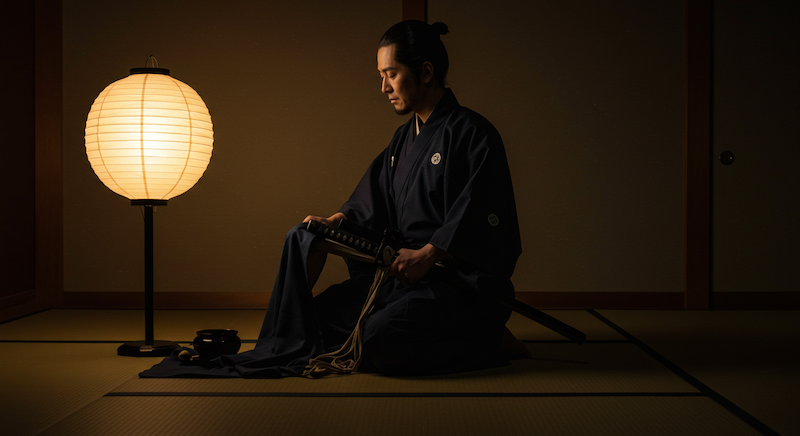
Two samurai texts have found large audiences in the contemporary West, and both are routinely misread.
The Hagakure (葉隠), written by Yamamoto Tsunetomo in the early 18th century, is most famous for a single line: “Bushido to wa, shinu koto to mitsuketari” — Bushido is found in dying. Western readers encountering this for the first time tend to read it as either a glorification of death, a justification for extreme loyalty at the cost of self-preservation, or evidence that samurai culture was psychologically pathological. None of these readings are quite right.
The Book of Five Rings (Gorin no Sho, 五輪書), written by the swordsman Miyamoto Musashi around 1645, is routinely marketed as a strategy guide for business. Corporate training programs invoke it. Executives carry it. The framing is: here is a master of competitive situations, and his principles transfer directly to the boardroom.
This reading is also not quite right — though it is closer to being useful than the Hagakure misreading.
Both books deserve more careful attention than they usually receive. What they are actually saying is more interesting, and more demanding, than their popular reputations suggest.
The Hagakure: Death as a Practice, Not a Goal
The Hagakure was not written by a great warrior. Yamamoto Tsunetomo (1659–1719) was a samurai retainer who had been denied the right to follow his lord in death when that lord died in 1700. The practice of junshi — following one’s lord into death — had been banned by the Tokugawa shogunate, and Tsunetomo was forced to live, becoming a Buddhist monk and spending the rest of his life reflecting on what it meant to be a samurai in a time when there were no longer wars to fight.
The Hagakure grew from conversations between Tsunetomo and a young samurai named Tashiro Tsuramoto over a period of seven years. It is not a systematic philosophical work. It is a collection of observations, anecdotes, criticisms, and meditations — rambling, sometimes contradictory, and full of the particular bitterness of a man who felt he had been denied the death he considered proper.
The famous line needs to be understood in this context. Tsunetomo was not recommending suicide. He was describing a practice: the samurai who wants to be fully capable of correct action should, each morning, imagine all the ways he might die that day. He should live with the acceptance that death is likely, that it may come today, and that this is acceptable. Having done that work, he is free from the distortion that fear of death produces in everything he does.
This is, in effect, a meditation practice. Modern clinical psychology has a version of it — imaginal exposure therapy uses the deliberate, repeated imagination of feared outcomes to reduce their power over behavior. Tsunetomo arrived at something similar through the demands of his culture, three centuries earlier.
The goal is not death. The goal is the particular quality of presence and clarity that becomes available when death is fully accepted rather than managed by avoidance. A person who has not made peace with the possibility of dying today is making decisions partly under the influence of that unresolved fear, whether they know it or not. The samurai who has sat with his death each morning is making decisions from a different place.
What the Hagakure Is Not
It is worth being direct about the aspects of the Hagakure that do not translate well or do not deserve uncritical admiration.
Tsunetomo’s view of loyalty was extreme even by the standards of his time. He argued that a samurai should be so completely devoted to his lord that questions of the lord’s moral character were essentially irrelevant — the retainer’s job was not to judge but to serve. He was explicitly critical of calculating, rational loyalty that weighed the lord’s worthiness. He wanted a loyalty that was more like devotion, prior to any evaluation.
This is not a value that most people today would or should adopt wholesale. It is also worth noting that Tsunetomo’s bitterness about being denied junshi colors a great deal of the Hagakure — some of what reads as wisdom is also the expression of a specific, wounded personal situation.
Reading the Hagakure well requires taking what is genuinely useful — particularly the death meditation, the insistence on full presence, and the critique of decision-making distorted by self-interest — and being clear-eyed about the rest.
The Book of Five Rings: Strategy as a Way of Being
Miyamoto Musashi (1584–1645) was, by most accounts, the greatest swordsman in Japanese history. He fought in over sixty duels beginning in his early teens and won all of them. He lived a deliberately ascetic life — he never married, rarely bathed, and spent long periods in solitary training and reflection. He wrote The Book of Five Rings in a cave on Mount Iwato in the final years of his life, completing it shortly before his death.
The book is structured around five elements — Earth, Water, Fire, Wind, and Void — each corresponding to a different dimension of strategy and mind. The Earth chapter covers the foundation of the way. Water covers adaptability and fluidity of mind. Fire covers the dynamics of direct confrontation. Wind covers understanding other schools and approaches. The Void chapter — the briefest — covers what cannot be taught directly, the quality that exists beyond technique.
The reason Western readers have found it applicable to business is that Musashi’s concerns are, in an important sense, not specifically about swordsmanship. He was interested in the principles underlying any competitive situation: how to read an opponent, how to find and maintain psychological advantage, how to avoid being locked into a single approach, and how to act decisively without hesitation when the moment arrives.
Musashi’s Core Principles: What He Was Actually Teaching
Several themes run through the text consistently and are worth pulling out directly.
Do not depend on any single weapon or approach. Musashi was critical of schools that became identified with one technique or style. The swordsman who can only fight one way is vulnerable to any opponent who presents a different situation. The principle transfers: the strategist who has only one framework will misread situations that do not fit it.
Maintain heijosin (平常心) — ordinary mind in all situations. The concept of heijosin refers to the mental state that does not change between practice and combat, between high-stakes situations and routine ones. The person who becomes different when the stakes are high is not fully trained. Musashi was trying to cultivate a mind that is the same whether nothing is happening or everything is on the line.
Do not look at the trees. See the forest. Musashi repeatedly warns against becoming fixated on one element of a situation — a particular movement, a single weakness, one moment. The strategist who locks onto a specific thing loses the capacity to respond to what is actually happening. Seeing clearly means maintaining peripheral awareness, not narrowing to a target.
Rhythm and timing are everything. Much of the Fire chapter concerns the ability to read the rhythm of a confrontation and to disrupt it. Matching an opponent’s rhythm is defensive and passive. Finding the moment when the rhythm can be broken — and acting at that moment — is what creates decisive opportunity.
The Void is not emptiness but potential. The final chapter on Void (ku, 空) is the hardest to paraphrase. Musashi points toward a state of mind that is not filled with technique, expectation, or plan — because those things create a particular orientation that can be anticipated and countered. The Void is the mind that has no fixed position and therefore cannot be predicted. It is the reservoir from which appropriate action arises.
What Connects the Two Books
The Hagakure and The Book of Five Rings come from different men with different temperaments and different concerns. Tsunetomo was a retainer, and his preoccupation was loyalty and the proper relationship to one’s lord. Musashi was a freelance warrior and artist, and his preoccupation was the perfection of individual strategy and mind.
But they share a central concern: the quality of presence that becomes available when a person is not governed by fear, desire, or attachment to specific outcomes.
Tsunetomo gets there through the acceptance of death. Musashi gets there through the cultivation of heijosin and the Void. Both are pointing at the same thing: the person who is genuinely free of the distortions that self-preservation and ego-protection produce thinks and acts from a different place. That difference is what both books are trying to cultivate.
Zen Buddhism is the common background. Both texts are deeply influenced by the Zen insistence that the quality of mind brought to an action matters more than the technique or the plan — and that the only way to train that quality is through direct, repeated confrontation with what you are most afraid of.
Frequently Asked Questions (FAQ)
-
Is the Hagakure actually a good guide to living well, or is it extreme and outdated?
-
It is both. The death meditation — the practice of beginning each day with a full acceptance of the possibility that today is the day you die — is a genuinely useful psychological practice, and there is modern research supporting the value of mortality salience in clarifying priorities and reducing petty anxiety. Other aspects of the Hagakure, particularly its extreme view of unconditional loyalty, are not values to adopt wholesale. Reading it well means engaging critically rather than treating it as a complete system. Take what has genuine applicability and understand the rest as historically specific.
-
Is The Book of Five Rings actually useful for business strategy, or is that a stretch?
-
It is useful, but with important caveats. The principles Musashi articulates — maintaining equanimity under pressure, avoiding fixation on a single approach, reading the rhythm of a competitive situation — do transfer to contexts beyond swordsmanship. Where the business reading goes wrong is in treating it as a tactics manual. Musashi was not primarily teaching tactics. He was teaching a quality of mind. The tactics are downstream of the mind. Readers who take the tactics without attending to what Musashi says about how the mind should be trained are taking the less interesting and less transferable part.
-
How did Zen Buddhism influence samurai culture — and these texts specifically?
-
Zen’s influence on samurai culture was deep and practical rather than primarily spiritual. The Zen emphasis on direct experience over conceptual understanding, and on the quality of mind in the present moment, mapped onto what samurai needed in combat: a mind that did not hesitate, did not catastrophize, and did not become fixated. Rinzai Zen, with its koan practice, was particularly influential — the koan is designed to break the mind’s habit of seeking conceptual answers and force a more direct mode of engagement. Both the Hagakure‘s death meditation and Musashi’s concept of the Void reflect this influence.
Never Miss an Update
New articles and exclusive cultural insights are announced first on LinkedIn. If you want to keep expanding your understanding of Japanese philosophy and modern resilience, let’s stay in touch.
[Follow My LinkedIn Profile Here]
If this article brought a moment of peace or insight to your day, consider supporting my work.
Thank you.