What Do You Think About When Death Gets Close?
I don’t mean this as a dramatic opener. It’s a real question — one I find myself returning to whenever I read the final pages of Yoshikawa Eiji’s Musashi.
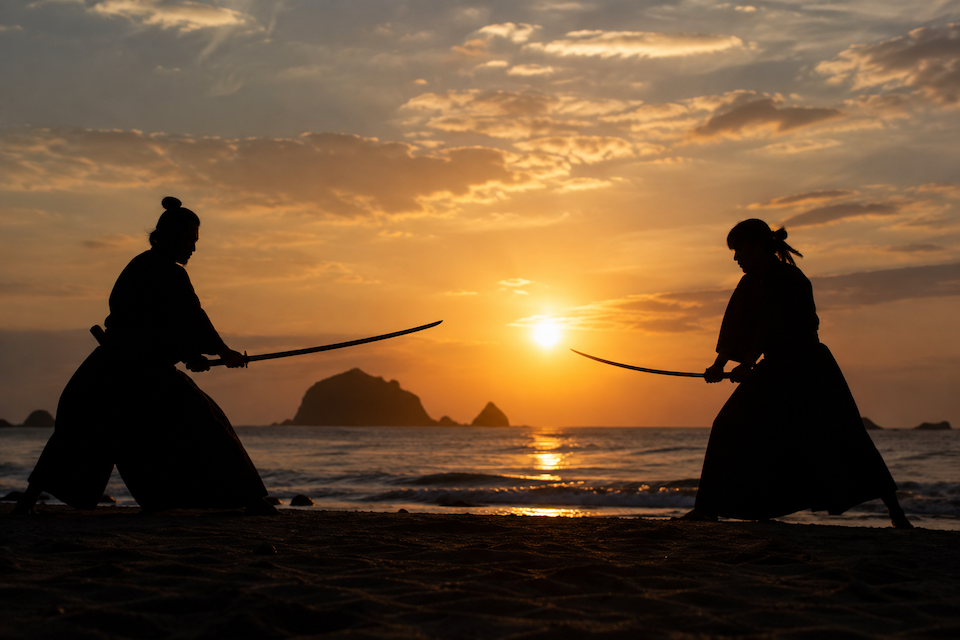
There’s a moment in the novel — the duel at Ganryūjima — that I’ve read more than once, and each time it does something strange to me. Sasaki Kojirō arrives first. He is polished, precise, supremely confident. He has spent his life perfecting a single technique — the Tsubame Gaeshi, a strike so fast it was said to cut down a swallow in mid-flight. He waits on the beach, composed, certain. The morning is still. The sea is flat.
Then he waits a little longer.
And longer still.
When Musashi’s boat finally appears on the horizon, Kojirō is already irritated. By the time it beaches, he is furious. Musashi is late — deliberately, almost insultingly late. He steps off the boat holding not a proper sword but a roughly shaped piece of wood, carved from his oar during the crossing. He hasn’t even bothered to bring a real blade.
Kojirō draws immediately, his scabbard thrown aside. The throw is elegant. Unnecessary. The gesture of a man performing his own legend.
Musashi doesn’t react. He watches.
What Yoshikawa captures in the pages that follow isn’t really a fight. It’s two completely different relationships with death meeting head-on.
Kojirō dies not because his technique fails him. He dies because Musashi, in that moment, simply isn’t afraid. And Kojirō — for all his mastery — is.
Before We Go Further: What Is This Novel?
If you’ve never encountered Musashi before, a brief orientation might be useful — because the book has an unusual status, somewhere between historical fiction, national mythology, and genuine philosophical text.
Yoshikawa Eiji’s Musashi was serialized in Japan’s Asahi Shimbun newspaper from 1935 to 1939. It’s a long novel — over a thousand pages in English translation — and it follows the life of Miyamoto Musashi from his chaotic youth through decades of wandering, dueling, and reluctant self-examination. It was enormously popular when it was published and remains so today. For many Japanese readers, Yoshikawa’s Musashi is Musashi — the historical figure and the fictional character have fused almost completely in the public imagination.
The important thing to understand is that Yoshikawa was writing fiction. He took the broad outlines of a real life and built a novel around them. The historical Miyamoto Musashi was a real person — a swordsman, a painter, and a strategist who lived from roughly 1584 to 1645. The duel at Ganryūjima almost certainly happened. Many of the other details are invented or embellished.
But the historical Musashi did leave behind one verified text of his own: the Go Rin No Sho (五輪書), the Book of Five Rings, written in the final weeks of his life in a mountain cave. That text has never gone out of print. It’s studied in Japanese martial arts schools, taught in business schools in the United States and Europe, and has been cited by everyone from hedge fund managers to professional athletes as a framework for thinking under pressure.
So we have two versions of Musashi: the literary one Yoshikawa gave us, and the historical one who actually put brush to paper in 1645. I find both valuable, and I think they’re best read in sequence — the novel first, as a way of understanding the person, and then the Go Rin No Sho as a way of encountering the mind directly.
That’s the order I want to follow here.
A Young Man Who Couldn’t Stop Fighting
The Musashi of the novel’s early chapters is not someone you’d necessarily admire. He is raw, furious, and convinced that killing enough people will eventually make him invincible. He fights with the kind of desperation that looks like courage but is mostly fear with nowhere to go.
Yoshikawa doesn’t let him off the hook for this. The novel’s structure — and it’s a long novel, originally serialized in a newspaper over nearly a decade — is essentially the story of what happens when a gifted, violent young man is slowly forced to confront the difference between winning fights and understanding what he’s actually doing.
That transformation doesn’t happen through a single revelation. It happens through loss. Through humiliation. Through being suspended in a tree for days by the monk Takuan. Through falling in love with someone he can’t have. Through watching people he respects die in ways that make no dramatic sense.
Musashi doesn’t become great because he trained harder. He becomes great because he eventually stopped running from the parts of himself he didn’t like.
From Emotion to Observation
There’s a passage in the novel — I’m paraphrasing here, because the nuance matters more than the exact words — where the older Musashi reflects on how his sword has changed. When he was young, he fought against his opponent. Later, he realized he had spent most of his career fighting against himself. The anger, the pride, the need to prove something. His own emotions were his most dangerous enemy.
What he eventually developed — and what Yoshikawa renders in increasingly sparse, almost meditative prose as the novel progresses — is something closer to observation than aggression. Not passivity. Not detachment in the sense of not caring. Something harder to describe: a quality of presence that didn’t flinch, didn’t project, didn’t anticipate. He became someone who could see a situation as it actually was, not as his fear or ambition needed it to be.
I’m aware that sounds like the kind of thing you’d read on a motivational poster. But in the context of Yoshikawa’s novel, it earns that description slowly, over hundreds of pages of failure.
When I think about it in terms of ordinary life — not sword fights, but the situations where I’ve made decisions badly — the pattern is recognizable. The times I’ve acted from wounded pride, or reacted before I understood what was actually happening. Musashi’s arc, as Yoshikawa tells it, is essentially a very long, painful lesson in the gap between reaction and response.
I’m not sure I’ve fully learned it either.
Why He Won at Ganryūjima (My Reading, Not the Official One)
There are many interpretations of why Musashi defeated Kojirō. The psychological game of arriving late. The sun in Kojirō’s eyes. Superior reach with the longer wooden sword.
But what strikes me in Yoshikawa’s rendering is something subtler.
Kojirō, by that point in the novel, has become his own technique. He is the Tsubame Gaeshi. He has identified completely with his reputation, his method, his certainty. When Musashi steps off that boat, Kojirō is already furious — and that fury is the tell. It means he needs the duel to go a certain way. He has something to lose.
Musashi, by contrast, has spent the journey across the water carving a sword from an oar. In Zen terms — and I’m reading this in, I should say, not claiming Yoshikawa intended this explicitly — he arrives in something close to mushin (無心): no-mind, or perhaps more accurately, no-agenda. He isn’t fighting to prove something. He isn’t fighting to protect a reputation. He’s simply there, present, awake to what the moment actually requires.
Ku (空) — emptiness, in the Buddhist sense — isn’t a void. It’s the absence of obstruction. A mirror that reflects everything because it clings to nothing.
That’s my reading of it. You might read it differently. The novel supports multiple interpretations, and I think that’s part of its value.
What I Take From This (For Myself, Not As Advice)
I want to be careful here, because this kind of writing slides easily into prescription — here’s what Musashi can teach you about leadership — and that’s not what I’m interested in.
But I’ll say what I actually do with it, and leave you to decide whether it’s relevant to you.
When I’m in a situation where I feel reactive — where something has been said or done and I want to respond immediately, from that tight place in the chest — I sometimes think of Kojirō. Not Musashi. Kojirō.
Because Kojirō is the more relatable figure, honestly. He worked extraordinarily hard. He was genuinely skilled. He had real reasons to be confident. And he still lost, because in that final moment he couldn’t find the gap between what was happening and his feelings about it.
That gap is very small, and very hard to hold open, and I don’t always manage it. But I find the image useful. The question it leaves me with isn’t how do I become more like Musashi? — that feels like the wrong framing. It’s more like: in this particular moment, what is actually happening, versus what am I afraid is happening?
Those are often different things.
What This Means to Me
I’ve lived most of my life surrounded by the aesthetics of the sword — not as violence, but as michi (道), the Way. Kendo was part of my childhood in the way that Saturday morning baseball might have been part of someone else’s. Not something I chose, exactly. Something that was simply there, shaping how I held my body, how I entered a room, what I noticed when I was nervous.
Reading Yoshikawa’s Musashi as an adult is a strange experience because of that. I recognize things in it that I absorbed long before I had language for them. The idea that your biggest opponent is internal. That the perfection of technique, without an equally serious reckoning with the self, eventually becomes a trap.
I don’t know if this maps onto your life. I suspect something in it might, because the psychological pattern Yoshikawa is describing — the long, uncomfortable work of learning to act from clarity rather than fear — doesn’t seem uniquely Japanese to me. But I’m aware that I’m reading it from inside a particular tradition, and you’re reading it from outside one.
That difference matters. I’d rather honor it than flatten it.
What I can say is this: when I finished the novel again recently, the feeling I was left with wasn’t admiration for Musashi exactly. It was something more like recognition. The awareness that the hardest thing he had to defeat was something he carried with him everywhere.
Never Miss an Update
New articles and exclusive cultural insights are announced first on LinkedIn. If you want to keep expanding your understanding of Japanese philosophy and modern resilience, let’s stay in touch.
[Follow My LinkedIn Profile Here]
If this article brought a moment of peace or insight to your day, consider supporting my work.
Thank you.