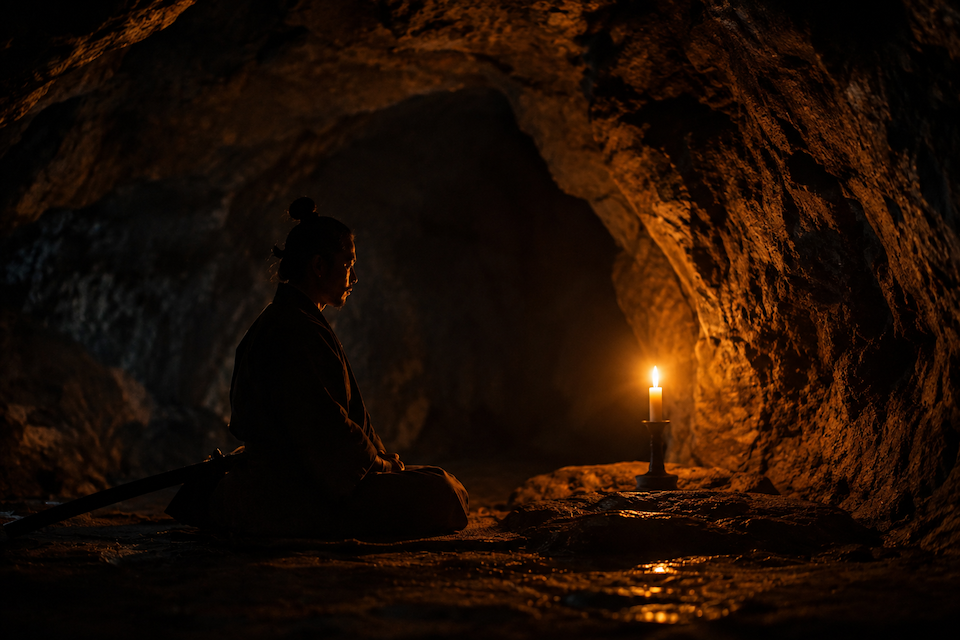
Miyamoto Musashi wrote The Book of Five Rings in a cave on a Japanese island, alone, in the final weeks of his life. He was 60 years old, had fought over 60 duels without a single defeat, and had spent decades refining a philosophy of strategy that went far beyond swordsmanship. The manuscript he left behind, known in Japanese as Go Rin No Sho, has been studied by military commanders, corporate executives, and martial artists for nearly four centuries.
It is not an easy read. Musashi was a practitioner, not a writer, and he had little patience for abstraction divorced from reality. But that directness is exactly what gives the text its staying power.
What the Book Actually Is
The Book of Five Rings is structured around five scrolls, each named after a classical element: Earth, Water, Fire, Wind, and Void. Each scroll addresses a different layer of strategic thinking, from foundational principles and physical technique to understanding your opponents, studying other schools, and finally, confronting the nature of emptiness itself.
Musashi wrote it as a transmission to his students, not as a mass-market strategy manual. He wanted to document the core of his Niten Ichi-ryu style of swordsmanship, but as you read it, it becomes clear that he was describing something much broader: a way of perceiving the world and responding to it without hesitation or distortion.
The title refers to these five scrolls, not to the Olympic rings. In traditional Japanese philosophy, the five elements represented the fundamental categories through which reality could be understood. Musashi used that framework to organize a complete theory of conflict and mastery.
Who Was Miyamoto Musashi?
Musashi was born around 1584, during one of the most violent periods in Japanese history. He fought his first duel at the age of 13 and reportedly never lost a formal contest. His most famous encounter was against Sasaki Kojiro in 1612, fought on a small island and already mythologized within Musashi’s own lifetime.
Unlike many warriors of his era, Musashi was also a painter, a sculptor, and a calligrapher. His ink paintings survive today and are considered masterworks of Zen-influenced art. This combination of martial precision and artistic sensitivity shaped the way he thought about skill itself. For Musashi, swordsmanship and brush painting drew from the same source.
He spent his later years traveling, teaching, and writing. The Book of Five Rings was completed shortly before his death in 1645.
Why the West Came to This Book Late
The text existed in Japan for centuries before a Western audience encountered it seriously. Thomas Cleary’s widely read English translation appeared in 1974, and the book gained broader recognition in the 1980s when American business culture became fascinated with Japanese management practices. Executives noticed that Japanese companies seemed to operate with a kind of calm strategic consistency that Western competitors struggled to match, and some traced part of that to texts like this one.
That context is worth understanding, because it shaped how the book has been read in the West. Many readers arrived looking for tactical advice they could apply to quarterly goals or competitive positioning. What they found was something more demanding: a philosophy that requires you to change how you see before it tells you what to do.
The Core Idea Musashi Keeps Coming Back To
Throughout all five scrolls, Musashi returns to one insistence: see things as they actually are, not as you wish them to be or fear them to be. He was deeply suspicious of habit, of relying on what worked yesterday, and of mistaking technical fluency for genuine understanding.
He writes about the danger of becoming attached to a single rhythm, a single technique, or a single way of reading a situation. The swordsman who depends on one reliable move will eventually meet an opponent who has studied that move. The business that wins through one competitive advantage will eventually meet a market that has adapted around it.
This is not pessimism. Musashi was confident that rigorous practice and honest self-examination produce a kind of strategic clarity that cannot be easily outmaneuvered. But that clarity has to be earned and continually renewed. It cannot be stored.
Is This a Book About Business?
Musashi never used that word, and it would be a mistake to reduce the text to a collection of management tips. But the questions it raises are genuinely useful for anyone navigating competition, whether in a market, an organization, or a creative field.
How do you act decisively under uncertainty? How do you study a competitor without becoming a copy of them? How do you maintain composure when the situation is moving faster than your plans? How do you know when your current approach has reached its limit?
These are not questions that belong exclusively to combat. Musashi’s answers are grounded in specific physical experience, but the underlying logic transfers.
On Comparing It to The Art of War
Readers often ask how Musashi’s text compares to Sun Tzu’s The Art of War, and the contrast is instructive. Sun Tzu wrote for generals commanding large armies across vast territories. His concerns are political, logistical, and systemic. His ideal outcome is winning without fighting at all.
Musashi wrote for the individual practitioner in a direct confrontation. His concern is not avoiding conflict but meeting it with total presence and skill. Where Sun Tzu prizes deception and positional advantage, Musashi prizes clarity and initiative.
Neither approach is more useful in the abstract. They address different scales and different problems. But if your challenge is personal rather than institutional, one-on-one rather than one-to-many, Musashi speaks more directly to that situation.
Which Translation Should You Read?
The most widely available English translations are by Thomas Cleary, Victor Harris, and William Scott Wilson. Each reflects different priorities.
Cleary’s version is readable and keeps the philosophical weight of the original, though some readers find it slightly loose. Harris’s translation, published under the Penguin Classics imprint, is more literal and gives a stronger sense of the text’s martial context. Wilson’s version, perhaps the most scholarly of the three, includes careful annotation and is worth the extra effort if you want to understand what Musashi was responding to in the tradition he inherited.
There is no perfect translation of any text this old and this compressed. Reading two versions side by side, even briefly, often reveals more than either does alone.
Frequently Asked Questions (FAQ)
-
What is The Book of Five Rings?
-
It is a text on strategy and martial philosophy written by the Japanese swordsman Miyamoto Musashi in 1645. Structured around five scrolls named after classical elements, it addresses everything from foundational principles to the nature of mastery itself.
-
What do the “Five Rings” mean?
-
The five rings refer to the five scrolls: Earth, Water, Fire, Wind, and Void. Each represents a layer of strategic thinking. The title draws on a traditional Japanese philosophical framework in which these five elements describe the structure of reality.
-
Who was Miyamoto Musashi?
-
A Japanese swordsman born around 1584, known for an undefeated record in formal duels. He was also a skilled painter and calligrapher. He spent his later years writing and teaching, and completed The Book of Five Rings shortly before his death.
-
When and where was it written?
-
Musashi wrote it in 1645 in a cave called Reigando on the island of Kyushu, in the final weeks of his life.
-
Is it true that Musashi never lost a duel?
-
The historical record is incomplete, but no credible account of a defeat survives. By the time he was writing The Book of Five Rings, his reputation as an undefeated duelist was established and widely accepted.
-
Is the book influenced by Zen Buddhism?
-
Yes, though Musashi does not frame it in explicitly Buddhist terms. The concept of the Void draws directly on Zen ideas about emptiness and non-attachment, and the overall orientation toward present-moment awareness reflects Zen influence.
-
What is the main difference between The Art of War and The Book of Five Rings?
-
Sun Tzu wrote for generals managing large-scale strategic campaigns, emphasizing positioning and winning without direct conflict. Musashi wrote for the individual practitioner in direct confrontation, emphasizing presence and initiative. Different scales, different problems.
-
Which English translation is best?
-
Thomas Cleary’s version is the most widely read and balances readability with philosophical depth. Victor Harris’s Penguin Classics translation stays closer to the martial context. William Scott Wilson’s scholarly edition includes detailed annotation. Reading more than one version is worthwhile.
-
What is Dokkodo, and how is it related?
-
Dokkodo (“The Way of Walking Alone”) is a short list of 21 principles Musashi wrote in the same period as The Book of Five Rings. It is more personal and austere: a set of rules he set for his own life rather than a strategic teaching.
-
Do modern Japanese businesspeople still read this book?
-
Yes. It has been part of Japanese professional culture for decades and is regularly cited in discussions of strategy and leadership. Its status in Japan is somewhat different from its Western reception: it is treated more as cultural inheritance than as a discovery.
Never Miss an Update
New articles and exclusive cultural insights are announced first on LinkedIn. If you want to keep expanding your understanding of Japanese philosophy and modern resilience, let’s stay in touch.
[Follow My LinkedIn Profile Here]
If this article brought a moment of peace or insight to your day, consider supporting my work.
Thank you.