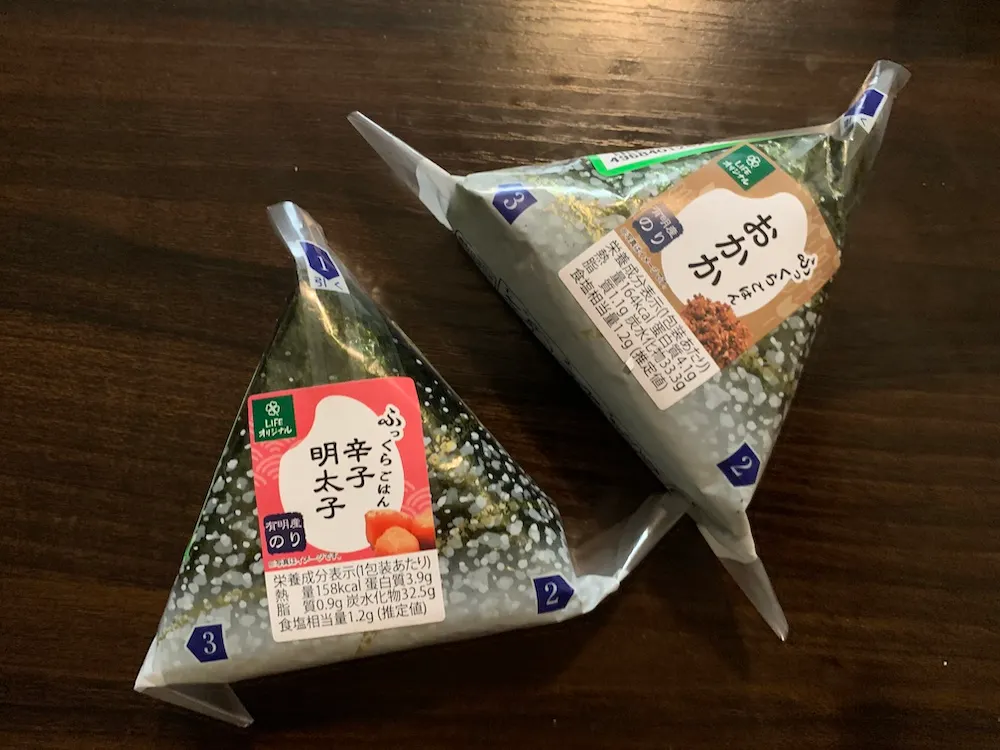
A few weeks ago, I watched a young woman from France sitting on the bench outside a Lawson near Shinsaibashi. She was holding a tuna mayo onigiri with both hands, reading the back of the package with the kind of focused attention most of us reserve for something genuinely important. When she finally unwrapped it — that distinctive three-step ritual with the plastic — she took her first bite and just stopped. Eyes closed—something like quiet disbelief on her face.
I had just walked out of the same store, holding my own onigiri. I’d already eaten three that week without once stopping to think about what I was eating.
I’m not telling this story to romanticize a tourist moment. I’m telling it because something about watching her made me uneasy — and it took me a few days to understand why. It wasn’t that the experience moved her. It was that I wasn’t.
The Ordinary Is Never Actually Ordinary
That onigiri she was holding — the one that stopped her in her tracks — is rice. Shaped by hand, or by a machine that imitates a hand. Salt. A sheet of nori. Maybe some tuna mixed with mayonnaise.
But rice in Japan is not simply rice.
Recent archaeological findings have pushed back the timeline of rice cultivation in Japan further than we once believed — into the Jomon period, long before the Yayoi era that textbooks traditionally cite. This means that somewhere around three thousand years ago, possibly more, people on these islands were already tending rice paddies, watching the water levels, reading the sky.
They were also eating shellfish. We know this because their kitchen middens — kaizuka, shell mounds — are scattered across Japan even today as place names. Kaizuka in Osaka. Kaizuka in Chiba. Fragments of a diet embedded permanently into the geography of the country.
What strikes me about this is not the antiquity of it. It’s the attention. These were people who paid close attention to what the land and the sea gave them. They had to. Their lives depended on it.
When Gods Ate With People
The ancient Japanese didn’t just eat what the land gave them. They gave it back — symbolically, ritually, as an acknowledgment that what they received was not owed to them.
In the Kojiki, Japan’s oldest chronicle of myth and history, two goddesses appear in one of its stranger passages: Kisagaihime, the clam shell goddess, and Umugihime, the ark shell goddess. They are summoned to restore the god Okuninushi after he is killed. They do so by grinding shell into a paste that becomes mother’s milk. It’s a peculiar myth, but it preserves something: the sea’s gifts were understood as having their own divine agency. The shellfish didn’t belong to humans. They were on loan.
The rice, too, arrived with a story. Ninigi no Mikoto, the grandson of Amaterasu, the sun goddess, descended from the heavens to the Japanese islands carrying with him seeds of sacred rice — the same rice, in a theological sense, that grows in Japan today. The Niiname-sai, the harvest festival held each autumn, and the Daijosai, performed once in the reign of each new Emperor, re-enact this moment: the first rice of the season offered to the gods before anyone eats.
But here is the part of Shinto that often gets lost in translation: the gods don’t keep the offering. In a practice called shinku — sometimes translated as “communal eating with the gods” — the food offered to the deities is brought down from the altar and shared among the community. The gods eat first. Then the people eat what the gods have eaten.
This is not a metaphor. It’s a practice still observed at shrines across Japan. The distance between the divine and the human, in Shinto, was never meant to be infinite.
A Word With No English Translation
Before every meal in Japan, we say itadakimasu.
Most Japanese children learn it as table manners. You say it before you eat, the same way you say please and thank you. But the word itself means something more specific: I humbly receive. It comes from the verb itadaku, which means to receive something from someone above you, with both hands, with your head slightly bowed.
You are not just acknowledging the food. You are acknowledging everything that made the food possible. The farmer who grew it. The fisherman. The truck driver. The person who cooked it. And further back — the soil, the rain, the sea, the sun.
When you trace itadakimasu back far enough, you arrive at the shrine altar. At Ninigi’s seeds. At the clam goddess grinding shell into something that could restore life.
This is what I mean when I say that Shinto offers a different shape of mindfulness. It doesn’t ask you to empty your mind. It asks you to fill it — briefly, honestly — with the full weight of what you’re about to receive.
What We’ve Stopped Noticing
I don’t want to be the person who says things were better before. They weren’t, not simply, not across the board. People in Jomon Japan died from things we now cure in a weekend. The abundance we live inside — the ability to walk into a Lawson at midnight and buy a perfectly made onigiri for 130 yen — is genuinely extraordinary. It represents centuries of agricultural refinement, infrastructure, refrigeration, logistics, and labor.
But that’s exactly the problem. It’s so extraordinary that it has become invisible.
Somewhere in the gap between extraordinary and invisible, itadakimasu became a reflex. A sound you make before eating, the way you say “fine” when someone asks how you are. The word is still there. What it was pointing at has quietly left the room.
I don’t think this is unique to Japan. I think it’s what happens when scarcity disappears. You stop noticing what you have because the effort of obtaining it is no longer visible to you. The fish arrives in a plastic tray. The rice is microwaveable. The sea and the soil are somewhere behind the packaging, behind the supply chain, behind the convenience.
What I can speak to is Japan specifically, and to my own generation — people old enough to remember when rice was something your grandmother made with visible intention, something you didn’t waste, something that arrived at the table with a certain weight. That weight has not disappeared. We have just stopped feeling it.
The Frenchwoman’s Onigiri
I keep coming back to the woman at Lawson.
She didn’t know about Ninigi no Mikoto. She almost certainly didn’t know the word itadakimasu or what it meant. She had no framework for Shinto, no understanding of Niiname-sai or the ritual logic of shrine offerings.
And yet she stopped. She paid attention. She received what she was given with something resembling gratitude, even if she couldn’t have named it that.
I had the framework. I had grown up with the word, the rituals, the stories. I walked past all of it to check my phone.
I’m not drawing a lesson from this. I’m not sure what the lesson would be, or who it belongs to. What I’m left with is the discomfort of the gap — between what I know and what I actually practice, between the tradition I was given and how casually I’ve come to carry it.
Maybe that discomfort is where it starts. Or maybe this is just what happens to every generation, and the generation after us will feel it fresh again.
The rice doesn’t change. Only our relationship to it does.
What to Take Away
There are two ways to be present with what you eat.
One is to empty yourself — to let the meal be simply what it is, in this moment, without history or story. The Zen direction.
The other is to fill yourself — to let the full weight of what arrived on the table actually land. Where it grew. What moved it from the field to the plate. Whose hands were involved, seen and unseen. The Shinto direction, if you want to call it that.
Itadakimasu was designed for the second kind. Whether it still performs that function depends entirely on who is saying it and whether anyone is home when they say it.
What I can tell you is that a French woman eating an onigiri on a bench outside a Lawson in Shinsaibashi stopped completely — without knowing any of this history — because something in the experience was too present to ignore.
And I walked past her, heading somewhere.
I said itadakimasu this morning. I think I meant it.
I’m fairly sure I’ll forget to mean it tomorrow. And probably remember again the day after.
That might be what practice actually looks like, rather than the version I prefer to imagine — where the understanding arrives once and stays.
Never Miss an Update
New articles and exclusive cultural insights are announced first on LinkedIn. If you want to keep expanding your understanding of Japanese philosophy and modern resilience, let’s stay in touch.
[Follow My LinkedIn Profile Here]
If this article brought a moment of peace or insight to your day, consider supporting my work.
Thank you.