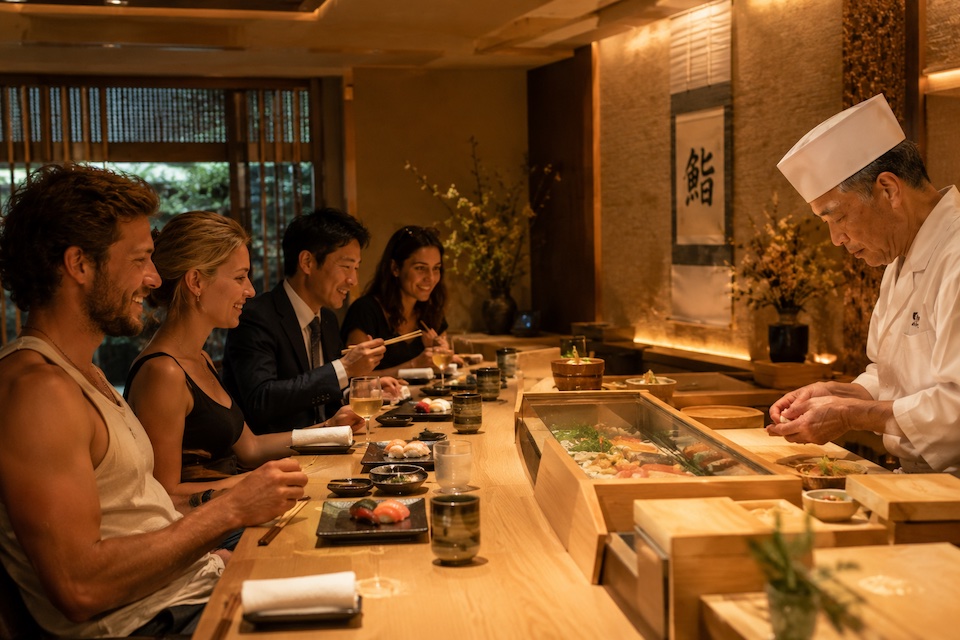
A few weeks ago I wrote about an evening at a sushi counter I’ve visited for years. Several tourists came in wearing tank tops and shorts, and I didn’t like it. The chef, a man about my age, served them with the same care he gives me. After they left, he said they probably didn’t know our customs, that they’d come a long way, and that it might be their first and last trip to Japan. I went home ashamed of myself.
That essay, Tourists in Tank Tops, and the Margin I Had Lost, was published in The Narrative Arc. [https://medium.com/the-narrative-arc/tourists-in-tank-tops-and-the-margin-i-had-lost-fe1687322aad?sharedUserId=shibumi4011]
I showed it to two friends. Nicholas is a forty-five-year-old New Yorker who runs a financial firm in Osaka’s Kitahama district and explains most of life through the New York Yankees. Catherine is a graduate student from California at Osaka University, where she studies the sociology of Japanese culture. (Both are composites drawn from real people I know.)
I expected them to talk about sushi. Nicholas had something else on his mind.
“I Was the Guy in the Tank Top”
Nicholas: I read it twice. And I need to confess something before we go any further.
Takeshi: Go ahead.
Nicholas: I was the guy in the tank top.
Catherine: (laughing) No.
Nicholas: First week in Osaka, five years ago. August. You know what Kitahama feels like in August. A colleague takes me to a sushi place, little counter, maybe eight seats. I show up in a tank top, shorts and flip-flops, because it’s ninety-five degrees and I’m from New York and nobody told me anything.
Takeshi: What did the chef do?
Nicholas: Nothing. That’s what gets me now. He served me like I was the Emperor. Explained every piece in broken English. Smiled. My colleague didn’t say a word either. I walked out of there thinking, what a great country, everybody’s so relaxed.
Catherine: When did you figure it out?
Nicholas: Months later. I went back to the same place in a suit, straight from a meeting, and I noticed the chef’s coat. Spotless. Pressed. And I looked at the other customers, and I thought, oh no. Oh no, that was me.
Takeshi: And the chef never said anything.
Nicholas: Never. Five years, and he’s never said a word about it. I’m not even sure he remembers. But I do.
Why No One Tells You the Rules in Japan
Catherine: This is what I find so interesting from a research point of view. Nicholas, nobody told you. Not the chef, not your colleague. Takeshi, would you have said something?
Takeshi: Honestly? No. I would have felt it, and I wouldn’t have said it.
Catherine: So the rule exists, everyone around you knows it, and the one person who doesn’t know it is the only one who isn’t allowed to be told.
Takeshi: When you put it that way, it sounds cruel.
Catherine: It’s a little cruel.
Takeshi: It is. I should be honest about that. We have a phrase, kūki wo yomu (空気を読む), “reading the air.” You’re expected to sense what’s appropriate without anyone spelling it out. It works well among people who grew up breathing the same air. For someone who just landed at Kansai Airport, there’s nothing to read. And instead of telling them, we look at them. A look like that can be worse than a sentence.
Nicholas: I’ve gotten that look. On the train, early on. I was on the phone.
Takeshi: Everyone who has lived here has gotten that look.
Nicholas: Including you?
Takeshi: I gave it, at the sushi counter. That’s why I wrote the essay.
Do You Tip in Japan? What Nicholas Learned Instead
Nicholas: Can I tell you the other half of it? Because the tank top was only the beginning.
Takeshi: Please.
Nicholas: In New York, if somebody takes care of you, you tip. That’s how you say thank you. Twenty percent, maybe more if they were great. So my first month here, I’m leaving cash on the table everywhere. And twice, twice, a waiter came running down the street after me holding the money, because they thought I’d forgotten it.
Catherine: That happens to everyone. It’s practically a rite of passage.
Nicholas: It was embarrassing. I felt like I didn’t know how to say thank you in this country. Money was the only language I had for it.
Takeshi: And now?
Nicholas: Now I think I get it, or I’m getting closer. The chef doesn’t want my twenty percent. He wants me to show up properly. Be on time for the reservation. Put my phone away. Eat the piece when he puts it down, not five minutes later after I’ve photographed it. Say gochisōsama deshita (ごちそうさまでした) on the way out like I mean it.
Takeshi: That’s it exactly. In your essay terms, you stopped paying him and started answering him.
Nicholas: And honestly? It’s harder. A tip costs me money. Respect costs me attention. I’ve got more money than attention.
Catherine: That might be the most Kitahama sentence I’ve ever heard.
The Bleacher Creatures and the Unwritten Rule
Catherine: But Nicholas, here’s what I want to know. You were the tank-top guy. Now you’ve changed. So how do you feel when you see tourists in tank tops?
Nicholas: (long pause) Annoyed.
Catherine: Really?
Nicholas: I know. I know. It’s ridiculous. Five years ago I was them, and now I’m sitting there feeling exactly what Takeshi felt. Which, by the way, is the worst part of reading your essay. I recognized myself in the tourists and in you.
Takeshi: Both sides of the counter.
Nicholas: Let me put it in terms I understand. You know the Bleacher Creatures? Right field at Yankee Stadium?
Takeshi: I’ve heard you mention them. Once or twice.
Nicholas: More than twice. Top of the first inning, the Creatures do the roll call. They chant every position player’s name, one by one, until the guy turns and acknowledges them. Judge does it every game. It’s sacred. And there’s no sign at the gate explaining it. Nobody hands you a pamphlet.
Catherine: So a tourist sits in the bleachers…
Nicholas: A tourist from, I don’t know, Munich, sits in the bleachers, and in the middle of the roll call he stands up to go get a hot dog, blocking the whole row. And forty guys turn around and look at him like he just spit on Babe Ruth’s grave. He has no idea what he did. How could he? It’s written nowhere. You learn it by sitting there for fifty games.
Takeshi: And the man from Munich only has one game.
Nicholas: One game. Maybe two if the Red Sox are in town.
Why a Week in Japan Is Too Short to Learn Its Customs
Catherine: This is actually what my field would say, more or less. There’s a concept from Pierre Bourdieu called habitus. It’s the set of habits and instincts you absorb from the world you grow up in. How you sit, how you speak, what feels polite. You don’t learn it from a book. It settles into your body over years.
Nicholas: Years. Not a ten-day vacation.
Catherine: Right. A tourist can read a guidebook that says “don’t tip,” because that’s a rule you can write down. But the feeling of what to wear across from a man in a pressed white coat? That’s habitus. It isn’t in the guidebook, and even if it were, reading it wouldn’t put it into your body.
Takeshi: A trip is too short for that. Far too short. The chef understood that immediately. It took me longer, and I’ve lived here my whole life.
Nicholas: So the tourists can’t win.
Takeshi: I wouldn’t say that. They’re doing the one thing a short trip allows. They came. They sat down at the counter. They let a stranger feed them in a language they don’t speak. That takes some courage, actually.
Catherine: And it was the chef’s job, in a way, to meet that courage.
Takeshi: He saw it that way. I didn’t, that night.
Should Japan Just Explain the Rules?
Nicholas: Okay, here’s where I push back a little.
Takeshi: Good.
Nicholas: If the problem is that nobody tells anyone anything, why not just tell them? Put a little card on the counter. “Our chef prepares from five a.m. Please dress with care.” Done. Problem solved. In New York, we’d have that sign up by Tuesday.
Catherine: Some places in Kyoto do that now. Signs about photos, about touching things.
Takeshi: They do. And I understand why. But I feel something get lost when I see those signs.
Nicholas: Lost how?
Takeshi: The chef’s preparation is offered without being announced. If he hangs a sign asking for respect, it starts to feel like a transaction. “I cleaned for you, so you owe me a collared shirt.” The thing that moved me about him was that he asked for nothing.
Nicholas: But that’s a little romantic, isn’t it? He asks for nothing, and then guys like you sit there and silently judge the customer on his behalf.
Takeshi: (pause) Yes. That’s fair.
Nicholas: So which is kinder? The sign, or the look?
Takeshi: I don’t know. I really don’t. The sign is clearer. The look is crueler. And the chef did a third thing, which was neither.
Catherine: He just served them.
Takeshi: He just served them.
A Grain of Rice
Catherine: Can I ask where this comes from for you? The feeling that a guest owes something back. Because in California, honestly, the customer is king. You pay, you get served.
Takeshi: I think it starts with rice. When I was a boy, if I left even one grain in my bowl, the adults would tell me I’d go hungry when I grew up. Or that the gods would punish me. Or that I was letting down the farmers who’d worked so hard to grow it. Every meal, someone was reminding me that there were people behind the food.
Nicholas: That’s a lot of pressure for one grain of rice.
Takeshi: It is. Kids today mostly don’t hear it the same way. But it got into me. When I eat sushi at that counter, I can’t help seeing the knife-sharpening and the floor-wiping and the years of training. Then someone walks in dressed for the beach, and the boy who was scolded over a grain of rice gets upset.
Catherine: So the irritation and the gratitude come from the same place.
Takeshi: I hadn’t thought of it like that. But yes. I think they’re the same root.
Nicholas: That’s Judge, by the way.
Catherine: Of course it is.
Nicholas: No, listen. The same thing that makes Judge run out every routine grounder is what makes him furious when a teammate jogs. You can’t have one without the other. The discipline and the frustration come as a pair. The trick is what you do with the frustration.
Takeshi: And the chef did something with it that I couldn’t.
The Last Word
Catherine: So what do you want readers to take from all this? Should tourists dress up? Should locals relax?
Takeshi: I don’t want to tell anyone what to do. I’d only be the man at the counter giving the look again, in writing.
Nicholas: Then I’ll say it, because I was the guy. If you’re visiting, you won’t learn it all. You can’t. Ten days isn’t enough. But if you notice the chef’s coat, you’ve already started.
Catherine: And if you live here?
Nicholas: Then remember you were the tourist once. Most of us were, somewhere.
Catherine: Takeshi?
Takeshi: I’m still thinking about the people in tank tops. I hope they had a wonderful time.
Nicholas: Me too. (pause) Although I did give a guy a look on the Midosuji Line last Thursday.
Catherine: So the two of you are the problem now.
Takeshi: (laughing) It seems so.
Never Miss an Update
New articles and exclusive cultural insights are announced first on LinkedIn. If you want to keep expanding your understanding of Japanese philosophy and modern resilience, let’s stay in touch.
[Follow My LinkedIn Profile Here]
If this article brought a moment of peace or insight to your day, consider supporting my work.
Thank you.