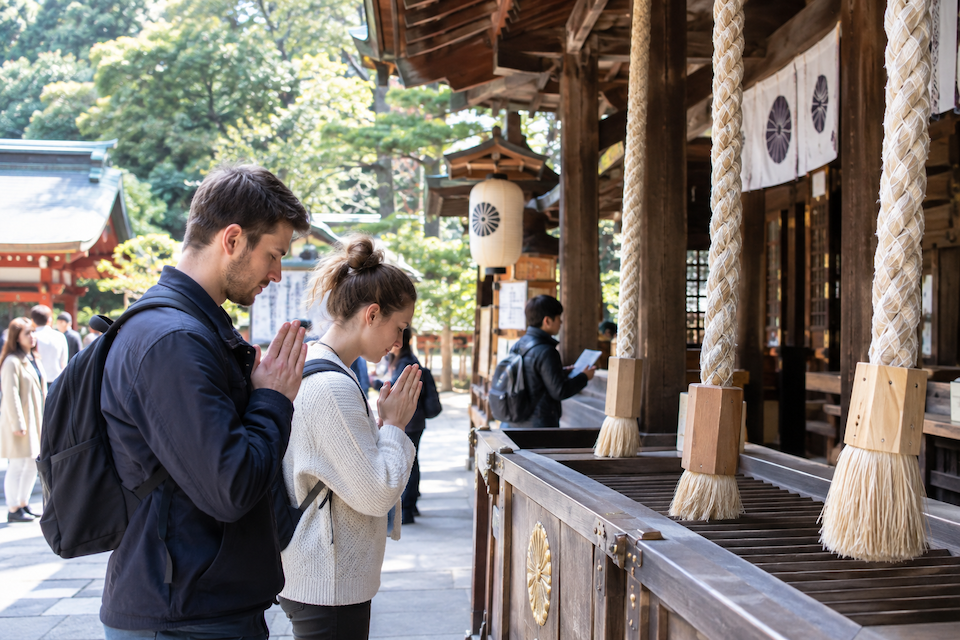
The most common worry foreigners have before visiting a Shinto shrine is that they will do something wrong. They will bow at the wrong time. They will clap incorrectly. They will accidentally offend a god they do not understand.
Here is the good news: Shinto shrines welcome everyone. There is no membership requirement. There is no entrance exam. There is no conversion necessary. You do not need to believe in kami. You do not need to be Japanese. The shrine exists, the kami are there, and you are invited.
That said, knowing what you are doing and why makes the experience significantly better. Not because the kami will punish mistakes, but because understanding the meaning behind each element transforms a tourist photo opportunity into something genuinely worthwhile.
The torii gate: Entering sacred space
The torii (鳥居) is the most recognizable symbol of Shinto. It marks the entrance to a shrine, and it functions as a threshold between the everyday world and the sacred domain of the kami.
Most torii are painted vermillion red (though some are raw wood, stone, or even concrete). The color has practical and symbolic roots: the red-orange pigment used traditionally contained mercury compounds that helped preserve the wood, and the color itself is associated with vitality and protection against evil.
When you approach a torii, pause briefly and bow slightly before passing through. Walk to the side, not through the center. The center of the path (sei-chū, 正中) is considered the kami’s pathway. You are a visitor in their space. Staying to the side is not a rule enforced by anyone, but it reflects the appropriate relationship: you are here by invitation, not by right.
Some shrines have multiple torii gates, creating a tunnel effect. Fushimi Inari Shrine in Kyoto is famous for its thousands of vermillion torii covering hillside paths. Each gate was donated by a business or individual as an offering, and walking through the tunnel of gates is both visually spectacular and symbolically meaningful: you are moving deeper and deeper into the kami’s world.
The temizu: Washing before you pray
Near the shrine entrance, you will find a stone basin with running water and wooden ladles. This is the temizuya (手水舎) or chōzuya, and using it is a simplified form of misogi, the Shinto practice of purification.
The procedure is straightforward:
Pick up the ladle with your right hand. Scoop water and pour it over your left hand. Switch the ladle to your left hand and pour water over your right hand. Switch back to your right hand, cup a small amount of water in your left palm, and rinse your mouth (do not swallow). Spit the water quietly beside the basin, not back into it. Pour the remaining water down the handle of the ladle to clean it for the next person. Replace the ladle.
You are not washing dirt off your hands. You are symbolically cleansing yourself of kegare (spiritual depletion) before entering the kami’s presence. Think of it less as hygiene and more as a moment to shift your attention from the noise of the outside world to the stillness of what is ahead.
Some shrines have replaced the communal basin with individual water spouts since 2020, for public health reasons. The purification principle is the same.
The sandō: Walking the approach
The path from the torii to the main hall is called the sandō (参道). Walking it slowly and quietly is part of the experience. Many shrines are surrounded by trees (chinju no mori, the protective grove), and the transition from street noise to forest quiet is itself a form of preparation.
Along the sandō, you may see:
Komainu (狛犬): Paired stone guardian figures flanking the path or the main hall. They look like lions or dogs, one with its mouth open (saying “a,” the first sound in the Sanskrit alphabet) and one with its mouth closed (saying “un,” the last sound). Together they represent the beginning and end of all things. Their job is to guard the kami and the shrine.
Inari fox statues (kitsune): If the shrine is dedicated to Inari, the kami of rice, fertility, and business prosperity, the guardians will be foxes instead of lion-dogs. Foxes are considered the messengers (shinshi) of Inari. They are not the kami themselves, but the kami’s envoys. You may see them holding keys, jewels, rice sheaves, or scrolls in their mouths.
Stone lanterns (tōrō): These line many sandō paths. Originally lit to guide worshippers, they now serve a more aesthetic function, though some shrines still light them during festivals.
How to pray: Nihai-nihakushu-ichihai
The standard form of prayer at a Shinto shrine is called nihai-nihakushu-ichihai (二拝二拍手一拝): two bows, two claps, one bow.
Stand before the main hall (haiden). If there is an offering box (saisen-bako), drop in a coin. Five-yen coins (go-en, 五円) are traditional because the word go-en also means “good fortune” or “connection” (ご縁), but any coin is fine.
If there is a bell rope (suzu), shake it to ring the bell. The sound is believed to get the kami’s attention and to purify the space.
Then: bow deeply twice. Clap your hands twice at chest height (bringing your palms together with a sharp sound). With your hands still together, close your eyes and make your prayer silently. Then bow deeply once more.
That is it. There is no required prayer text. You can pray in any language. You can ask for anything or simply express gratitude. The kami are not listening for specific words. They are responding to sincerity.
A few exceptions: at Izumo Taisha in Shimane Prefecture, the custom is four claps instead of two. At some other shrines, the specific form varies. If you are unsure, watch what the local visitors do and follow their lead.
Omamori: Sacred charms
Shrine offices sell small fabric pouches called omamori (お守り). These are protective charms, each designed for a specific purpose:
Kōtsū anzen (交通安全): Traffic safety. These are among the most popular. People hang them from their car’s rearview mirror.
Gakugyō jōju (学業成就): Academic success. Students buy these before exams.
En-musubi (縁結び): Romantic connection. Popular at shrines known for love, such as Jishu Shrine in Kyoto.
Kenko (健康): Health and physical well-being.
Shōbai hanjō (商売繁盛): Business prosperity. Especially common at Inari shrines.
Omamori are not souvenirs in the usual sense. They are believed to contain a portion of the kami’s power, sealed inside the pouch. Opening the pouch is considered disrespectful and is said to release the power.
Traditionally, omamori are returned to the shrine after one year (usually at New Year, when shrines collect old charms for ritual burning). The power is considered spent after a year, and the charm should be respectfully retired. You can return it to any shrine, not necessarily the one where you bought it.
Ema: Prayer boards
Ema (絵馬) are small wooden plaques on which you write a wish or prayer. The word literally means “picture horse,” because in ancient times, real horses were offered to shrines as gifts to the kami. Over time, paintings of horses replaced actual horses, and eventually the paintings shrank to palm-sized wooden boards.
You buy an ema at the shrine office, write your wish on the back (in any language), and hang it on the designated rack near the shrine. The wishes are left exposed, and yes, other visitors can read them. Popular ema at famous shrines near exam season are a fascinating window into human hopes: “Please let me pass the entrance exam for Tokyo University.” “Please let Tanaka-kun notice me.”
You are not required to believe that the ema will make your wish come true. The act of writing it, of clarifying what you want and placing it in a sacred space, has its own value.
Omikuji: Fortune slips
Omikuji (おみくじ) are paper fortune slips. You draw one randomly (either by shaking a numbered stick from a container or by pulling a folded paper from a box) and read your fortune.
The standard rankings, from best to worst: dai-kichi (great blessing), chū-kichi (middle blessing), shō-kichi (small blessing), kichi (blessing), sue-kichi (future blessing), kyō (bad luck), dai-kyō (great bad luck). There are variations depending on the shrine.
If you draw a good fortune, you can keep it. If you draw a bad fortune, the traditional response is to tie it to a tree branch or a designated rack at the shrine. By leaving the bad fortune there, you symbolically leave it with the kami rather than carrying it home.
Omikuji are not prophecies. They are more like advice. The fortune typically includes guidance about various aspects of life: health, business, love, travel, lost items. Reading between the lines is part of the experience.
What about deeper rituals?
Beyond the standard prayer, shrines offer more formal rituals for those who want them.
Kitō (祈祷): A formal prayer conducted by the shrine priest inside the haiden. You request it at the shrine office, pay a fee (usually a few thousand yen), and the priest performs a purification and prayer on your behalf. This is commonly done for traffic safety with a new car, business success for a new venture, or safety during pregnancy.
Shichi-go-san (七五三): A ceremony for children at ages three, five, and seven. Families dress children in formal kimono and visit the shrine for blessings.
Hatsumōde (初詣): The first shrine visit of the new year. Tens of millions of Japanese people visit a shrine in the first three days of January.
As a foreigner, you can participate in any of these. Shrine staff are accustomed to visitors from abroad and will help you through the process. The only thing you need to do is show up with respect and a willingness to follow the forms.
The spirit behind the forms
All of these practices (the bow, the clap, the water, the charm, the fortune slip) are forms. They are containers. What you put into them is up to you.
Some visitors come with deep faith. Some come with casual curiosity. Some come because the shrine is beautiful and they want to take a photo. All of these motivations are acceptable. Shinto does not police your inner state.
But I will say this from personal experience: the forms work better when you slow down. When you actually feel the water on your hands instead of rushing through the motions. When you let the clap be a real clap, not a perfunctory gesture. When you stand before the haiden and allow a moment of genuine silence before you pray.
The kami may or may not be listening. That is a question for theologians. But you are definitely listening to yourself. And a shrine, with its trees and stones and water and silence, is an excellent place to do that.
Frequently Asked Questions (FAQ)
-
Do I need to remove my shoes at a Shinto shrine?
-
Generally, no. Outdoor shrine areas (the torii, sandō, and main prayer area in front of the haiden) do not require removing shoes. However, if you are invited inside a building for a formal prayer (kitō), you will be asked to remove your shoes before stepping onto the raised floor. This is standard practice in Japan for any indoor space with tatami or wood flooring.
-
Is it disrespectful to take photos at a shrine?
-
Photography is generally allowed in outdoor shrine areas. However, some shrines prohibit photography inside the main hall or in certain sacred areas. Look for signs with a camera icon crossed out. During formal ceremonies, it is respectful to put the camera away. When in doubt, ask at the shrine office (shamusho).
-
Can I buy omamori as gifts for people back home?
-
Yes, and many visitors do. Omamori make meaningful gifts because they carry a specific blessing (health, safe travel, academic success). The power is considered to be sealed inside the pouch regardless of who carries it. When giving one as a gift, it is a nice touch to explain what the specific charm is for.
If this article brought a moment of peace or insight to your day, consider supporting my work.
Thank you.