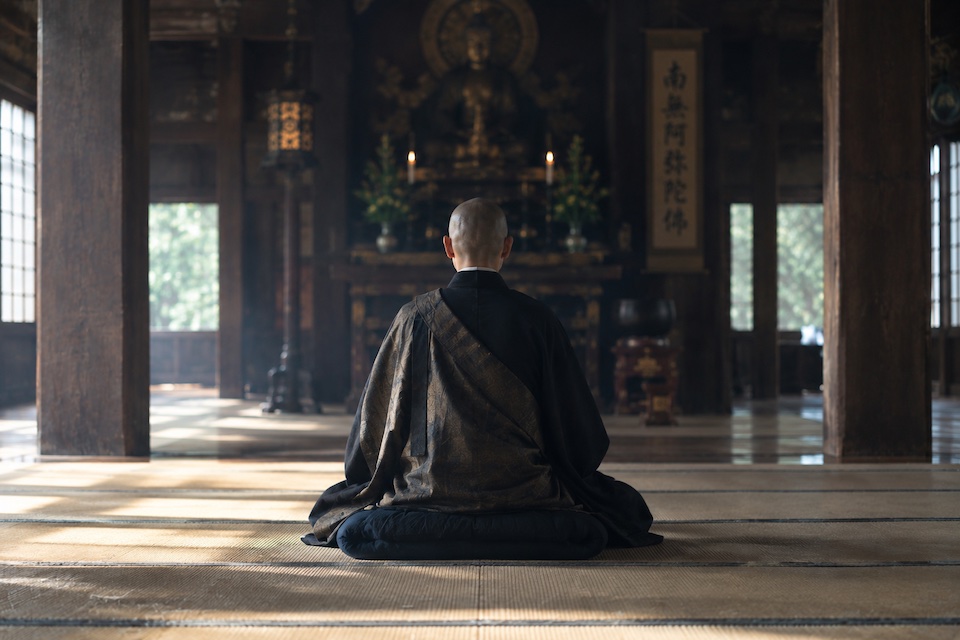
There’s a moment I’ve noticed, watching people finish a meditation session. The timer sounds. They open their eyes. They pick up their phone. Just like that — back to life. As if a door closed behind them.
I understand it. I’m not criticizing it. But that door is the thing I want to talk about.
The Wall We Build Between Practice and Life
In the Western approach to mindfulness, there is almost always a clear boundary. On one side: the session. Cushion, silence, breath, presence. On the other side: everything else. The commute, the inbox, the lunch meeting, the noise.
The session is treated as a protected zone, carved out from the chaos. You enter it deliberately, you exit it deliberately, and the qualities practiced inside — presence, attention, stillness — largely stay inside.
I understand why this boundary feels necessary. And in one sense, it is. You need a place to begin. A container.
But over time, I wonder if the container itself becomes the problem. If the wall between “mindfulness time” and “the rest of life” is actually what prevents mindfulness from becoming what it’s capable of being.
Because in Zen, there is no such wall. Not conceptually, and not in practice.
When we treat stillness as something that exists only inside a scheduled session, we train ourselves to be present for thirty minutes a day and distracted for the remaining twenty-three and a half hours.
The Afterglow Is Real — If You Let It
When I sit in the morning — and I want to be clear, I’m just sitting because there are a few minutes before breakfast, nothing more ceremonious than that — something happens that doesn’t stop when I stand up.
It’s not a feeling exactly. More like a quality of pace. The tea tastes like tea. The light through the window is actually visible to me. When I walk to my desk, I walk rather than drift. Things are slightly more present than they were.
This is the afterglow of sitting — and I’d argue it is as important as the sitting itself.
Not because it’s some elevated spiritual state. It isn’t. It’s subtle, and it fades. But in the minutes and sometimes hours that follow, there’s a thread of attention still running. If I reach for my phone out of habit, I notice the reach. If I eat while working, I notice I’m eating while working. The quality of awareness cultivated in silence doesn’t vanish the moment I stand up — it continues, quietly, if I let it.
The question is: do we let it?
We’re Trained to Switch Modes — and It Costs Us
Here’s what I think happens instead.
We finish the session and, almost reflexively, re-enter full-speed life. The phone. The news. The first task of the day. We’ve been conditioned to context-switch so efficiently that we treat the end of meditation the same way we’d treat the end of any other scheduled block — close it out, move on.
And in doing so, we discard what may be the most transferable part of the practice.
I’m not suggesting you sit in slow motion for the rest of the morning. Life has things in it. People need answers, trains run on schedules, children need to be fed. I know this.
But there is a difference between re-entering life and slamming back into it. Between carrying the thread of attention with you and dropping it at the door.
That difference doesn’t require more time. It requires a different relationship to the transition itself.
What Japanese Daily Life Understands About This
This is where I find it difficult to translate, but let me try.
In Japanese daily life, the practices most aligned with what the West calls mindfulness are not separate from ordinary activities — they are ordinary activities. Itadakimasu before a meal is not a mindfulness exercise you do before eating. It is the eating, beginning. The bow in the dojo is not preparation for training. It is the training, beginning.
There is no mode-switch. There is no wall. The attention brought to the cushion is the same attention brought to the kitchen, the workshop, the conversation. Not because Japanese people are more enlightened — they’re not, and plenty are just as distracted as anyone — but because the culture doesn’t draw the same line between sacred time and ordinary time.
The concept I keep returning to is 一期一会 (ichigo ichie) — roughly, “one time, one meeting.” The understanding that this moment, this particular gathering of circumstances, will never occur again.
Not in a dramatic sense. Just as a quiet fact.
This meal, this conversation, this light at this hour — it won’t repeat. That’s all. But if you actually hold that, even lightly, multitasking becomes harder to justify. The present becomes harder to abandon.
一期一会 (Ichigo ichie) is not a philosophy to believe. It is a fact to inhabit — that this exact moment, this precise arrangement of people and light and circumstance, is happening exactly once.
This is mindfulness as a baseline orientation, not a scheduled appointment.
The Session Is the Beginning, Not the Practice
What I want to offer — carefully, because your practice belongs to you — is a small reframe.
What if the meditation session is not the practice, but the preparation for practice?
The thirty minutes of sitting, or ten, or five — that’s where you learn what sustained attention feels like. Where you remember, again, how to come back to the breath when the mind wanders. It’s essential. But it’s the training ground, not the arena.
The arena is the rest of the day.
The conversation you’re half-present for. The meal you eat while reading. The commute you spend rehearsing tomorrow’s argument. These are where attention either holds or doesn’t — and where mindfulness, if it has actually taken root, begins to matter.
So when the timer sounds, consider not reaching for the phone immediately. Just sit for another minute. Let what was cultivated in the silence have somewhere to go. Feel the room. Notice what it’s like to be a person in a body, in a space, before the day fully begins.
That minute of transition — unhurried, unstructured — might be more important than the session that preceded it.
What Changes When the Wall Comes Down
I’ve watched this in myself over many years, and I’ve noticed it in others who practice seriously: the quality of someone’s sitting eventually shows up in the way they walk. In how they listen. In whether they’re actually there when you’re talking to them.
It’s not dramatic. It doesn’t look spiritual. It just looks like someone who isn’t quite as far away as most people are.
That’s what’s available on the other side of the wall — when it comes down.
Not a transformed life. Not an enlightened mind. Just a person slightly more present in the life they already have.
The gap between “meditation time” and the rest of your life is not just a scheduling inconvenience. It may be the central obstacle. The session matters. The minute after matters more.
Never Miss an Update
New articles and exclusive cultural insights are announced first on LinkedIn. If you want to keep expanding your understanding of Japanese philosophy and modern resilience, let’s stay in touch.
[Follow My LinkedIn Profile Here]
If this article brought a moment of peace or insight to your day, consider supporting my work.
Thank you.