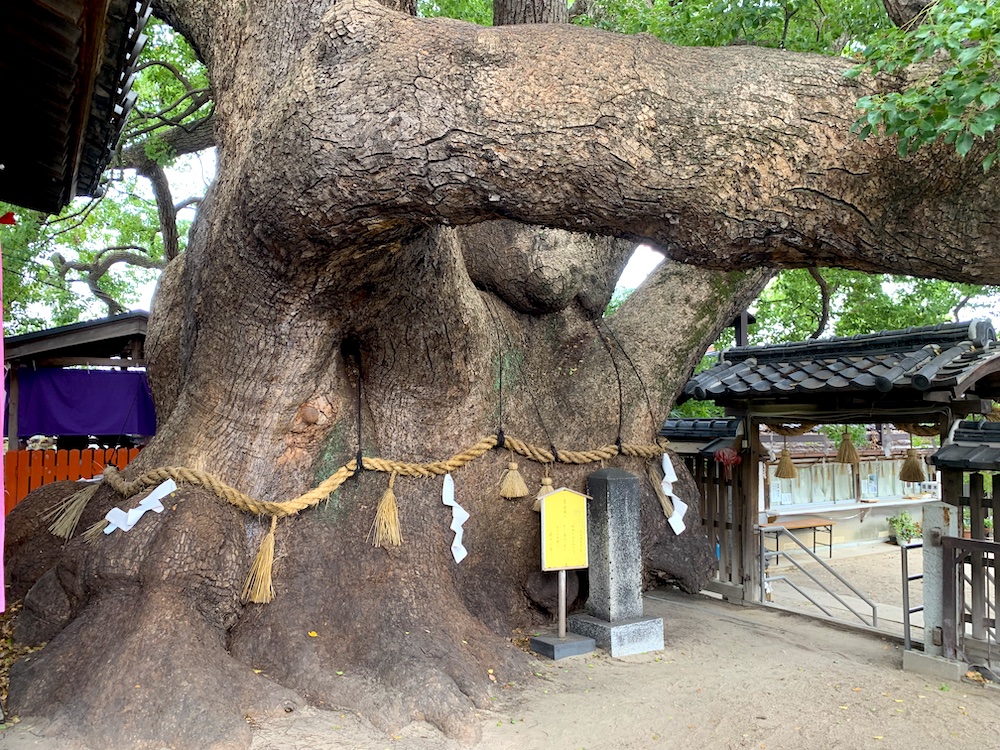
It will be old. Probably centuries old. Its trunk will be too wide for one person to wrap their arms around. And around that trunk, you will notice a thick rope made of twisted rice straw, hung with white paper streamers that zigzag like lightning bolts.
Nobody put a plaque on it explaining what it is. There is no entrance fee, no gift shop, no guided tour. The tree is just there, marked with a rope, and locals walk past it every day without pausing.
That rope is called a shimenawa. Those paper streamers are called shide. Together, they mark the boundary between the ordinary world and the sacred. What they are telling you is: something lives here that is not the tree, or rather, something that is the tree but is also more than the tree. A kami.
Why Japanese people wrap ropes around trees
The practice of marking sacred trees (goshinboku, 御神木) with shimenawa is one of the oldest continuous spiritual practices in Japan. It predates written history. It predates the word “Shinto.”
The underlying idea is simple and, to Western ears, strange: certain natural objects are not just objects. They are yorishiro (依り代), vessels or dwelling places where kami reside. A particularly old tree, an unusually shaped rock, a waterfall with a certain sound, a mountain with a certain presence. These things attract kami, or perhaps it would be more accurate to say that kami are already present in them, and humans learned to recognize the signs.
The shimenawa marks the recognition. It does not create the sacredness. It announces it. This is an important distinction. In many Western religious traditions, a place becomes sacred through human action: consecration, blessing, the building of a church. In Shinto, the place is already sacred. The rope is simply the human acknowledgment of what was already there.
The most famous goshinboku in Japan is the great camphor tree at Atami’s Kinomiya Shrine, estimated to be over 2,000 years old. But you do not need to visit a famous shrine to see this practice. Walk through any Japanese neighborhood with a shrine, and chances are you will find a tree with a rope around it. Sometimes it is a massive ancient cedar. Sometimes it is a modest pine in a residential area. Size is not the only criterion. What matters is the quality that the tree carries, something that the community has recognized, generation after generation.
The forests that shrines have been protecting for centuries
Behind many Shinto shrines in Japan, there is a grove of trees that has never been logged. These are called chinju no mori (鎮守の森), literally “the grove that guards and pacifies.”
These forests exist because they belong to the kami. Cutting them down would offend the kami of the shrine. This is not a metaphor. It is a practical reason that has, for centuries, kept developers, loggers, and farmers away from these patches of old-growth forest.
The ecological consequences are remarkable. In a country where most lowland forests were cleared for agriculture long ago, chinju no mori are often the only remaining fragments of original forest in urbanized areas. Ecologists have studied them and found that they contain species diversity far beyond what you would expect for their size. They function as miniature preserves, holding plant and animal species that have disappeared everywhere else.
The late ecologist Akira Miyawaki devoted much of his career to studying these shrine forests. He found that they represented the natural potential vegetation of Japan, the forest that would exist if humans had never intervened. His method of rapid reforestation, now used worldwide, was directly inspired by the structure and composition of chinju no mori.
This is worth sitting with for a moment. A spiritual practice that marks certain trees and forests as sacred, without any concept of “environmentalism” or “conservation biology,” has preserved fragments of Japan’s original ecosystem for a thousand years. The kami did what national parks were designed to do, centuries before national parks existed.
How Shinto’s view of nature differs from Western environmentalism
Western environmentalism, for all its urgency and importance, tends to rest on a particular foundation: nature is a resource that humans must manage responsibly. We should protect forests because they filter our water, sequester our carbon, and support biodiversity that may prove useful. The argument is fundamentally utilitarian. Nature deserves protection because of what it does for us.
Shinto operates on a different premise. Nature is not a resource. Nature is a community of beings that includes humans, animals, plants, rocks, rivers, and mountains, all of which may possess kami. The relationship is not management. It is participation.
This is not an abstract philosophical distinction. It shapes behavior.
A Western environmentalist might argue against cutting down a 500-year-old tree because of its carbon storage, its habitat value, or its rarity. A Japanese person influenced by Shinto might feel something simpler and less articulable: that cutting down a 500-year-old tree is disrespectful. Not disrespectful to a policy or a principle, but disrespectful to the tree itself, to whatever is living in it.
I do not raise this difference to argue that one approach is better than the other. Both are needed. But the Shinto approach offers something that utilitarian environmentalism sometimes struggles to generate: an emotional, almost visceral sense of obligation toward the natural world that does not depend on calculating costs and benefits.
Shinrin-yoku: Forest bathing’s hidden roots
The term shinrin-yoku (森林浴, “forest bathing”) was coined in 1982 by Japan’s Ministry of Agriculture, Forestry, and Fisheries. It has since become a global wellness phenomenon. Books have been written about it. Studies have measured its effects on cortisol, blood pressure, and immune function. Forest bathing programs exist in the United States, Germany, South Korea, and dozens of other countries.
What gets lost in the international version is the Shinto context.
Shinrin-yoku, as practiced in Japan, is not just walking through any forest. The forests most associated with the practice are often the forests surrounding Shinto shrines and Buddhist temples. The groves that have been preserved because they belong to the kami. The places where, for centuries, Japanese people have gone to feel a specific quality of stillness.
When a Japanese person walks through a shrine forest, they are not just absorbing phytoncides (the aromatic compounds that trees release, which studies have linked to immune benefits). They are entering sacred space. The forest is a chinju no mori. The trees are under the protection of kami. The atmosphere is different there, not only in a measurable scientific sense, but in a felt sense that the Japanese language calls kuuki (空気), literally “air,” but carrying connotations of atmosphere, mood, and spiritual presence.
Modern shinrin-yoku programs tend to strip away this spiritual dimension and present forest bathing as a health intervention: lower your blood pressure, boost your NK cells. That is fine as far as it goes. But something is lost when you remove the relationship. In Shinto, you are not just visiting the forest for your own benefit. You are entering someone else’s home. The kami’s home. And your behavior should reflect that.
The Ise Grand Shrine forest
The most powerful example of Shinto nature conservation is the forest surrounding Ise Grand Shrine (Ise Jingū) in Mie Prefecture.
Ise is the most sacred site in Shinto, dedicated to Amaterasu, the kami of the sun. The shrine buildings themselves are modest in size and rebuilt every twenty years. But the forest surrounding them is vast: approximately 5,500 hectares of old-growth timber.
This forest has been protected for centuries because it belongs to the kami. Logging has been restricted or prohibited for most of its history. The result is a forest of extraordinary maturity, with trees hundreds of years old, a dense understory, and a richness of life that most Japanese forests lost long ago.
Walking through the Ise forest is a particular experience. The approach to the inner shrine takes you along a path bordered by ancient cedars and cypresses. The air changes. The light changes. The sound changes. You are inside something, not just geographically but psychologically. The boundary between the ordinary world and the sacred has shifted, and you can feel it.
Related: [Why Ise Grand Shrine Is Rebuilt Every 20 Years]]
What we might learn from sacred trees
I am a designer, not an ecologist. But I notice things about form and intention.
In my work with Japanese traditional patterns and family crests (kamon), I am constantly struck by how many of them are derived from natural forms. Pine needles, wisteria, chrysanthemums, waves, clouds. These patterns were not chosen because they looked nice. They were chosen because they carried meaning, because the natural forms they depicted were felt to possess qualities worth honoring.
This is the same impulse that wraps a rope around a tree. It is a way of saying: I see you. I recognize that you are here. I acknowledge that your presence matters.
In a time when the scale of environmental destruction can feel paralyzing, there may be something useful in this very small, very old practice. Not as a replacement for policy or science, but as a companion to them. The rope around the tree does not stop climate change. But it maintains something that climate policy alone cannot generate: a felt sense of relationship with the natural world.
And maybe that relationship, the one where you look at a tree and see not lumber but a living presence, is the thing that makes all the policy and science feel worth doing.
Frequently Asked Questions (FAQ)
-
What are the white zigzag papers hanging from shimenawa?
-
Those are called shide (紙垂). They are made from folded washi paper and are a marker of sacred space in Shinto. You will see them on shimenawa ropes, on the tamagushi branches used in rituals, and at shrine entrances. The exact meaning is debated, but they are generally understood to mark the boundary of a purified, sacred area and to indicate the presence of kami.
-
Can anyone visit a goshinboku (sacred tree)?
-
Yes, most goshinboku are on public shrine grounds and can be visited freely. There is no special ritual required. However, it is respectful to bow slightly before approaching, and you should not touch the shimenawa or shide. If the tree is in a shrine compound, follow the same basic etiquette as a shrine visit: be quiet, be respectful, and do not climb or damage the tree.
-
Is Shinto the reason Japan has so many hot spring (onsen) resorts?
-
There is a connection, though it is indirect. Many onsen sites were originally regarded as sacred places because of their unusual natural properties (water emerging from the earth at high temperatures, sometimes with sulfurous smells). Some were associated with kami or used for misogi (purification bathing). The cultural reverence for natural water, rooted partly in Shinto and partly in Buddhism, certainly contributed to the development of Japan’s bathing culture.
If this article brought a moment of peace or insight to your day, consider supporting my work.
Thank you.