The Stone at the Heart of Shimogamo Shrine and Japan
A growing stone and the meaning behind a line in Japan’s national anthem

君が代は千代に八千代にさざれ石の巌となりて苔の生すまで
May your reign continue for a thousand, eight thousand generations, until the tiny pebbles grow into massive boulders lush with moss. (Japanese National Anthem)
Once a year, when I have time in Kyoto, I used to visit all the famous shrines. Now, I only take the time to walk out to Shimogamo Shrine.
Recently, so many Foreign tourists sit on the ground to eat that those places have started to feel like something to look at rather than somewhere to stand. I do not blame the crowds for this. I only notice that I no longer stop.
Yet, there are still places at Shimogamo that are quiet. Its approach runs through Tadasu no Mori, an old forest whose name carries the sense of setting something straight, and a few steps in, the city drops away behind you.
I go here to greet the two enshrined kami: Kamo Taketsunumi-no-mikoto (賀茂建角身命) and his daughter Tamayori-hime-no-mikoto (玉依媛命). But before I reach them, I stop at a stone almost everyone walks past. It sits low near the entrance, unremarkable, and in all my visits I have never once seen another person pause in front of it. It is a sazare-ishi (細石).
A sazare-ishi is a mass of small stones bound into one. Over a very long time, lime and iron seep into the gaps between the pebbles and set, and the loose gravel hardens into a single boulder, an iwao (巌). The shrine keeps one because of a line in Kimigayo (君が代), Japan’s national anthem, whose words are far older than its melody. The poem wishes for an age that lasts until the sazare-ishi grows into an iwao and moss covers it.
The poem was written in the Heian period by an author no one can name. What stops me every time I stand there is a simple question: how did they know?
The chemistry of it was invisible to them. No one in the tenth century could have described cementation, or the slow work of groundwater in the spaces between stones. And yet the image in the poem is exactly right. Small stones do, given enough centuries, become one stone. The poet cannot have known the mechanism.
The poet knew the outcome. To carry that image without any science behind it, you have to believe something about stones: that they are not finished objects, that they grow, that a rock sits closer to a living thing than to a dead one.
I grew up frightened of stones. The stories I heard as a boy were not gentle. There was the weeping stone (yonaki-ishi) of Sayo no Nakayama, where a murdered woman’s spirit was said to have entered a roadside rock and cried through the night. There was the killing stone (Sesshō-seki) of Nasu, a boulder that struck dead any creature that came near it. In those stories, a stone was a place a spirit could go and stay. So when I kept goldfish and turtles as a child and wanted a stone from the riverbed for the tank, I would bow to it first and say, under my breath, “let me borrow this.” I laugh at it now. At the time I meant it completely.
A stone was not mine to take without asking.
That child is still there in the gesture I make at Shimogamo. Standing in front of the sazare-ishi, I tell it, silently, where I have come from. I have come from Osaka. I was in the area, so I stopped in. I will pay my respects to Kamo Taketsunumi-no-mikoto and Tamayori-hime-no-mikoto, and then I will head home. I introduce myself the way I would at the door of an unfamiliar house. Then I bow and go on to the main hall.
The shrine has other stones with stories, if you look. Among the old wonders told of this place, there is a sacred stone in the Mitarashi stream said to make small pebbles leap when the water is stirred in times of drought. Whether pebbles leap or not, someone once watched a stone closely enough to believe it might answer.
For most of my life I read the anthem’s line in the ordinary way. Small stones gathering into a boulder meant people drawing together, standing as one. That is the reading I was taught, and it is a good one. Since I began stopping at the sazare-ishi, another reading has settled over it, and I want to be clear that this one is mine, not a scholar’s.
If a single stone can hold a spirit, then a boulder made of countless small stones is a gathering of countless small presences. Here we speak of yaoyorozu no kami (八百万), the eight million gods: a sense that the divine is scattered through the whole world rather than seated in one place, present in trees and mountains and, yes, in stones.
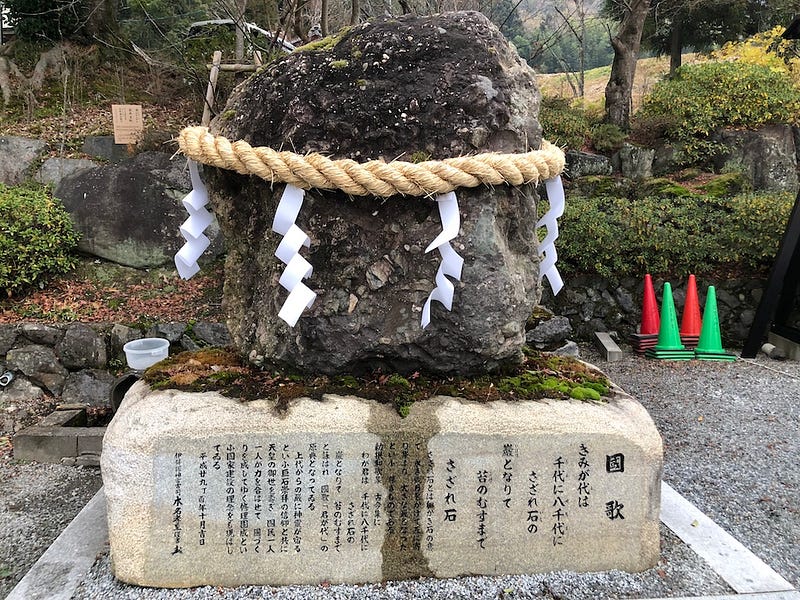
Read that way, the line holds more than people uniting. The sazare-ishi becoming an iwao is people and kami gathering into one, and staying gathered until the moss grows. Even the first word carries a doubleness. Kimi can mean a particular person, a lord or a loved one; some also read the old ki and mi as man and woman. I do not press the point.
I have no idea whether the poet meant any of this. Probably not in the words I would use. But the turn of mind that could hold such an image, the same turn that lets a person kneel by a river and ask a stone’s permission, has shaped how people here move through the world.
It shows up as a reflex more than a belief. You bow at the entrance of a shrine before you have decided anything about the gods. You greet a mountain before you climb it. You treat the non-human world as if it might be paying attention. Whether or not anything is listening, the person who bows already stands differently in the place than the person who does not.
I cannot promise that stopping at a stone will do anything for you. It has never promised me anything. I return to the sazare-ishi each year, and it looks exactly as it did, low and grey and overlooked, growing at a speed no life can watch. I bow, I say where I have come from, I move on. Nothing announces itself. And still, on the walk back out through the trees, something sits a little differently than it did on the way in. I have stopped trying to name it.
Takeshi Kitagawa heads the SHIBUMIWORKS PROJECT, which aims to introduce Japanese culture. Rooted in his years of Kendo, Zen, and Shinto practice, the project explores whether these traditions have anything real to offer modern life — without pretending they have all the answers.
コメントを残す