投稿者: admin

  • Nitobe Wrote It for the West. I’m Writing It for Now.

    Bushido Virtue Series

    Nitobe Wrote It for the West. I’m Writing It for Now.

    A prologue to the Bushido Virtue Series: on what the code was, what it became, and why it still shapes the country I live in

    Cherry blossom pattern inspired by traditional Japanese Yuzen dyeing. Designed by Takeshi Kitagawa
    Cherry blossom pattern inspired by traditional Japanese Yuzen dyeing. Designed by Takeshi Kitagawa

    The Book That Explained Japan to the West

    In 1900, a Japanese diplomat and agricultural economist named Nitobe Inazo published a small book in English. He called it Bushido: The Soul of Japan. He was not writing for Japanese readers. He was writing for his wife’s country, for the drawing rooms and reading clubs of the English-speaking world, for Western readers who had watched Japan modernize at improbable speed and were asking, with genuine curiosity and more than a little suspicion: what are these people made of?

    Nitobe’s answer was Bushido. A coherent moral code, rooted in the samurai tradition, expressed through seven virtues: 義(Gi, rectitude), 勇(Yū, courage), 仁(Jin, benevolence), 礼(Rei, respect), 誠(Makoto, sincerity), 名誉(Meiyo, honor), and 忠義(Chūgi, loyalty). He drew parallels with European chivalry, with Stoic philosophy, with Christian ethics. He made the samurai legible to the West by making them recognizable.

    The book was, by any measure, a remarkable success. It was translated into multiple languages. Theodore Roosevelt reportedly bought dozens of copies to give to friends. For generations of Western readers, it became the primary lens through which the samurai tradition was understood.

    I have read it many times. I find myself, each time, grateful for what it accomplished and uneasy about how it got there.

    What Nitobe Left Out

    Nitobe was a Quaker, an internationalist, a man who had spent formative years in the United States and Germany and who married an American woman. He understood, precisely, how the West saw Japan, and he was writing with a purpose: to demonstrate that Japan’s moral foundations were serious, sophisticated, and not so different from those the West recognized in itself.

    That purpose shaped everything he included, and everything he didn’t.

    The samurai class he describes is noble, philosophically grounded, concerned above all with conduct and conscience. What he does not describe in any sustained way is what the samurai tradition looked like on the ground: the violence that was not ritualized, the loyalty that became coercion, the honor culture that destroyed men for transgressions that had nothing to do with rectitude. Sengoku Japan, the period of near-constant civil war between roughly 1467 and 1615, produced warriors who operated in circumstances where survival, not virtue, was the governing logic. Nitobe’s samurai code arrived, in its more formal articulations, largely during the Edo period, when the samurai class had been at peace for generations and had the leisure to theorize about what a warrior should be.

    The gap between the philosophical ideal and the historical reality is not unique to Japan. Every tradition idealizes its own past. Greek philosophy did not reflect the average Greek life. Chivalry did not describe how most medieval knights actually behaved. The issue is not that Nitobe idealized. The issue is that he idealized for an audience, with a diplomatic and cultural argument to make, and that argument shaped which idealizations he chose.

    I am not claiming Bushido was fiction. The seven virtues Nitobe named were real values, genuinely held and transmitted across generations. But the version that reached the West was a translation in a deeper sense than language: it was the samurai code made intelligible to an 1899 Western reader, which required selecting the parts that translated and setting aside the parts that didn’t.

    The Sword Was Taken. The Code Remained.

    For readers who did not grow up in Japan, a brief piece of history is worth placing here, because the story of Bushido is inseparable from the story of its disappearance.

    The samurai class, as a social institution, was abolished with the Meiji Restoration of 1868. The new government issued the Haitorei, the Sword Abolition Edict of 1876, and with it the most visible marker of samurai identity was stripped away. A man who had carried two swords as a mark of his station and his obligation now carried none. The topknot was cut. The formal costume was replaced. Within a generation, the figure that had defined Japanese society for centuries was gone from the streets.

    The conflict that produced this transformation was, in essence, a civil war between two visions of Japan held by people who loved the same country. On one side stood the new Meiji government, committed to opening Japan to the world, adopting Western technology and institutions, and building a nation-state capable of surviving in the international order that had arrived at its shores uninvited. On the other stood those who believed that Japan’s strength lay precisely in remaining Japan: in the traditions, the hierarchy, the way of the warrior that had sustained the country through centuries of internal order.

    Westerners curious about what that conflict looked like on the ground will find it rendered, with reasonable fidelity and considerable drama, in Edward Zwick’s 2003 film The Last Samurai, in which Tom Cruise plays an American military advisor who finds himself among the last holdouts of the old warrior class, and Ken Watanabe plays their commander with a dignity that the film earns. The geography is compressed and the protagonist is a foreigner, as Hollywood requires, but the underlying tension (tradition facing modernization, neither side entirely wrong) is real.

    What the film cannot fully show, because it ends with a battle, is what happened afterward. The samurai as a social class ceased to exist. But the people who had been samurai did not cease to exist, and neither did the ethic they had been shaped by. Emperor Meiji himself governed in the spirit of Bushido’s demands. General Nogi Maresuke, who had fought on the government side in the Satsuma Rebellion that ended the samurai era, carried the warrior’s code in his body until the day he died, in 1912. Admiral Tōgō Heihachirō, who commanded the Japanese fleet to a decisive victory at the Battle of Tsushima in 1905, was described in his lifetime as the embodiment of the samurai ideal in a modern naval uniform.

    And it was not only the generals. In ordinary families, in schools, in the way people spoke about obligation and endurance and what was owed to the people around you, something persisted. Not the swords. Not the formal hierarchy. Something less visible and considerably more durable.

    That is what this series is about.

    What the Code Actually Did

    Here is what I am more confident about, because I can see it in the world around me.

    Bushido, as an ethic (impure, contested, never as coherent as Nitobe described) shaped the people who came after it in ways that are still visible. Not as a conscious inheritance, the way someone might study a philosophy and adopt it. As something closer to grammar: a structure that shapes how you speak before you are old enough to know there are other structures.

    The Japanese reflex toward meticulous work, shokunin culture, the conviction that a thing worth doing is worth doing with complete attention, carries Bushido’s fingerprints. So does the particular relationship many Japanese people have with obligation: the weight of on, the debt incurred simply by receiving, and giri, the duty that follows from it. These are not samurai concepts that survived intact. They are patterns that passed through the samurai tradition and arrived here, altered, embedded in ordinary life.

    The emphasis on endurance, gaman, is another thread. The willingness, and sometimes the compulsion, to bear what is asked of you without complaint, because complaint is a kind of weakness and weakness reflects on those around you. In Bushido, this had a philosophical dignity: the warrior who suffered without flinching demonstrated the discipline of his training. In its contemporary form, it produces people who work seventy-hour weeks in silence until the silence breaks them. The same root, a very different situation.

    The hardest thing to write about is what happened next. The code that Nitobe described as essentially peaceful and philosophically sophisticated was taken up by a militarist state and turned into a slogan. In the Russo-Japanese War and again across the Pacific War, Japan sent hundreds of thousands of its young men to die under the banner of virtues whose meaning had been quietly reversed. The loyalty that Nitobe described as including the right (even the obligation) to correct an unjust lord became, in practice, a demand for obedience that silenced that corrective function entirely. Surrender was reframed as shameful. A beautiful death was held up as the highest thing a man could offer. The distance between Nitobe’s moral philosophy and what the state made of it was not as large as anyone would like to believe.

    I do not enjoy writing that paragraph. I write it because the series I am beginning cannot have the intellectual honesty I intend for it without it. The samurai code was not only beautiful things. It was also what people did with it.

    None of this was consciously chosen. That is perhaps the most important thing to understand about how Bushido survives in contemporary Japan. Nobody alive today thinks of themselves as living by a warrior code. There are no samurai. The word Bushido does not appear in school curricula as a subject of instruction. And yet the values it carried (the emphasis on self-discipline, the weight of obligation toward others, the particular shame that attaches to letting people down, the expectation that difficulty should be borne quietly) moved through the generations in the way that most cultural transmission actually works: not through declaration but through imitation.

    A parent who never named Bushido in their life nonetheless passed something of it to a child who watched how they handled difficulty, how they spoke about obligation, what they did when nobody was watching. A teacher who knew nothing of Nitobe still shaped a classroom in ways the tradition would have recognized. The code dissolved into the ordinary texture of how people were raised, and in that dissolved form it became, in some respects, more durable than it ever was as a formal philosophy.

    Why Write About It at All

    That is not a rhetorical question. I’ve asked it myself, seriously, more than once.

    My own relationship with this tradition began before I had the language for it. From the age of six I trained in kendō at a police station near my home in Kobe: cold floors, worn wood, a teacher whose silences told you more than his corrections. The bow before a match, which I performed hundreds of times before I thought to ask why, was not a ceremony laid on top of the fighting. It was the fighting’s other half. An acknowledgment: the person across from me was someone worth meeting fully.

    That bow was Bushido before I knew what Bushido was. What I learned later, studying Zen and classical texts in Kyoto, refined and complicated what the dōjō had already placed in the body. The texts gave me language for something I had encountered first as practice.

    So when I say the code shaped me, I am not speaking abstractly. I am describing what I found when I looked at how I actually move through the world: the standards I hold, the debts I feel, the instinct to endure rather than complain, the unease that follows when I fall below what I think is required of me. I did not arrive at these through Nitobe. I arrived at them through the thousand ordinary transmissions that are how a culture actually moves between people.

    Which is why I think the virtues Nitobe named are worth examining. Not because his book was right about them, but because the human patterns he was reaching for are real. They show up in contemporary Japanese life in forms he wouldn’t have predicted. They show up, in different clothes, in human situations everywhere, because the underlying questions he was asking (about rectitude under pressure, about the courage to act, about what loyalty actually requires) are not Japanese questions. They are just questions.

    What This Series Is

    I have written about Bushido before, in pieces that circled the tradition without committing to it fully. This series is a different attempt: seven essays, one for each of the virtues Nitobe named, written with the intention of taking each one seriously rather than admiring it from a distance.

    This prologue is where that series begins. What I want to say at the outset is this:

    I have not tried to rehabilitate Bushido. I have not tried to condemn it. I intend to take each virtue on its own terms: to trace where it came from, what it asked of people, and what residue it left in the culture that came after. Where the ideal and the historical reality diverged, I’ll say so. Where I find something usable, I’ll say that too, carefully, without promising it will be useful to you.

    The essays do not promise outcomes. Bushido didn’t either, not to anyone paying attention. What it offered was a structure: a way of framing the choices that come at you, so that when they arrive, you are not encountering them for the first time.

    Whether that structure has anything to offer you, in the shape your life takes, I genuinely don’t know. I can only tell you what it has cost me to take it seriously, and what I think it has given back.

    English is not my first language; I use AI as a linguistic tool to bridge that gap. The thinking is mine. The words are a collaboration.
  • On Beauty That Refuses to Be Defined

    On Beauty That Refuses to Be Defined

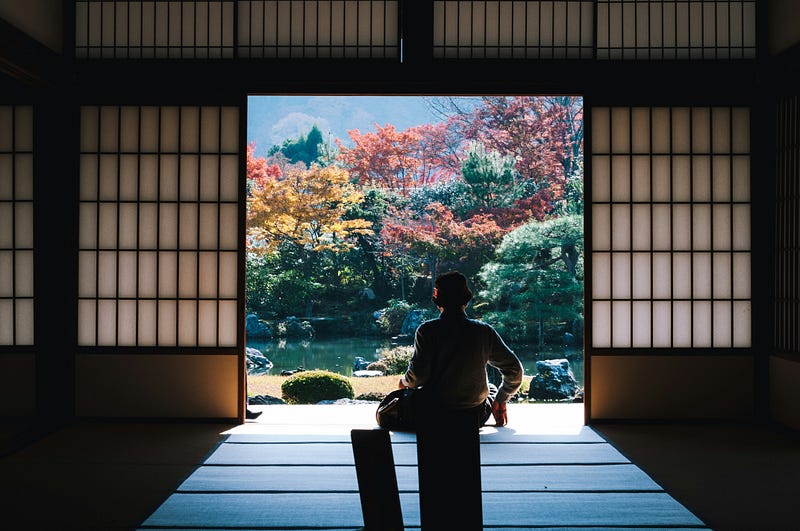
    Photo by Masaaki Komori on Unsplash

    There is a certain kind of Japanese man, and I have been him, who after a few drinks will lean back and announce what the real way to drink is, the real way to carry yourself, or what a man’s aesthetic ought to be. In Japanese we say:

    Kore ga otoko no bigaku to iu mon da (This is the aesthetics of a man)

    The second the words leave his mouth, you already know that it is going to wrong. Whatever quiet thing he was gesturing at stops being true the instant he says it out loud. He would have been better off saying nothing and simply continuing to drink.

    I think about this phenomena quite a bit because the opening line of the Tao Te Ching (道徳経) is about exactly this, and it has been mistranslated into self-help for so long that it has almost become meaningless.

    道可道,非常道。名可名,非常名。 
    The way that can be spoken is not the eternal way. The name that can be named is not the eternal name.

    Most readers stop at the first line and take it as a piece of mystical modesty, a poet clearing his throat before the real teaching. It is not modesty. It is a warning about what naming does. The second line is the one I want to sit with, because it is the one nobody quotes: the name that can be named is not the eternal name. The moment a thing is fixed in language, it is no longer the thing. It has become the word, and the word is smaller.

    I came to Laozi (老子) young, through Zen and through the temples in Kyoto where I spent my twenties reading. But the line about names did not fully land for me there. It landed decades later, at a desk, as a graphic designer, with a piece of work in front of me that I could not stop touching.

    The problem of the box

    Consider what the West did with beauty. It built a discipline to hold it. Aesthetics, Baumgarten’s coinage, Aesthetica, from the 1750s, was an attempt to make a science of sensory experience, to give feeling a place in the architecture of knowledge. It was a serious and in many ways beautiful project. But look at what the project assumes: that the felt quality of a thing can be lifted out of the feeling, set down on a table, and named. That beauty will hold still long enough to be defined.

    The strange part is what happened when Western art tried to honor the unfinished. There is a whole tradition of it. The Italians gave it a name, non-finito, the deliberately unfinished, the rough surface left rough. Michelangelo’s slaves twist half-free of the marble, one shoulder emerging, the legs still stone. It is genuinely moving. And yet notice: even the unfinished got a name. Even incompleteness was caught, labeled, filed, and hung on the wall with a placard. The box was large enough to contain its own opposite.

    And Michelangelo himself believed the finished figure was already inside the stone before he began. His task, as he described it, was to remove everything that was not the figure, to release a form that pre-existed his chisel. The endpoint was known from the start. The unfinished sculpture is unfinished only because he stopped short of a destination that was always there, waiting in the marble.

    Hold that thought, because it is where my own experience parts ways with his.

    The hand that stops

    I am a designer. Most days the work has a destination I can see, and I go toward it and arrive, and the thing is done. But there are other days. There is a point, working on certain pieces, where I lift my hand and think: if I touch this any more it will go wrong. Not because it has reached some standard I could name. I could not tell you what rule it satisfies. I only know that one more move would break it.

    Is that piece finished or unfinished? Complete or incomplete? I do not know. I genuinely do not know, and I have stopped needing to. A composer must know the feeling: the bar after which the next note would be one note too many. A potter lifting a cup off the wheel a moment before the shape says more than it should. We call it “stopping,” but it is not stopping short of anything. There is no visible destination I am declining to reach.

    Here is the thing I keep returning to. Michelangelo could measure his unfinished slave against the finished figure in the marble. The work was at eighty percent of a hundred he could see. But when my hand lifts, I have no hundred to measure against. In that moment the piece is at a hundred percent, because a hundred percent is simply here, now, the best available. There may be a hundred and twenty I cannot imagine. If there is, I will never know it, and naming my stopping-point “incomplete” would be a lie, because incompleteness implies a completion I can see. I cannot see one. The hand knew before the mind could name it.

    That is the second line of the Tao Te Ching, lived at a desk. The judgment happened before language. The instant I could say this is finished, it would already be false, because saying so fixes a point that has no fixed location.

    Beauty is not a discipline

    So here is where I find myself, and I offer it as a doubt rather than a doctrine.

    I do not think beauty can be a discipline. Not in the sense the West means, and not in the sense the Kyoto School meant either when it took Japanese sensibility and rebuilt it in the vocabulary of German philosophy. I want to be careful here, because these were profound thinkers and I am a designer with an opinion. But their move and Baumgarten’s move are, at the root, the same move: to take beauty, including the beauty of the incomplete, the ambiguous, the not-yet, and set it inside the box of definition, of -ology, of the systematized gaku (学), the “study of.” The instant beauty becomes a study, it holds still. And beauty that holds still is already the named name, not the eternal one.

    There is a whole grammar of this in Japanese, hidden in the difference between the ending -gaku (学), the study of a thing, and the ending dō (道), the way of it. A -gaku stands outside its object and takes it apart to see how it works. A steps inside and does it. The science of physical movement is one thing; the martial way is another entirely, and no amount of the first will carry you into the second. You can know everything about how a body should move and still never enter the way of the sword. The two run parallel and never touch, because one is built to know its object and the other to live it. Aesthetics is a -gaku. It knows beauty. It is not clear to me that knowing beauty and being inside it are the same act, or even neighbors.

    The culture I come from has a word for the reluctance to do this. Kotoage senu kuni (言挙げせぬ国), the land that does not raise words. It is how the Man’yōshū poet Kakinomoto no Hitomaro described this country twelve centuries ago: a place that does not declare, does not argue doctrine, does not lecture its own feelings into definition. Shintō has no catechism, no systematic theology, precisely because to state the thing is to lose it. You do not explain the mountain. You bow to it and go up in silence.

    I have done that. At Ōmiwa Jinja (大神神社) mountain itself is the deity and you climb without speaking. Nobody defines what is present in the trees, the rocks, the turning of the path. If they did, it would evaporate. The whole practice is an agreement not to raise the word.

    The way of beauty, which cannot be defined

    And so, tentatively, half-seriously, I want to propose something. Not a study of beauty but a bidō (美道), a “way of beauty,” to sit alongside the other dō (道): the way of tea, the way of the sword, the way of the brush. A way, not a study. Something you walk, not something you define.

    What would bidō hold as beautiful? The unfinished, the ambiguous, the not-yet, the same territory the aestheticians mapped. But bidō would refuse to draw the map. And here the sharpest reader has already caught me, so let me catch myself first: is a definition that refuses to define not still a definition? Are you not, in proposing bidō, raising exactly the word you say should not be raised?

    Yes. Of course. And I have no clean escape, only the oldest company. Laozi wrote five thousand characters to say the way cannot be spoken. Hitomaro sang this is a land that does not raise words, and then, in the very next breath of the poem, raised his: and yet, and yet, I raise mine. The land does not declare, he says, declaring. The paradox is not a flaw in the argument I can polish out. It is the actual shape of the thing. To point at what cannot be named, you must use a name, and betray it in the pointing, and this betrayal is unavoidable and everyone honest has always known it.

    The difference, the only difference I can defend, is knowing you are doing it. The man at the bar does not know. He thinks his words have captured his aesthetic, when they have killed it. Hitomaro knows. He raises the word anyway, for love, for the safe return of a friend, and he tells you plainly that he is breaking the country’s own reticence to do it. He keeps the paradox open instead of sealing it shut. That is the whole art.

    How a thing like this shapes a person

    I have wondered why this reluctance runs so deep here, and I think it does something to how people are built.

    If you grow up in a culture that does not raise words around its deepest things, that will not define the sacred, will not systematize the beautiful, will not let a man announce his own aesthetic without something collapsing, then you learn to locate value somewhere below language. You learn to trust the hand that stops before the mind can say why. You come to feel that the most important judgments are the ones made in silence, in the body, in the gesture, and that dragging them up into speech does not clarify them but thins them out.

    That is not always a virtue. It can curdle into evasion, into a refusal to ever say the plain thing that needs saying. I know that. But at its center is a real perception, one that Laozi carved into six characters and that I found again, without expecting to, at a desk with my hand hovering over a piece I could not name as finished: the moment you fix it in a word, you have already stepped away from it.

    Let me end where I began, with the two men and their drink. The one who announces the aesthetics of a man is not wrong. He knows the form. He has simply never gone down into the part of it that cannot be said, and so he mistakes the name for the thing. The one who says nothing and drinks the way he drinks is not right, either, in any way he could defend. He only loves the deep part and does it, and could not tell you why if you asked. One knows. The other does the thing. Between knowing and doing runs the same line that runs between the study and the way, and it does not close.

    Neither of them is wrong. 
    The bidō, if it is anywhere, is on the line between them.

    Takeshi Kitagawa heads the SHIBUMIWORKS PROJECT, which aims to introduce Japanese culture. Rooted in his years of Kendo, Zen, and Shinto practice, the project explores whether these traditions have anything real to offer modern life―without pretending they have all the answers.
    English is not my first language; I use AI as a linguistic tool to bridge that gap. The thinking is mine. The words are a collaboration.

  • Nine Years of Cleaning My Own Classroom

    A traditional Japanese classroom with rows of two-person wooden desks.
    Photo by urusy on Unsplash

    I did not want to clean.

    For nine years, the bell at the end of the school day did not send us home. It sent us to our brooms and our buckets. Six years of elementary school, three years of junior high. Every child raised in Japan goes through this. If you know someone who grew up here, ask them whether they cleaned their own classroom for nine years. They will say yes, and they will not find the question strange.

    What I hated most came in winter. On wiping duty, you carried a bucket to the tap, filled it, wet a rag in the cold water, wrung it out, and went over the shelves and the desks. Not your own desk only. Everyone’s. You wiped a classmate’s desk as carefully as your own, the cold rag pressed flat, since a desk half wiped was worse than a desk not touched. In winter the water was so cold that your hands felt as if they might come apart at the knuckles, and I wrung that rag with my fingers already aching, resenting every second of it.

    And then I would look down into the bucket. The water had gone brown. I had been certain the desks were clean, and the proof that they were not sat right there, clouding the water I had carried in clear a few minutes before. It happened with the broom, too. You swept a floor you were sure held nothing, tipped the dustpan, and there was far more than nothing in it, a grey drift of dust. That is how I learned the room was dirty. Looking had assured me it was clean. My cold hands and the browning water taught me otherwise, and they did it by making me do the thing I did not want to do.

    You might ask why I kept at something I hated. No one punished us for skipping it. There was no detention, no mark set against your name. We did it because we had done it together since the first week of elementary school, every child in the room, year after year, until it stopped being a thing you could question and became simply what you did when the lessons ended.

    Something else came with the cold water, though I only understood it much later. On the days I was not on duty, my desk was already clean when I sat down, because someone else had wiped it. It was always clean. And because I knew the cold of that water from my own turns at the bucket, I could not take the clean desk as my due. Somebody’s hands had been in the cold for it. That left a small gratitude in me where I might otherwise have felt nothing.

    I grew up hearing that this custom came down from the temple schools of the Edo period, an unbroken thread from some older and wiser Japan. That story is comfortable, and mostly untrue. The deeper root is the Zen idea of samu(作務) physical labour – sweeping, cooking, and repair, treated as the practice itself rather than as chores to clear out of the way before the real practice begins. What I performed as a boy was not ancient. It was written into the national curriculum after the war by planners assembling a new country. By the time it reached me, it had stopped looking like a rule at all. It was only what you did when the lessons ended, as ordinary as taking your shoes off at the door.

    That ordinariness shaped me more than any lesson I sat through. Because I cleaned, dropping rubbish came to feel like a small shame, close to how a lie feels like a small shame. No rule produced that. Litter on the ground is simply work left undone, and the work was always ours. Cleaning was never a thing a paid stranger did after we went home. That single fact, set early and repeated for nine years, follows a person onto every train platform and into every borrowed room for the rest of their life.

    There was another floor I wiped in those years, and no one ever forced me to.

    From the age of six, I trained in kendo at a police dojo in Kobe. Some mornings, I would arrive early, certain I was the first, and find the boards already occupied, three or four others down on all fours, pushing wrung-out rags from one end of the hall to the other at a half-sprint. We had no mops then. You folded yourself over the cloth, pressed it flat with both hands, and ran.

    No one assigned this. No teacher checked, and skipping it carried no penalty at all. But the dojo was a place we held as sacred, and wiping its floor was simply part of being there, no different from the bow at the threshold. It never once arrived as a choice. I cleaned, and two feelings grew in me while I did.

    The first was plain: everyone else was down on the boards, so I could hardly be the one boy who stood and watched. The second was slower, and it has stayed with me longer. The work was cold and unpleasant, and because it was unpleasant, it felt right to be among the ones who took it up rather than the ones who waited to be told. You do not leave the thing people dislike for someone else to carry.

    At school, I had been made to clean, and something in me pulled against it the whole time. At the dojo, no one made me, and I knelt to the cold boards willingly. The sacred floor gave the same cold labour a weight the classroom never troubled to give it. And so I had to give up an idea I had carried for years without examining it, that people clean only when they are forced to. Take the force away and the cleaning does not stop. Someone begins, unbidden, and the rest fold down beside him.

    I have turned this over for a long time and cannot make it come out clean. I cannot even pretend the dojo was a fair test. Every boy on those boards had already spent years with a school rag in his hand. Perhaps the reverence I felt was real, and perhaps it was only the school reflex in better clothes, showing itself where no one was made to do anything. I have never been able to decide which.

    Once a month, I take a bag around the Momozono garden at Osaka Castle with my neighbours, on our own time, though the city keeps a cleaning department that does the same job. When I watch them bent over it, none of them ever asking why they are giving up a Sunday morning to this, I feel the two things I felt as a boy.

    There is the pride, which is real and which I will not pretend away. And under it, there is something colder. From a step back it can look like conditioning. It can look like a mouth full of teeth straightened in childhood, even and faintly unnatural, corrected long before the child was asked whether straight teeth were wanted.

    Then I remember the dojo, where no one straightened anything, and the boys went down onto the boards anyway. Both pictures are true. I cannot lay one over the other and make them agree.

    I am glad I was made to clean. I will say that without softening it. And I have stopped waiting for the gladness to answer the harder thing, which is whether it was right to require this of every child in the country, the ones it suited and the ones it did not, before a single one of us was old enough to be asked.

    And I have no way to check the answer. There is no Japanese my age who was spared this, no unswept version of me or of anyone raised here to set beside the swept one. Ask whoever you like: they cleaned for nine years, which leaves me nothing to weigh the nine years against. A whole country, and not one of us was left out of it. Seen from outside, that may be stranger than the cleaning itself.

    What I am left with is smaller than a verdict. The resentment and the habit did not arrive one after the other, the hating first and the gratitude later, the way these stories are supposed to go. They came together, two sides of one motion, and they have never come apart.

    I am sixty-one now. I have forgotten the faces of most of the teachers from those years, and I have not forgotten the cold. Bring my hands near cold water in winter and the whole of it returns, the ache in the knuckles, the brown clouding the bucket, as near as yesterday. The room was dirtier than I thought. I found that out only because someone stood over me until I wiped it, and I still do not know whether I needed them there. I only know that I never stopped being the boy they stood over, and that whoever I am now was built around him.

    Takeshi Kitagawa heads the SHIBUMIWORKS PROJECT, which aims to introduce Japanese culture. Rooted in his years of Kendo, Zen, and Shinto practice, the project explores whether these traditions have anything real to offer modern life―without pretending they have all the answers.
    English is not my first language; I use AI as a linguistic tool to bridge that gap. The thinking is mine. The words are a collaboration.

  • My Grandfather’s Unspoken Dead

    My Grandfather’s Unspoken Dead

    Inside an Osaka temple, ten thousand flames burn for the dead. It took me fifty years to understand which ones my grandfather was carrying

    little firey lights that look like people
    Dusk at Shitennō-ji, Osaka, during the mantō kuyō (Author’s photo)

    Obon ended a few days ago. The heat has not, and will not for weeks, but my summer is over. It ends every year on the same evening, at Shitennō-ji in Osaka, in a courtyard full of candles.

    The service is called mantō kuyō(万灯供養, an offering of ten thousand lights. The temple gives you a candle and an ink brush, and you write on it the name of someone who has died. The candles are set out on tiered wooden stands that run the length of the compound, so the flames stand at about the height of a man’s waist. After dark the monks walk the central compound chanting the Heart Sutra, and they begin again every fifteen minutes until the gates close, and anyone standing there can walk with them. Printed sheets of the sutra wait at the entrance for people who never learned it. By full dark there are close to ten thousand flames burning at once.

    As a boy I hated going.

    My grandparents took me. I have no idea what year it was or how old I was, only that I was small enough to be led by the hand. August in Osaka is thick enough to lean against before anyone lights anything, and inside the compound ten thousand flames had been working on the air for an hour. There was wax in it, and smoke, or the steam that comes off that much burning at once. It sat in my throat. I remember breathing carefully, the way you do when the air seems to be running out.

    Then I looked at the flames, and at that age they were level with my face.

    They moved without any wind. A whole field of them in the dark, each one leaning and recovering on its own schedule, none of them agreeing with the others. I understood at once, the way a child understands things, that they were not candles. Every one of them was somebody who had come back, there were ten thousand of them, and they were standing all around me breathing the same used-up air. Nothing about this was consoling. I was frightened badly enough to still have it, fifty-odd years later.

    Not once did I ask my grandparents why we were there. Children accept the shape of the year the way they accept the weather. We went because August came.

    Then my grandfather died, and we stopped going.

    I did not notice the absence. I was young. The summers filled with other things, and later with work, and the service became something my grandparents used to do, filed away with the rest of what disappears when the people who organized it are gone. Thirty years went past. I stayed away for no reason at all, which is to say that nothing was asking me to go.

    Ten Thousand Candles and the Five-Story Pagoda of Shitennoji Temple
    Ten Thousand Candles and the Five-Story Pagoda of Shitennoji Temple (Author’s photo)

    Then a friend from my university years died.

    We had been close as students, the kind of closeness that assumes an unlimited supply of future afternoons. After we started working we still made time, less often each year, and then several years went by in which neither of us managed it. We were busy. That is the entire explanation and it is not much of one. The last time we met I did not know it was the last time, and nothing about the evening marked itself. It had never crossed my mind that the next thing I would do for him would be to write his name on a candle.

    Five or six years ago I went back to Shitennō-ji.

    My friends have graves. Every one of them is somewhere, in a family plot, in a city I would have to take a train to, on a hillside I would have to find. A man with a working life does not have many free days in August, the graves are scattered, and the honest accounting is that I can reach one or two of them in a summer and not the rest. So they come to Osaka instead. There is room on the candle for a single name and I choose one, which is not a comfortable minute, and the others stand behind him while I hold the flame steady. Nobody at that temple writes down everyone they mean. You put down the one you can manage, and the rest are understood.

    I was standing there with the brush in my hand when I understood what my grandfather had been doing.

    The Kitagawa family has a temple. It is Konkai-Kōmyō-ji in Kyoto, it belongs to the Pure Land school, and our dead are there. That is where a family goes for its ancestors. Shitennō-ji has no claim on us at all. It belongs to Washū, a school founded to stand outside the sect system entirely, tracing itself back to Prince Shōtoku in the sixth century. My grandparents crossed the city in the worst heat of the year, with a small boy in tow, to a temple that was not ours, for someone who was not us.

    My grandfather was a naval officer. He came home from a war that had taken most of the men he trained beside, he never spoke about them, and nobody in the family asked him to. A family stone has room for the family. It has no room for the men he served with, and there is no ceremony in the Japanese year for someone who wants to remember people he has no standing to remember. Shitennō-ji belongs to no sect and asks nothing of a visitor except that he come and write a name.

    He also came home, and they did not. He lived another forty years after that, married, raised children, took a grandson to a temple in the heat. I doubt he ever put words to what he owed them or what he thought he had done wrong by surviving. He simply went every August and stood in the smoke, and whatever he was carrying in there with him, affection was only part of it.

    I cannot prove any of this. He never said so, I never asked, and there is no one left to ask now. I know only that at fifty-something, with one name chosen out of several, I was doing something I had watched him do without understanding it, and it suited me for reasons he would have recognized.

    Something else had changed by then, and it took me longer to admit.

    Candles bearing the names of the deceased bathe the temple grounds in an orange glow.
    Candles bearing the names of the deceased bathe the temple grounds in an orange glow (Author’s photo)

    Ten thousand is not a number you can feel by reading it. In that compound it stands at waist height and runs the length of the courtyard. Every one of those flames is a person who died of something. An illness that took a long time, or a road, or an age that finally arrived, or a war. I know nothing about any of them, and outside the gate a stranger’s death does not reach me at all. Inside, with the whole field of them burning at once, I cannot get rid of a single one. All of these people had reasons, and all of them ran out.

    The man crouching beside me, shielding his candle with one hand until it catches, will not be at this service in some August either. Neither will the woman behind him holding a sutra sheet she does not need. I have known since I was young that everybody dies. The courtyard puts it in front of me as a quantity, and a quantity is harder to look away from. I spent most of my life not looking. The thing I was frightened of at five and the thing I avoided at thirty are the same thing, and it can be stood in for an evening without much happening to you.

    The flames I was so frightened of as a boy were never the dead. They were an evening’s worth of people who had agreed to carry a name for a few hours in the heat. My grandfather stood in that compound with names he could not say out loud. I stand there now with my friends. In some August I will not be standing there, and I will be one of the small flames leaning and recovering in the dark.

    This year I stayed until the chanting started again. The heat over the compound had warped the air so that the far wall came and went. I went back to find my friend and could not tell his flame from the ones on either side of it, doing what the rest of them were doing.

    Then I walked out through the gate and left them to the evening.

    Takeshi Kitagawa heads the SHIBUMIWORKS PROJECT, which aims to introduce Japanese culture. Rooted in his years of Kendo, Zen, and Shinto practice, the project explores whether these traditions have anything real to offer modern life―without pretending they have all the answers.
    English is not my first language; I use AI as a linguistic tool to bridge that gap. The thinking is mine. The words are a collaboration.

  • Katazuke: The Japanese Word for Tidying That Also Means Settling Things

    Katazuke: The Japanese Word for Tidying That Also Means Settling Things

    On putting what’s out of place back where it belongs — including the parts of yourself you would rather not keep

    Photo by Nick Sorockin on Unsplash

    I do graphic design for a living, and some afternoons the work simply stops moving.

    It rarely stops for a good reason. I will have an idea, a real one, clean and whole, and then my own mind begins to crowd it. The client mentioned he liked a lot of white space. Smaller type is everywhere this season. Didn’t someone say the logo should breathe? None of it is wrong. All of it belongs somewhere. But none of it belongs here, in this moment, standing between me and the thing I had already found. The idea I was holding goes soft at the edges. It blurs, then drifts, and a hesitation appears where a moment ago there was none, over a choice I had no reason to doubt.

    And the desk, meanwhile, fills up. When I try to force an idea, I pull references, I spread out printouts, I open six windows, and the surface in front of me turns into a landscape of half-finished thoughts. The room and the head go to pieces together.

    So I stop trying. I gather the paper into a pile, close the windows, wipe the desk, and sit down again as if starting the morning over. And often, not always but often, a different idea surfaces on its own, while my hands are busy putting things away. I do not shout brilliant! I usually do not even notice the moment it arrives. I just find, some minutes later, that I am working again, and that the file goes in.

    The thing you are looking for is most often found the moment you stop looking for it.

    You know this. Everyone does. It is not Japanese, and it is not mystical. But Japanese happens to hold a small door onto it, in one ordinary word. What waits behind it is not a tip for working better. It is closer to being on decent terms with your own mind.

    Two things the same word does

    The word is katazuke(片付け). Every Japanese child learns it before learning it means anything. A parent says it before dinner, a teacher says it at the end of the day. Tidy up. Put the room back in order.

    But the same word carries a second life. We say we will katazukeru a problem, a dispute, an unfinished piece of business. There the sense is not tidiness at all. It is settlement: bringing a matter to its close, deciding what has hung unresolved. English keeps these two ideas in separate rooms: you tidy a desk, but you settle a score. Japanese keeps them under one roof.

    Buried in the word is an even older gesture, hō o tsukeru(方をつける), literally “to attach a direction,” to give a wandering matter its resolution. To tidy a room, then, is faintly to settle something, to bring a thing to rest.

    I do not think a language builds a metaphor like that by accident. A culture that never split arranging from resolving comes, over centuries, to feel the order of the room and the settling of the mind as one continuous act. Straighten the outer thing and something inner quiets, not because you willed it, but because your own language never taught you the two were separate.

    Not “spark joy”

    Here I have to part ways, gently, with the most famous export of Japanese tidying.

    Marie Kondo gave the world a word worth having, tokimeki(ときめき), the small flutter of the heart. Hold each object; keep what sparks joy; thank and release the rest. Millions of people found real relief in it, and I would not take that from anyone. But notice what the method is for. It aims at something: a curated home, a lighter life, the self you mean to become. It is tidying pointed at an ideal.

    And the moment tidying becomes a project aimed at an ideal, a quiet reversal sets in. You start walking the room hunting for things to be rid of. You stand holding an object you neither love nor need, negotiating with it. Should this go? Does this spark anything? The search itself becomes a low, grinding stress, and you have arrived exactly where you did not mean to be. In Japanese we would call it honmatsu tentō, the root and the branch changed places: you took up tidying to feel settled, and now the tidying is the thing unsettling you.

    The instant tidying becomes a goal, it begins to undo the very calm you took it up to find.

    What I mean by katazuke is smaller and less ambitious than a better life. It is not aimed at anything. It is only this: putting what is out of place back where it belongs.

    The desk, and then the mind

    Watch what the intruding thoughts actually were, that afternoon at my desk. The client’s preferences. This season’s fashions. Not garbage. Not noise to be thrown out. They were true and useful, reference material that belongs in a back drawer, pulled to the front at the wrong hour and left lying across the work.

    So I do not throw them away. I put them back. And clearing the physical desk seems to do the same work on the mental one. The moment the surface is straight and the thing I was after comes back into view, the intruding thoughts lose their grip and recede on their own. They just returned to their drawer once there was room to see again.

    The heart drifts, too

    If the room mirrors the mind, and every language that fused tidying with settling seems to suspect it does, then the heart needs the same treatment, for the same reason.

    Something dull and demanding lands on me: the month-end ledger, a tax form, a chore I cannot make interesting. And a part of the heart that ought to sit quietly in the back gets knocked loose and rises to the front. Irritation, mostly. It moves into the foreground, out of its proper place, and starts crowding the work exactly as the client’s half-remembered preferences crowded my design.

    I cannot order it back. I learned this writing an earlier piece, about the swordsman’s fault the old teachers called igatsuki(居付き), the mind that sticks fast where it lands and will not move. You cannot command a stuck mind to unstick, because the command is one more thing to stick on. “Settle down” is not an instruction the heart can obey. It never has been.

    But I can tidy the desk. And I can let myself believe, without straining to prove it, that in putting the books back on the shelf I am also putting something inner back in its place. That belief costs nothing and demands nothing. The hands do an easy, honest thing, and the heart is invited, not ordered, to follow.

    You cannot command the heart to settle. But you can put a book back on its shelf and quietly think: this, too.

    I once wrote that when I flee my ledger to reorganize the bookshelf, I honestly cannot say what has happened: whether I cleaned to clear my head or cleared my head by cleaning. I still cannot say. But here is one thing I have come to suspect since. The books were never the point. Putting them back was.

    The parts you cannot throw away

    Some things in a heart look exactly like clutter, no different from the objects Kondo would have you hold up and release. Take sorrow. If you could, wouldn’t you throw it out? I think most of us, on a bad day, would hand over sadness itself and feel we had cleared some useless, painful thing from the house. Spark no joy; discard.

    And yet a person who has never known sorrow cannot be gentle with anyone. The tenderness you show another human being is built, brick by brick, from the times you were hurt and survived them. Throw out the sadness and you throw out the kindness with it. It only looks like refuse. It is load-bearing. It cannot be discarded, because it is you.

    Japan has an old feeling for this. Long before anyone systematized it, the tradition spoke of a single spirit wearing more than one face. Among them the aramitama(荒魂), the wild and turbulent soul, and the nigimitama(和魂), the gentle and harmonious one. (The tidy four-soul scheme some readers may know, the ichirei shikon, is a later, nineteenth-century systematization; I lean here only on the old rough-and-gentle pairing, and offer the reading that follows as my own.) The aramitama is no use at a calm dinner table. It rages and will not be soothed, and a well-ordered social life has no room for it. And it cannot be thrown away. Cut it out and you have not become gentler; you have become less.

    So tidying the heart was never about discarding the wild parts, the sad parts, whatever embarrasses you at dinner. It is about returning them to their proper place, deep in the back, where they belong and hold the house up. You are not throwing them out. You are setting them down where they rest, and the manner of that return matters. You do it with care. The Japanese word for that care is itsukushimi(慈しみ), to cherish. You cherish even the rough soul, because it is yours, and because the day will come when you need it.

    Nothing is promised

    I should tell you that I am bad at tidying. My own room is proof of it. And if the room really does mirror the mind, then I am probably no better at tidying the heart. The anxieties pile up on my inner desk exactly as the printouts pile up on the real one.

    A tidy room, besides, does not stay tidy. Give it a week. And the heart is the same: return it to its place today and it drifts out again tomorrow, knocked loose by the next dull ledger, the next hard afternoon. This is not a technique that delivers a result. There is no result. There is only the returning, done again and again, for as long as you live in the room.

    So I will not hand you a method. I will only tell you what I do, which is small. When the work stops moving and the desk has gone to pieces, I clear it, and while my hands put the books back on the shelf, I picture the desk as the inside of my own mind, and I imagine setting the anxiety and the irritation, gently, back where they came from, deep at the rear where they can rest. Whether anything actually returns, I could not say. I was never going to feel it happen.

    But the file goes in. And something, I think, is quietly back in its place.

    Takeshi Kitagawa heads the SHIBUMIWORKS PROJECT, which aims to introduce Japanese culture. Rooted in his years of Kendo, Zen, and Shinto practice, the project explores whether these traditions have anything real to offer modern life―without pretending they have all the answers.
    English is not my first language; I use AI as a linguistic tool to bridge that gap. The thinking is mine. The words are a collaboration.

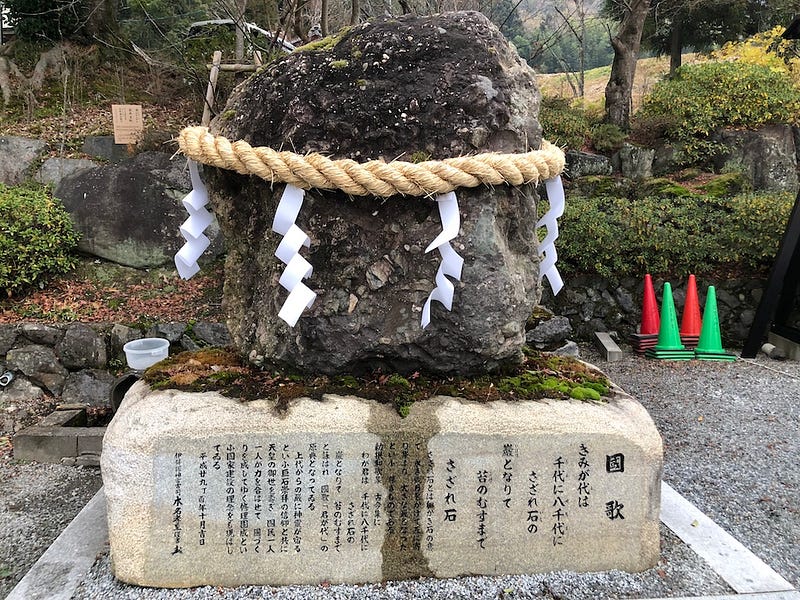
  • The Stone at the Heart of Shimogamo Shrine and Japan

    The Stone at the Heart of Shimogamo Shrine and Japan

    A growing stone and the meaning behind a line in Japan’s national anthem

    The sazare-ishi (pebble-conglomerate stone) at Shimogamo Shrine. Stones of various sizes fused over a long period to form a single massive rock. (Author’s photo)
    The sazare-ishi (pebble-conglomerate stone) at Shimogamo Shrine. Stones of various sizes fused over a long period to form a single massive rock. (Author’s photo)

    君が代は千代に八千代にさざれ石の巌となりて苔の生すまで

    May your reign continue for a thousand, eight thousand generations, until the tiny pebbles grow into massive boulders lush with moss. (Japanese National Anthem)

    Once a year, when I have time in Kyoto, I used to visit all the famous shrines. Now, I only take the time to walk out to Shimogamo Shrine.

    Recently, so many Foreign tourists sit on the ground to eat that those places have started to feel like something to look at rather than somewhere to stand. I do not blame the crowds for this. I only notice that I no longer stop.

    Yet, there are still places at Shimogamo that are quiet. Its approach runs through Tadasu no Mori, an old forest whose name carries the sense of setting something straight, and a few steps in, the city drops away behind you.

    I go here to greet the two enshrined kami: Kamo Taketsunumi-no-mikoto (賀茂建角身命) and his daughter Tamayori-hime-no-mikoto (玉依媛命). But before I reach them, I stop at a stone almost everyone walks past. It sits low near the entrance, unremarkable, and in all my visits I have never once seen another person pause in front of it. It is a sazare-ishi (細石).

    A sazare-ishi is a mass of small stones bound into one. Over a very long time, lime and iron seep into the gaps between the pebbles and set, and the loose gravel hardens into a single boulder, an iwao (巌). The shrine keeps one because of a line in Kimigayo (君が代), Japan’s national anthem, whose words are far older than its melody. The poem wishes for an age that lasts until the sazare-ishi grows into an iwao and moss covers it.

    The poem was written in the Heian period by an author no one can name. What stops me every time I stand there is a simple question: how did they know?

    The chemistry of it was invisible to them. No one in the tenth century could have described cementation, or the slow work of groundwater in the spaces between stones. And yet the image in the poem is exactly right. Small stones do, given enough centuries, become one stone. The poet cannot have known the mechanism.

    The poet knew the outcome. To carry that image without any science behind it, you have to believe something about stones: that they are not finished objects, that they grow, that a rock sits closer to a living thing than to a dead one.

    I grew up frightened of stones. The stories I heard as a boy were not gentle. There was the weeping stone (yonaki-ishi) of Sayo no Nakayama, where a murdered woman’s spirit was said to have entered a roadside rock and cried through the night. There was the killing stone (Sesshō-seki) of Nasu, a boulder that struck dead any creature that came near it. In those stories, a stone was a place a spirit could go and stay. So when I kept goldfish and turtles as a child and wanted a stone from the riverbed for the tank, I would bow to it first and say, under my breath, “let me borrow this.” I laugh at it now. At the time I meant it completely.

    A stone was not mine to take without asking.

    That child is still there in the gesture I make at Shimogamo. Standing in front of the sazare-ishi, I tell it, silently, where I have come from. I have come from Osaka. I was in the area, so I stopped in. I will pay my respects to Kamo Taketsunumi-no-mikoto and Tamayori-hime-no-mikoto, and then I will head home. I introduce myself the way I would at the door of an unfamiliar house. Then I bow and go on to the main hall.

    The shrine has other stones with stories, if you look. Among the old wonders told of this place, there is a sacred stone in the Mitarashi stream said to make small pebbles leap when the water is stirred in times of drought. Whether pebbles leap or not, someone once watched a stone closely enough to believe it might answer.

    For most of my life I read the anthem’s line in the ordinary way. Small stones gathering into a boulder meant people drawing together, standing as one. That is the reading I was taught, and it is a good one. Since I began stopping at the sazare-ishi, another reading has settled over it, and I want to be clear that this one is mine, not a scholar’s.

    If a single stone can hold a spirit, then a boulder made of countless small stones is a gathering of countless small presences. Here we speak of yaoyorozu no kami (八百万), the eight million gods: a sense that the divine is scattered through the whole world rather than seated in one place, present in trees and mountains and, yes, in stones.

    Sazare-ishi at Izumo Daijingu Shrine in Kameoka City, Kyoto Prefecture. The lyrics of “Kimigayo” (Japan’s national anthem) are inscribed on the stone’s base (Author’s photo))
    Sazare-ishi at Izumo Daijingu Shrine in Kameoka City, Kyoto Prefecture. The lyrics of “Kimigayo” (Japan’s national anthem) are inscribed on the stone’s base (Author’s photo))

    Read that way, the line holds more than people uniting. The sazare-ishi becoming an iwao is people and kami gathering into one, and staying gathered until the moss grows. Even the first word carries a doubleness. Kimi can mean a particular person, a lord or a loved one; some also read the old ki and mi as man and woman. I do not press the point.

    I have no idea whether the poet meant any of this. Probably not in the words I would use. But the turn of mind that could hold such an image, the same turn that lets a person kneel by a river and ask a stone’s permission, has shaped how people here move through the world.

    It shows up as a reflex more than a belief. You bow at the entrance of a shrine before you have decided anything about the gods. You greet a mountain before you climb it. You treat the non-human world as if it might be paying attention. Whether or not anything is listening, the person who bows already stands differently in the place than the person who does not.

    I cannot promise that stopping at a stone will do anything for you. It has never promised me anything. I return to the sazare-ishi each year, and it looks exactly as it did, low and grey and overlooked, growing at a speed no life can watch. I bow, I say where I have come from, I move on. Nothing announces itself. And still, on the walk back out through the trees, something sits a little differently than it did on the way in. I have stopped trying to name it.

    Takeshi Kitagawa heads the SHIBUMIWORKS PROJECT, which aims to introduce Japanese culture. Rooted in his years of Kendo, Zen, and Shinto practice, the project explores whether these traditions have anything real to offer modern life — without pretending they have all the answers.

  • Gate After Gate, and Still No Other Side

    Gate After Gate, and Still No Other Side

    On Obon, I walked through real gates all day in Kyoto — the one in my head, after decades of Zen, I still can’t say I’ve crossed

    Konkai Kōmyō-ji, Kyoto. From the stone steps above, looking back at the mountain gate I had just walked through. (Author’s photo)
    Konkai Kōmyō-ji, Kyoto. From the stone steps above, looking back at the mountain gate I had just walked through. (Author’s photo)

    A note before we begin: English is not my first language, and I use AI as a language tool to help me write it. The thinking is mine.

    This week is Obon, or by its full name, Urabon’e(盂蘭盆会. In the older Buddhist understanding, these are the summer days when the dead come back for a while to visit the living. Every year I go to Kyoto to stand at my parents’ grave, at a temple called Konkai Kōmyō-ji. Every year, before I head home, I walk the fifteen minutes from there to Nanzen-ji, the Zen temple I used to go to when I was young.

    The road between the two runs through a quiet stretch of houses. Almost no tourists come this way. In August there’s little to take in but the heat and the cicadas, which is a kind of relief. Then Nanzen-ji’s great gate, its Sanmon, rises at the end of the approach, and every year, standing under it, I think a version of the same thing.

    It’s this. Zen(禅)has been near me for most of my life, in temple rooms in Kyoto, in the long silences of teachers who met a question with what didn’t look like an answer. And I still don’t understand it.

    Maybe I simply haven’t studied enough. Twenty years, thirty. I’ve come to think that’s far too short a span to have earned the word understand, or even studied. A hundred might not be enough. So I won’t begin as someone who knows. I’ll begin where I actually am, which this week is a literal place: under a gate in the Kyoto heat, unsure whether I’ve walked through it or am only standing at its edge.

    My teachers never gave me clean answers. That was the point. In the tradition of mondō(問答), the question-and-answer exchange at the spine of Zen training, the reply is built not to satisfy but to unsettle. You ask what the Buddha is, and the teacher says: three pounds of flax. You leave more confused than you arrived. You come back. You ask again, differently. You leave confused again.

    This went on for years. It went on for years for me.

    At some point (I can’t tell you when) something shifted. Not understanding, exactly. Something in how I held the questions loosened. A kind of settling. I thought maybe that was it. Maybe that is what Zen feels like from the inside.

    Then people began to ask me about it, and something I didn’t expect happened.

    When young people ask me what I actually mean, when foreign friends press me to explain, the settled thing comes loose again. Catherine, a graduate student at Osaka University, once asked me why Zen teaching seems designed to confuse rather than clarify. Nicholas, an American friend I’ve known for years, asked me, with real exasperation, whether any of this is useful, or just beautiful-sounding nonsense.

    I couldn’t answer either of them cleanly.

    Nicholas runs a company. Professionally, he lives inside what can be counted: revenue, targets, the quarterly line that rises or falls and tells him whether the year was good. When he asks whether Zen is useful, he’s asking the only honest question his world knows how to ask: what does it produce, and how would I see it?

    It’s a fair question, and I’ve never had a clean answer. So one evening I tried to walk around it with him.

    Almost everything we call growth, we can feel. A company’s, you read on a chart. But even the quiet kinds report back. A musician practices and hears herself getting better. A painter watches his own hand grow surer. I practiced kendo(剣道)for years as a boy, and I can tell you: train hard enough and the strength arrives in your body, and you know it’s there.

    The soul sends back no signal at all. No chart, no ear, no muscle reporting that anything has changed. And here is the part I keep circling: if it did, if you could feel your soul growing, that feeling would be proof it hadn’t.

    Take me. I was an even-tempered boy, and I’m calmer now than I was then, quieter, less easily moved. It would be easy to call that growth. But the changes I can actually measure tell a plainer story. My body is weaker than it was ten years ago; there’s no arguing with that. My mind may be going the same way, a little slower each year, though that’s harder to catch from the inside.

    So when every part of me I can measure is on its way down, on what authority do I announce that the one part I can’t measure, the soul, is the exception, the single thing still climbing? I have no instrument fine enough to tell settling from decay. One thing does increase, and measurably: what I know. Whether knowledge is growth, though, I couldn’t tell you. And the years we’re given feel far too short to find out.

    That was the answer I gave Nicholas: no answer at all, only a longer set of questions. And that is exactly when it happens. Each time I fail to hand someone what they came for, a new texture surfaces in what I thought I’d already understood. Their questions keep opening rooms. Was what I knew only the entrance? Maybe I had only ever crossed the gate. Maybe there is no other side.

    Much later, I learned the not-knowing already had a name, eight centuries old, from a Chinese collection of kōans(公案): daidō mumon(大道無門), the great Way has no gate. I think of that phrase under the Sanmon, of all places. The name of the gate means the three barriers you’re supposed to pass through on the way to waking up, and there I stand beneath it, holding a line that says there was never a gate to pass. For decades I’d searched for a door I had, it turns out, already walked through. Or that was never there.

    Nanzen-ji, the Sanmon, Kyoto. The gates you can see are easy to walk through. (Author’s photo)
    Nanzen-ji, the Sanmon, Kyoto. The gates you can see are easy to walk through. (Author’s photo)

    I was born in 1965. My teachers, at the age I am now, were answering a young student named Takeshi. I wonder if they felt what I feel: this braid of settled and unsettled, knowing and not-knowing. Whether they were performing wisdom or living honestly in its absence. I suspect the latter. I think that’s what made their non-answers feel like something real.

    A culture built on kōan and mondō does something quiet to the people raised inside it. Across generations, it trains you not to resolve. You learn to hold a question open and unclosed, to live beside it without demanding that it clear. I didn’t choose this. I absorbed it before I could name it, and somewhere along the line it stopped being philosophy and became, simply, the air.

    But I don’t think the question is ours. If Zen were a tool that grew the soul, then everyone who never met it, everyone raised outside Japan, would be stunted, and that’s plainly false. Zen didn’t invent the not-knowing. It only built it a room and gave it a name. Under other names, in other rooms, people everywhere sit with the same unanswerable thing. Nicholas has no word for it and no practice; his exasperation is the question. He was already living it when he asked.

    Which is why I can’t hand it to you in sentences. I can describe its shape. I can circle it. But the thing itself doesn’t travel in words. There’s a frustration I’ve watched land more than once: someone follows a careful explanation, nods, and says, I think I get it. And I think: you’ve understood what it points to. You haven’t stood where it points.

    And then I think: neither have I. Not completely. Not finally.

    I don’t know if any of this reaches you. Most days I suspect it doesn’t. But when I think of my teachers, patient, unhurried, circling the same questions for decades, I think the point was never to arrive.

    Obon ends, the way it does. I turn from the Sanmon and walk back the way I came, past the same quiet houses, the cicadas still at it, and somewhere along that road I stop thinking about gates and start wondering what to eat. Nothing has been settled. No far side has shown itself. Nicholas would want a port on the map and a distance crossed off; I have a heading toward the rising sun and a horizon that sits exactly as far off as it did this morning. I’m hungry. The road is hot. I keep walking.

    The earth is round. There’s no starting line. There’s no finish line. There’s just the heading you hold, and the walking.

    Takeshi Kitagawa heads the SHIBUMIWORKS PROJECT, which aims to introduce Japanese culture. Rooted in his years of Kendo, Zen, and Shinto practice, the project explores whether these traditions have anything real to offer modern life―without pretending they have all the answers.
    English is not my first language; I use AI as a linguistic tool to bridge that gap. The thinking is mine. The words are a collaboration.

  • Wu-Wei in a Pile of Osaka Castle Leaves I Never Finished Sweeping

    Wu-Wei in a Pile of Osaka Castle Leaves I Never Finished Sweeping

    I sat with Lao Tzu’s hardest idea for years. It reached me over a broom

    The castle tower in the afternoon, viewed from Osaka Castle Park (Author’s photo)
    The castle tower in the afternoon, viewed from Osaka Castle Park (Author’s photo)

    Once a month, I help clean Osaka Castle Park. A few of us meet in the morning with brooms and plastic bags and work our way along the paths. No one pays us. No one inspects the work when it is done. When a stretch of gravel is still flecked with leaves, and my back has started to complain, I leave the leaves and tell myself they will keep until next time.

    This is not unusual here. In Japan, you will see people sweeping the pavement outside their own front doors, and neighborhood groups clearing gutters and verges that belong to no one in particular. Most of us were trained in it from a young age. For nine years, through elementary and junior high school, we cleaned our own classrooms and corridors after lessons. It was compulsory. I disliked it. I am still not fond of it. There is nothing serene about a twelve-year-old pushing a rag across a cold floor because the timetable says so, and the habit carries, somewhere in it, the pressure of a group that expects you to fall in.

    So cleaning, for me, is not a spiritual discipline. It is a habit whose original reason has worn away. I mention this early because the rest of what I want to say will make no sense if you imagine me sweeping in a state of grace. I am usually thinking about lunch.

    I have written elsewhere about sweeping as an act of attention, the path treated as if it deserved care, and I still hold to that. It is not what was happening on the morning I want to describe. My attention was on lunch. Where it was, and where it was not, turns out to be the whole of the matter.

    There is a thought I keep returning to about those nine years. Long before any of us could read a line of Lao Tzu (老子), the schedule had already trained a particular way of acting into us: work no one pays for, no one grades, that you are free to do badly and expected to do anyway. Whatever else that regime was, and it was partly just control, it installed the form of an act before the meaning of it. The behavior came first. The understanding, if it comes at all, can arrive forty years later, holding a broom.

    I have read Lao Tzu since I was a university student, and for most of that time I could have given you a serviceable definition of wu-wei (無為). The textbook gloss is not hard: non-action, non-forcing, not straining against the grain of things. I could recite it. What I could not do was reach the thing the word points at underneath the definition. For years, I sat with the question in meditation. Zazen (坐禅) is very good at showing you your own effort, and effort was all I found. I faced the question directly, on the cushion, and it gave me nothing.

    Then one morning in the park, mid-sweep, under a plain blue sky, it arrived. I was not thinking about Lao Tzu. I was thinking about what I would eat when we finished. And something I had never been able to reach at my desk or on my cushion was simply present, off to the side, as ordinary as the broom in my hands.

    What I had been reaching for had been standing next to my distracting thoughts the whole time.

    The word for those thoughts is zatsunen (雑念), the mental noise every meditator is told to clear away. I had spent years treating them as the obstacle. That morning, the thing I wanted seemed to have been leaning against them, close enough to touch, the entire time I was trying to sweep them out of the way.

    It came in the park and not on the cushion for a simple reason. In the park, I was not reaching for it. On the cushion, I had been trying to attain wu-wei, and trying is the one posture that puts it out of range. I do not think the years of sitting were wasted. They may be the reason I could recognize the thing when it came. But recognition and arrival happened in different places, and the second one happened where I had stopped looking.

    Edward Slingerland, who has written on this at length, compares it to a rainbow: walk toward it to lay a hand on it, and it withdraws by exactly the distance you advance. He calls this the paradox of wu-wei, and he observes that much of what makes a life worth living — spontaneity and ease among these things — seems to come only when approached from the side, never head-on. I offer his work as a company rather than proof. The brain research he draws on is suggestive, not settled, and a Chinese idea does not become true because a Canadian laboratory found a correlate for it. Still, the shape he describes matched the morning exactly.

    The park has something the cushion does not. No one pays me.

    If someone paid me, I would perfect the work. Because no one does, I am free to leave the leaves.

    A paid cleaner cannot tell himself the corner will keep until next time. His attention is bought, and a bought attention is governed by the result. Mine is not. I sweep imperfectly, I stop when I am tired, I compromise without guilt. The aim has been removed, and its removal is the whole condition. I had been trying, for decades, to reach wu-wei by aiming at it more precisely. The park works because there is nothing to aim at.

    Lao Tzu seems to have known which direction this runs. In the forty-eighth chapter of the Tao Te Ching (道徳経), he sets two motions against each other. In the pursuit of learning, he says, every day something is acquired; in the pursuit of the Tao, every day something is dropped. Dropped, and dropped again, until you arrive at non-doing (為學日益 / 為道日損). And then the line that used to sound to me like a riddle: “Do nothing, and nothing is left undone” (無為而無不為).

    I had been adding for most of my life. A decade in the dojo, years on the cushion, a long shelf of books, all of it effort aimed at the target. None of that was wasted, and I would not give any of it back. But addition was only ever the first motion. The chapter points to a second one, toward subtraction, toward letting the aim itself fall away until what remains can act on its own. The years of acquiring may be what made the dropping possible. You cannot let go of something you never picked up.

    I should be careful here, because this is exactly where the idea gets sold. Sometimes, sweeping, an idea comes to me that would not come at the desk. I do not want to oversell it. The ideas are not brilliant. I have never once finished sweeping and thought I had received something remarkable. But they tend to be better than whatever I had been grinding out by force an hour earlier, and now and then one is good enough that I set the broom down and go straight to my desk before it fades.

    That is the whole of it. Not a technique, not a productivity method, nothing I can hand you.

    The moment I sweep to receive an idea, the idea stops coming. I have tested this without meaning to. On mornings when I arrive at the park half-hoping the desk problem will solve itself, the park stays silent, and I go home with clean paths and nothing else. The aim comes back, and with it the closed door.

    This is why I cannot turn any of it into advice, and why I distrust the versions of wu-wei that arrive as four easy steps to effortless success. There is an older reading of Lao Tzu in which wu-wei is a ruler’s method, a way of governing people by appearing to do nothing, and I have never liked it. It dresses up ambition as surrender and leaves the aim fully intact behind the robe. The reading I have described is the quieter one, and I should say plainly that it is my reading, drawn from a park and a broom, not a claim about what the text finally means. Scholars disagree about that, and I am not one of them.

    I do not trust this reading either. I have believed I understood before, and each time a later understanding arrived and showed me the earlier one was wrong. I have no reason to think this one is the last. Some months from now, an idea may come to me while I am sitting still, and I will decide that sitting was the answer all along. I have reversed myself this way many times. The Lao Tzu I read at twenty-five is not the Lao Tzu I read now, and the one I read now will not survive my reading him at seventy. This unsettled me for years. I have stopped expecting it to settle. If subtraction is really the direction he points, then what I found in the park is not the floor. It is only the most recent thing I have not yet let go of.

    Next month, I will go back with my brooms and my bags, and I will think about lunch, and most likely nothing will happen. The path will be a little cleaner. That has always been reason enough to go, which may be the only part of this I am sure of. Whatever else arrives, arrives because I stopped waiting for it.

    About the Author

    Takeshi Kitagawa was born in Kobe in 1965 and now lives in Osaka. He practiced kendo for nearly a decade at a police dojo in Kobe, and studied Zen and Buddhist philosophy at temples in Kyoto, where he had the opportunity to listen directly to Sōtō and Rinzai priests over many years. His writing explores Japanese philosophy, aesthetics, and the traditions — not as cultural artifacts to be admired from a distance, but as living orientations toward how to be in the world.

  • Kibarashi: The Japanese Word for Cleaning When You Should Be Working

    Kibarashi: The Japanese Word for Cleaning When You Should Be Working

    A diversion only clears your head when you forget it was supposed to.

    A purposeless stroll along the Okawa River. (Photo by author)
    A purposeless stroll along the Okawa River. (Photo by author)

    It is the last week of the month, and the ledger is waiting.

    Somewhere on my desk are the invoices and account books my tax accountant needs by Friday. I am terrible at this work. I dislike it in a specific, physical way: the columns, the receipts, the small dishonesty of pretending I remember what a given expense was for. So I have resolved to deal with it. I sit down. I open the folder.

    Forty minutes later I am on my knees at the bookshelf, sorting paperbacks by height.

    I did not decide to clean the bookshelf. At no point did I think, I will now avoid my taxes. The cleaning arrived sideways, the way weather arrives, and by the time I noticed I was fully inside it, absorbed, oddly content, dusting the tops of books no one has opened in years.

    You know this feeling. Everyone does. The English-speaking internet even has names for it now (procrastination cleaning, productive procrastination), and a whole literature that treats it as a problem to be managed. Some of that literature scolds you: this is avoidance, a way to feel busy while the real task rots. Some of it forgives you and then immediately weaponizes the forgiveness. Set a ten-minute timer, ride the small dopamine reward, use the tidy desk to prime yourself for “real” work. Either way, the cleaning is a means. It gets judged by what it does for the thing you were supposed to be doing.

    The word for clearing your head

    Japan has a plainer word, and the plainness is the whole point.

    The word is kibarashi(気晴らし). It is not a philosophical term. Nobody sits you down to explain it; you absorb it as a child. A parent says it before a walk, a colleague says it on the way out for coffee, and no one imagines it means anything grand. Literally it joins ki(気) (mood, spirit, the weather of the mind) with harasu(晴らす), the verb for a sky clearing after rain. To do kibarashi is to let the overcast lift. Not to force the sun out. To let it clear.

    English keeps the same gesture buried in it (clear your head, get some air), so this is not some inscrutable Eastern secret. It is an ordinary human move that Japanese happened to name and keep. But naming a thing changes how a culture holds it. Because the word exists, stepping away carries no guilt and needs no defense. You require no therapist’s vocabulary, no app, no reason. The language handed you permission a long time ago.

    Here is the strange part, the part that has stayed with me since I began paying attention to it.

    The ledger is a duty, and I flee it. The bookshelf is also a chore (dusting is nobody’s idea of fun), and yet, dressed as kibarashi, I fall into it completely. Same drudgery, opposite gravity. As a task it repels me; as a diversion it draws me in.

    The same chore I flee as a duty, I fall into as a diversion.

    And when the shelf is finally straight and I stand up, I honestly cannot tell you what just happened. Did I clean in order to clear my head? Did I clear my head by cleaning? Was the tidying the point, or the escape? The two have dissolved into each other. I know only that I feel lighter, and that the ledger has somehow lost its teeth. I sit back down, and the work goes in.

    Why you can’t do it on purpose

    It would be easy to stop here and hand you the productivity lesson: clean the desk, unclog the mind, get more done. A magazine runs that article every week. But it is exactly wrong, and why it is wrong is the whole reason I am writing this.

    The moment I clean in order to be productive, the spell breaks. Cleaning becomes one more item on the list, one more thing I am doing to get somewhere, and the absorption never comes. I stay half inside the ledger, resentful, watching myself dust. Nothing clears. It worked the first time precisely because I had forgotten the ledger, because I was not managing my mood but had genuinely lost track of it.

    The moment I clean in order to be productive, nothing clears.

    The philosopher Jon Elster called these “states that are essentially by-products.” Some things, he argued, can arrive only as the side effect of aiming at something else, and the direct attempt to produce them destroys them. You cannot decide to fall asleep, or to forget, or to be spontaneous on command. And you cannot, it turns out, clear your own weather by staring at it. The clearing comes only once your attention has been caught by something else: the shelf, the shop window, the film. By then the diversion has stopped being a diversion and become, for a while, the only thing in the room.

    This is the thread running under the two essays that came before this one. Trying to relax makes you tense. Trying to make a day off “count” ruins the rest. And now: trying to clear your head on purpose keeps it clouded. The good things come in sideways, or they do not come at all.

    The opposite of sparking joy

    This is also, I think, why kibarashi never became a brand.

    Consider the fate of the Japanese words that did travel. Ikigai(生き甲斐) crossed the ocean and came back a diagram, four overlapping circles promising you your reason to live. Tidying became a global method under Marie Kondo, whose KonMari approach asks you to take each object in your hands and keep only what she calls “spark joy,” tokimeku(ときめく), a small flutter of the heart. Her bestseller promises that if you do it correctly, once, in the right order, you will never have to tidy again. Millions of us believed her. I was one of them.

    I want to be careful here, because it would be cheap to sneer. Kondo’s method is gentle and, on its own terms, kind. But notice its shape. It has a procedure. It has a criterion. It has, above all, a promise: a result you are working toward. Tidying has been turned into a technique for getting somewhere.

    Kibarashi is the quiet opposite. No procedure: you simply drift toward the shelf. No criterion: nothing is being decided. And no promise whatsoever. Nobody has ever claimed that kibarashi will change your life, or even that it will work. It asks nothing and guarantees nothing.

    Kibarashi never crossed the ocean because it had nothing to sell.

    That, I suspect, is the real reason the word stayed home while KonMari conquered the world. You can package a method. You can sell a promise. But you cannot bottle an experience whose entire nature is that you weren’t trying to have it. Turn kibarashi into a technique (do this to feel better) and you have rebuilt the ledger. It dies in your hands.

    What the temple already knew

    There is an older root beneath all of this, and I failed to see it for years.

    Zen(禅) monasteries keep a practice called samu(作務), the manual labor of the temple, the sweeping and weeding and cleaning of the grounds. An outsider reads it as the chores you finish so you can get to the real work of sitting. The priests I have known in Kyoto describe something else entirely. In their Sōtō(曹洞) understanding, the sweeping is already the practice, complete in itself; nothing is being led up to. The flagstones, the swing of the arm, the grit gathering at the foot of the wall. That is the whole of it.

    Sweeping is not the road to the practice. Sweeping is the practice.

    Kneeling at my bookshelf, having forgotten the ledger and forgotten myself, I suspect I am brushing against a domestic, secular echo of samu. And here I will say something that is my own reading rather than any established teaching: the kitchen version may be, in one narrow sense, purer. The monk with his broom at least knows his labor is meditation by another name; the frame is there, holding him. I, avoiding my taxes, had no frame at all. I was not trying to practice anything. Absorption simply arrived while my back was turned. Whatever it is that samu points toward, kibarashi may reach it precisely by never reaching.

    So I am not going to tell you to clean your desk.

    The temptation in an essay like this is the one I have circled the whole way through: to close it with an instruction. Next time you’re stuck, tidy something; it’ll get you unstuck. But you understand by now why I can’t. The instant cleaning becomes the thing you do to get unstuck, it is no longer kibarashi. It is management. It is the ledger in an apron, and it will not lift a single cloud.

    What I can offer is smaller and stranger than a technique. The next time the month-end paperwork defeats you and you catch yourself, without having decided to, wiping the monitor or squaring the edges of a stack of books, don’t correct yourself. Don’t name it avoidance and drag yourself back to your desk. Let the diversion be a diversion, which is to say, let it stop being one. Something is already clearing. You were never going to feel it happen. That was always the arrangement.

    This essay belongs to The By-Product Essays. Read all three here.

    Takeshi Kitagawa heads the SHIBUMIWORKS PROJECT, which aims to introduce Japanese culture. Rooted in his years of Kendo, Zen, and Shinto practice, the project explores whether these traditions have anything real to offer modern life―without pretending they have all the answers.
    English is not my first language; I use AI as a linguistic tool to bridge that gap. The thinking is mine. The words are a collaboration.

  • Somen: The Japanese Summer Noodle that Never Changes

    Somen: The Japanese Summer Noodle that Never Changes

    A simple 1,200-year-old dish that Japanese have come to love

    Cold somen noodles chilled in ice water and sliced ​​tomatoes (My lunch on a hot summer day)
    Cold somen noodles chilled in ice water and sliced ​​tomatoes (My lunch on a hot summer day)

    It is a little past eleven in Osaka, and I already know what I want for lunch. I want it most days this time of year, once the heat settles in: a bowl of thin cold noodles over ice, a small cup of chilled sauce, and a few slices of tomato beside it. Nothing else. This is sōmen (素麺) , and by late morning every August it is something I look forward to it.

    I have wanted it, off and on, every summer for as long as I can remember. Despite it is seeming like the least interesting food imaginable, I never tire of it. the fact that it is so loved while being so simple is the first of many interesting things about sōmen.

    What is sōmen?

    For those of you who don’t know, sōmen is a wheat noodle drawn out by hand until it is nearly a thread — finer than spaghetti, pale and almost translucent. its made from just Flour, salt, water, a little oil.

    You boil it for under a minute, rinse it, and eat it dipped in mentsuyu, a chilled broth of dashi, soy, and mirin. It is usually served over ice as is, called hiyashi sōmen.

    It is Japanese summer food in its plainest form.

    Plain is exactly the right word because sōmen offers you no choice. Just think of pasta with its dozens of shapes, whole-wheat and egg and semolina, and a whole shelf of sauces resulting in a different combination for every night of the week. Variety is half its pleasure. You could eat it for a month without repeating yourself.

    Sōmen is the opposite. It has one shape, because a thread has only one shape. It has essentially one preparation, dipped in that cool sauce. No ragù, no cream, no herbs. Sōmen is only ever sōmen.

    I used to think of this as a limitation. However, I have come to feel it as a benifit.

    There is nothing to get bored of, because nothing was ever put there to entertain you. What looks like poverty becomes, after a while, a kind of rest.

    A Battle for Less, not More

    If sōmen bends at all, it bends in a single direction: how fine the thread is pulled. In Miwa — the noodle’s birthplace, which I’ll come to shortly — the makers grade their sōmen with real precision, and every grade measures the same quality — Thinness. Since a hand-pulled noodle changes thickness along its own length, they don’t bother with millimeters; they count strands. The standard grade, Homare (誉), runs seventy to eighty strands to ten grams. The finest, Kamisugi (神杉), packs more than a hundred and twenty into the same ten grams — drawn so thin that only a handful of makers attempt it, and only in the coldest weeks of the year.

    Even its one axis of difference runs toward less. The highest grade of sōmen is simply the one that has come nearest to nothing at all.

    Miwa Somen (My picture)
    Miwa Somen (My picture)

    A Famine, a Prayer, and a Sacred Mountain

    Miwa is a small district in Sakurai, Nara, less than two hours from Osaka, and it is where hand-stretched sōmen began — around the year 827, in famine and plague.

    By tradition, a man named Tanenushi, the second son of the chief priest of Ōmiwa Shrine, prayed for the starving people around him and received an answer: sow wheat in the hills, grind it with a stone mill, knead the flour with the mountain’s spring water, and draw it into fine threads. That food is remembered as carrying people through the famine, and as the root of every hand-pulled sōmen since.

    The mountain is not a background detail. Ōmiwa Shrine is among the oldest in Japan, and it is known for what it lacks: no main hall. Worshippers stand at the prayer hall and bow toward Mt. Miwa itself, which is the object of worship.

    Years ago I climbed it and had to register, wear a white sash, and go up in silence, without eating, drinking, or taking a single photograph. I remember the quiet more than the trail. I won’t insist anything divine dwells in that mountain, but I came down sure that something does. I had a new appreciation for the mountain’s water and soil from which the noodles in my bowl first came.

    A Dish Born of Cold

    Another interesting fact about Somen is that the noodles are eaten in the fiercest heat of summer but are made in the deepest cold of winter. True Miwa sōmen is stretched only in winter in a two-day process in freezing air. The cold is not endured; it is the reason the noodles are any good. Worked slowly at low temperature, the wheat’s gluten grows dense, and that gives fine sōmen its koshi — the firm, springy bite that survives boiling water. Its strength is drawn out of the season least kind to it.

    Which brings me back to the bowl, and to the thing I find quietly remarkable about eating it. The noodles sit in ice, and as I eat, the ice melts. Little by little the meltwater slips into the mentsuyu and thins it. The sauce I began with — dark, salted, insistent — turns paler and softer with every dip.

    Most food declines as it sits, but not sōmen. As the seasoning weakens, the noodle steps forward: first a clean sweetness, then the faint scent of wheat, flavors the strong sauce had been standing in front of the entire time. By the last few bites I am tasting the sōmen almost bare, and it is just as good as the first bite.

    I never manage to taste the noodle by trying to. I taste it when the sauce quietly gets out of the way.

    What Noodles Taught Me About Summer

    I have started to think a food like this shapes more than a lunch hour. Our appetites now are trained on variety — new flavors, new products, some fresh thing to try before we’ve finished the last. Sōmen trains the opposite muscle. It asks you to eat one plain thing, over and over, and to discover that the reward is not novelty but attention: the longer you stay with the same small bowl, the more it hands back.

    This is a summer discipline as much as a meal. It is the same instinct that meets the heat by taking away rather than piling on — less in the bowl, less on the body, relief found in yielding to the season instead of trying to beat it. A thin, unchanging noodle taught that to a great many people, one hot afternoon at a time.

    I ate cold sōmen every summer because I wanted to, not because it is tradition. In fact, nobody even mentions the tradition. I learned only much later — reading, as an adult, about that famine and that mountain — that the plain thing I reached for by eleven each August morning had been reached for, in more or less the same way, for over a thousand years. It turned out to be sitting underneath it the whole time, like the wheat dissolved in the water.

    I don’t eat sōmen to honor twelve centuries. I eat it because by late morning, when the heat presses in and nothing else appeals, I find that I want it — the same thin cold noodle, the same fading sauce, the same few slices of tomato. That it happens to be ancient only makes it that much more enjoyable.

    Takeshi Kitagawa heads the SHIBUMIWORKS PROJECT, which aims to introduce Japanese culture. Rooted in his years of Kendo, Zen, and Shinto practice, the project explores whether these traditions have anything real to offer modern life―without pretending they have all the answers.